
Missing Size Charts: What to Confirm Before Sourcing Apparel
If a supplier listing has no usable size chart, do not match its “M” to your store's “Medium” by name alone. Ask for the measurements, how they were taken and which exact variant they describe before approving a purchase.
This guide helps Shopify and WooCommerce sellers prepare an apparel measurement request. It is not a universal sizing standard, a fit guarantee or a claim that every supplier can provide the requested information.
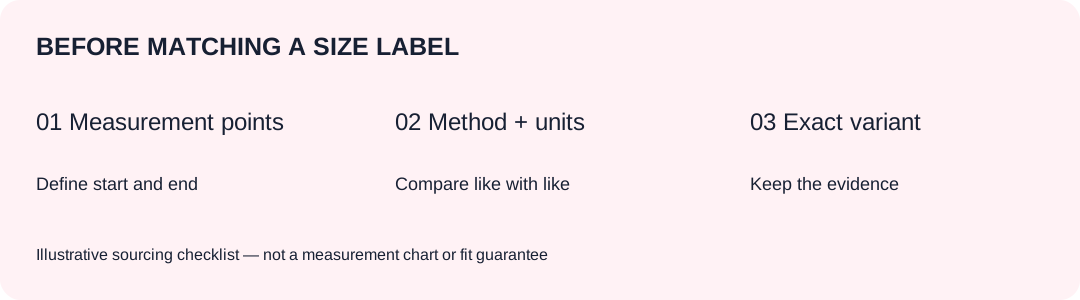
Identify what the listing actually tells you
A size label, a model photograph and a measurement chart answer different questions. A label identifies an option. A photograph shows an appearance under particular conditions. A chart may describe body measurements, garment measurements or something that is not clearly explained.
Record what is known and what remains unconfirmed. Check whether the chart belongs to the exact listing, style and variant you intend to buy. Do not transfer dimensions from a similar-looking garment or assume all colors and production batches share the same specifications.
Your customer-facing listing matters too. If it makes a specific measurement or material promise, use that as a requirement to verify—not as evidence that the supplier's product already meets it.
Request measurements with a defined method
A number without a measurement point can be misleading. Ask the supplier to identify the points used, the units, whether the garment is laid flat or measured around, and whether measurements are relaxed or stretched where relevant.
| Information | Question to resolve |
|---|---|
| Exact option | Which listing, style, size and color does the information cover? |
| Measurement points | Where does each measurement start and finish? |
| Units | Are the figures in centimeters or inches? |
| Method | Flat width or circumference? Relaxed or stretched? |
| Chart meaning | Does it describe the garment or the wearer's body? |
| Variation | What variation does the supplier state, if any? |
| Evidence | Is there a current chart, annotated image or other confirmation? |
Not every field applies to every garment. Use the points that matter to the item you sell. If a field cannot be confirmed, leave it unresolved rather than inventing a conversion or presenting it as a verified specification.
Example: two numbers that cannot yet be compared
Illustrative example, not a supplier quotation: your store lists a top with a 100 cm chest measurement. A candidate supplier says its chest measurement is 50 cm.
That is not enough to approve or reject the match. Ask whether the 50 cm figure is flat garment width, and whether the store's 100 cm figure describes circumference or a body measurement. Ask where and how each was measured. A numerical relationship alone does not prove equivalent sizing or fit.
If the supplier confirms a method, compare like with like and retain that explanation beside the size option. Do not publish an unverified size chart merely because its figures appear plausible.
Copy this measurement request
APPAREL MEASUREMENT REQUEST
Store product / internal reference:
Supplier listing and selected size/color:
Measurements required, with start and end points:
Units requested:
Please clarify: garment or body measurements?
Please clarify: flat width or circumference?
Please clarify: relaxed or stretched, where relevant?
Supplier-stated variation, if available:
Current supporting chart or annotated image:
Unresolved differences from our store specification:
Please confirm before purchasing; do not substitute a different size.
Keep the response with the exact supplier option. When the product, supplier or requirement changes, review whether the old information is still applicable. A previous match does not establish future stock availability or unchanged specifications.
Separate sourcing confirmation from warehouse checks
Lovegodrop provides three free QC photos per product after warehouse receiving. Do not assume ordinary photos include detailed measurements, fit testing or certification. If you need specific measurement photographs or other checks, describe them and confirm availability and any charge before proceeding.
Use the costs and payment rules for the distinction between basic QC and optional services. Changed prices, specifications or materials need confirmation before purchasing. The merchant guide covers the order workflow.
Start with one size option you intend to sell. Resolve its measurement basis, record the remaining uncertainty and approve only the specification you understand. A clear request is more useful than a confident-looking but unsupported size conversion.