
De inkoopkalender voor het hoogseizoen, teruggeteld
Drie sluitingen liggen tussen uw laatste verkoopweek en de volgende betrouwbare aanvulling. Tel terug vanaf de leverweek en houd de vroegste deadline aan.
Kernpunten
- Anchor the calendar to the lunar new year date for the coming year, not to last year's date.
- Count back from the delivery week with your own observed outbound transit, then take the earlier of that date and the shutdown date.
- Pre-position only SKUs with a stable link, flat demand, and handling that hurts; keep everything else per order.
- Lock production slots, price, spec and the QC set before the shutdown; leave variants and renegotiation until after.
- Change the storefront delivery promise in October, when a window is still a choice rather than an apology.
The three closures that decide your Q4 calendar
Your Q4 peak is not the hard part. The hard part is that three separate closures sit between your last heavy selling week and your next reliable restock, and each one bites earlier than the date printed on the calendar.
| Closure | What actually stops | When it bites, relative to a Q4 peak | Leading indicator |
|---|---|---|---|
| Factory shutdown around the lunar new year | Production slots, factory dispatch, and seller responses | After the peak. The binding date arrives weeks early, because production slots fill before dispatch stops | Sellers stop accepting new orders before they stop shipping |
| Pre-holiday air freight crunch | Outbound capacity and route availability | After the peak selling weeks, when every shipper pushes the same volume | Routes you normally use stop appearing in quotes; cut-off notices appear |
| Post-holiday supplier restock lag | Relisting, stock reliability, and staffing at the factory | After the holiday, affecting Q1 and any SKU you under-bought for Q4 | Listings return with changed prices and thinner variant grids |
The first one deserves a specific warning. The lunar new year date moves between late January and mid-February depending on the year, so look up the date for the year you are planning and work back from that. Do not reuse last year's date, and do not treat the nominal stop as the deadline. A factory stops accepting new production before it stops dispatching finished goods, because the last slots are taken by whoever asked first.
The second one is not a hard closure, which is why merchants plan badly around it. Nothing closes; capacity tightens and route availability shifts. The correct response is not a date, it is a quote requested earlier than usual, because freight depends on packed dimensions and route, and the quote is what governs.
The third one is the one that costs Q1. After the holiday, factories restart with reduced staffing, sellers relist slowly, and the listings that come back are not always the listings that went away. Any SKU you under-bought for Q4 gets its next chance weeks later than you expect.
Counting back from the delivery week you promised
State the assumptions first, because the answer is only as good as they are.
- Seller handling before domestic dispatch: 2 days.
- Domestic transit to the consolidation warehouse: 3 days.
- Receipt, weigh, measurement and quote at the warehouse: 1 day.
- Your approval of the shipping payment: 1 day.
- Outbound transit from first scan to delivery: T days. Take this from your own recent parcels on the route you intend to use. In this example T is 12.
- Contingency: 5 days.
| Step | Days | Counted back from delivery day |
|---|---|---|
| Delivery | 0 | Target week |
| Outbound transit, T, assumed 12 | 12 | D-12 |
| Your approval of the shipping payment | 1 | D-13 |
| Receipt, weigh, measure, quote | 1 | D-14 |
| Domestic transit to the warehouse | 3 | D-17 |
| Seller handling and dispatch | 2 | D-19 |
| Contingency | 5 | D-24 |
| Last safe purchase date | D-24, about three and a half weeks |
That gives one deadline. There is a second one, derived from the shutdown rather than from transit, and the rule is simple: the binding date is the earlier of the two. If your transit-derived date is D-24 and the last production slot your supplier will commit to is further back than that, the supplier's slot binds.
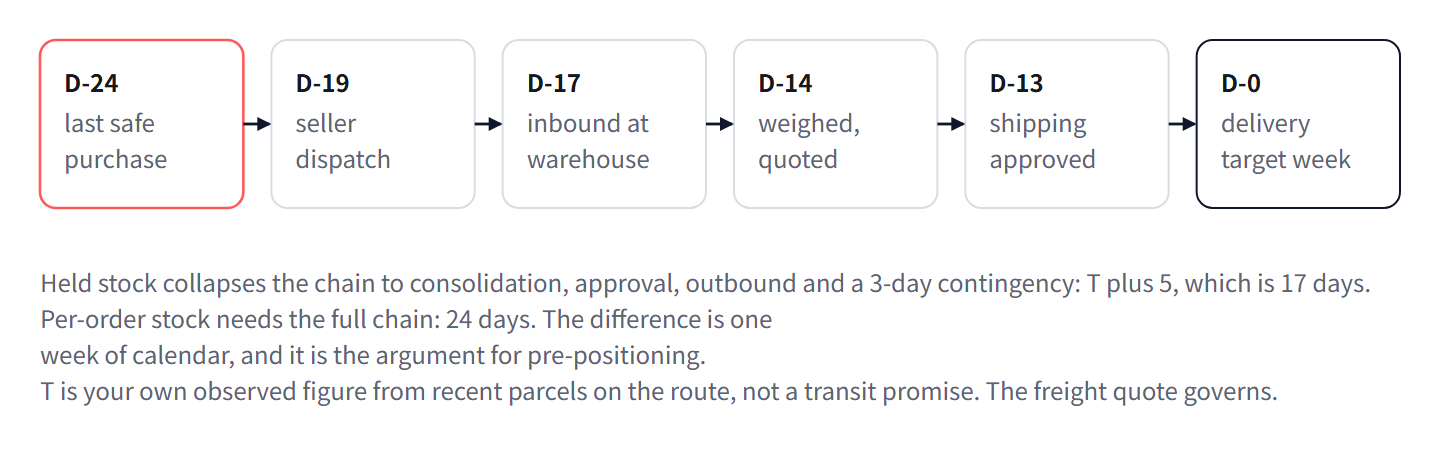
The comparison at the bottom of that figure is the reason to pre-position at all. Stock already at the warehouse skips seller handling, domestic transit and the receipt-and-weigh step, because consolidation and the freight quote happen once the parcel is packed. With T at 12, held stock needs 17 days and per-order stock needs 24. One week of calendar, in the part of the year where calendar is exactly what runs out.
What to pre-position in the 90-day storage window
Storage for 90 days is included at no extra charge, which changes the shape of the decision. You are not weighing a holding cost against a purchase price; you are deciding which SKUs are worth removing from the per-order chain during the closure window.
Pre-position a SKU when all four of these are true:
- Demand across the window is forecastable from your own trailing sales, meaning the week-to-week swing is small enough that six weeks of cover cannot be badly wrong.
- The supply link is stable: one seller, one link, no variant churn in the last quarter.
- The item is bulky or fragile enough that handling it once per order costs you more than handling it once per batch.
- The seller's reliability historically degrades before the holiday, based on your own order history with them.
Keep buying a SKU per order when any of these is true: the variant mix is still moving, the listing price moves week to week, the return rate on the SKU is above your own threshold, or the SKU has not sold enough times yet to forecast at all.
| Signal | Pre-position | Keep buying per order |
|---|---|---|
| Trailing sales flat across eight weeks | Yes | |
| Weekly demand swinging widely | Yes | |
| One stable link, no re-sourcing this quarter | Yes | |
| Link re-sourced more than once this quarter | Yes | |
| Bulky, fragile, or awkward to pack singly | Yes | |
| Small and cheap to handle per order | Yes | |
| Seller historically goes quiet before the holiday | Yes | |
| New listing, too few sales to forecast | Yes |
Here is the sizing arithmetic. Assume SKU A sells 40 units a month, with a week-to-week swing small enough to forecast. Assume the shutdown plus the restock lag covers 6 weeks, which is about 1.4 months. Cover is 40 multiplied by 1.4, which is 56 units. Add a safety factor of 15 percent: 56 multiplied by 1.15 is 64.4, so order 65.
That 65 units sits inside the 90-day storage window without a storage charge. The alternative, buying 56 units per order through the closure, does not fail on price. It fails on availability, which is a worse failure, because a stockout during the closure has no recovery path until the lag ends.
Lock before the shutdown, leave until after
| Item | Lock before | Leave until after | Why |
|---|---|---|---|
| Stock allocation for the run you need | Yes | Production slots fill before dispatch stops | |
| Price for the next production run | Yes | Re-quoting after restart is normal, and the new quote is rarely lower | |
| Variant and packaging specification | Yes | A spec change after restart needs a new sample and a new QC set | |
| QC photo set for the batch | Yes | You want the photos taken while the staff who made the batch are still there | |
| Freight route and an estimated chargeable weight | Estimate only | Final quote after weighing | Measurement happens at the warehouse, and the quote depends on packed dimensions and route |
| New-season variants | Yes | Listings are unstable right after restart | |
| Renegotiation on reordered runs | Yes | Sellers quote differently once they are back | |
| Substitutions for out-of-stock SKUs | Yes | You do not know what went out of stock until they relist |
The middle two rows are where merchants lose the most by guessing. An estimated chargeable weight is useful for planning and useless for a promise, because the parcel is weighed and measured after it arrives, and the freight quote is issued from that measurement. Similarly, a substitution made before the shutdown is a guess about what will be missing; a substitution made after the relist is a decision based on what actually is.
The promise you change in October, not December
The delivery promise is a string of text in three places: the storefront, the order confirmation email, and the answer in your FAQ. In December your only remaining moves are a refund and an apology. In October you still have options, so change it in October.
Three rules for the new wording. State a window, not a date, because the chain behind it contains a supplier you do not control. State a cut-off, expressed as the last date an order can be placed and still make the window. State what happens to orders placed after the cut-off, which is that they ship in the next production cycle rather than never.
Use the count-back table to set the cut-off rather than optimism. If your transit-derived date is D-24 and the shutdown-derived date is earlier, the cut-off is the earlier one, and publishing the later one means publishing something you will break.
Then put the identical sentence in all three places. A promise that differs between the storefront and the confirmation email produces the exact ticket this calendar is meant to prevent.
The eight-week countdown, week by week
- Week D-8 of the countdown: run the count-back with your own T, write down both deadlines, take the earlier one, and publish the changed promise. Artefact: one dated line in your calendar.
- Week D-7: audit open orders and clear anything stuck in the weighed-and-quoted state, because an order waiting on your approval in November becomes a ticket in December. Artefact: an empty approval queue.
- Week D-6: apply the selection rule, pick the pre-position SKUs, and place those purchases first, ahead of everything else. Artefact: the pre-position purchase list.
- Week D-5: confirm production slots and stock allocation with suppliers in writing, and record the dispatch date they commit to. Artefact: one confirmation message per supplier.
- Week D-4: verify the pre-positioned goods have arrived and been measured, and request the QC photo set for the batch. Artefact: QC photos on file for every pre-positioned SKU.
- Week D-3: freeze catalogue changes on the SKUs you will depend on, including variant edits, because a variant edit during the window breaks the binding at the worst possible moment. Artefact: a frozen SKU list.
- Week D-2: run one order end to end on the route you intend to use, and check the observed transit against the T in your count-back. Artefact: a tested route and a corrected T.
- Week D-1: switch the storefront wording to the peak promise, and brief whoever answers customer messages with the five-state sentences they are allowed to use. Artefact: a published promise and a briefed inbox.
Veelgestelde vragen
When should I stop importing new products for the season?
At the last safe purchase date from your count-back. Anything imported after that arrives after the restart, which means you are launching into the restock lag rather than into the peak.
Do I need to hold stock for every SKU?
No, and holding everything is the faster way to a problem. Use the four-condition rule: stable link, forecastable demand, handling that hurts, and a seller who goes quiet. Everything else stays per order.
My supplier says they will ship before the holiday. What do I ask for?
The production slot and the committed dispatch date in writing, not the reassurance. A promise about shipping is worth nothing if the slot was never allocated.
Can I still use air freight during the crunch?
Usually yes, but the mechanism changes rather than the answer: capacity and route availability tighten, and chargeable weight drives the quote. Request a quote for the specific route instead of assuming the route you used in September is still offered.
How do I change the delivery promise without losing conversion?
State a window and a cut-off rather than removing the promise entirely. Customers accept a window they can plan around more readily than silence, and a cut-off date gives them a reason to order now.
Wat deze week te doen
- Look up the lunar new year date for the coming year and write it down before you plan anything around it.
- Take your own last 20 parcels on the route you use most and compute your observed outbound transit, which is your T.
- Run the count-back with that T, write both deadlines, and take the earlier one as your last safe purchase date.
- Apply the selection rule to your top SKUs and place the pre-position purchases ahead of everything else.
- Rewrite the delivery promise on the storefront, in the confirmation email, and in the FAQ, with the same sentence in all three.
Geschreven en onderhouden door het sourcingteam van Lovegodrop. Hoe deze pagina's worden geschreven en gecontroleerd.
Begin met een order die u al heeft verkocht
Verbind een Shopify- of WooCommerce-winkel, kies een betaalde order en bekijk de inkoop- en verzendofferte voor precies die order voordat u iets vastlegt.