
A Weekly Review Sheet for Your First Fulfillment Orders
Review your first fulfillment orders by the decisions and exceptions they reveal, not just by how many have shipped. A small weekly worksheet can show whether the same missing specification, unclear quote or delayed approval is repeatedly stopping progress.
This is an operating review for Shopify and WooCommerce sellers, not a performance benchmark or a report that Lovegodrop automatically generates. Use your own verified order records. Do not interpret a handful of orders as proof of a guaranteed delivery speed or long-term supplier reliability.
Choose a consistent group of orders
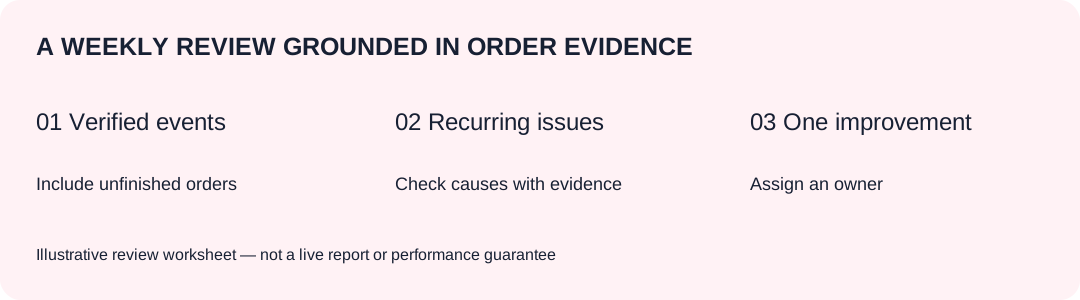
Start with the orders for which you approved product purchasing during a defined week. Keep unfinished orders in the group rather than reviewing only those that shipped. Otherwise the review hides the cases that may need the most attention.
Write the date range, the review date and the inclusion rule at the top of your worksheet. If an order is excluded, record why. Avoid combining an order's creation date with another order's dispatch date and then calling the result one consistent week's performance.
Use internal references instead of customer addresses or telephone numbers. Read the current order record before making a decision from an older note.
Record the event and the unresolved question
| Field | What to record |
|---|---|
| Order reference | Store and internal order references |
| Purchase scope | Exact variant, quantity and confirmed quote type |
| Verified events | Available purchasing, receiving, QC and shipping events with dates |
| Current position | Last verified event, including unfinished orders |
| Exception | What required clarification or intervention? |
| Evidence | Relevant quote, message, photo or order record |
| Next owner | Who is responsible for the next action? |
| Preventive action | One specific change to the next request or review |
If an event date is unavailable, mark it unknown. Do not estimate it from a later event or substitute zero. If the record does not distinguish a supplier delay from time awaiting your own approval, keep the cause unresolved until you have evidence.
Look for repeated issues without inventing conclusions
Illustrative example, not customer data: three orders in a review required clarification because the purchase unit was unclear. That supports improving the brief's “piece, pair or set” field. It does not prove that all suppliers are unreliable or that a new platform would solve the issue.
Separate issues into useful working categories: product requirement, supplier availability, quote scope, merchant approval, warehouse review and shipping follow-up. These are labels for your own worksheet, not claims about app status names.
For counts, use a clear denominator. If four of ten reviewed orders needed clarification, describe that exact group and period. Do not present it as an industry rate or compare it with invented competitor figures. With a small group, prioritize the actual cases and their causes over an impressive-looking percentage.
Keep quote types and optional services distinct
Lovegodrop assisted sourcing can provide a product-only supplier-SKU quote or a quote including international shipping. A later freight payment under the product-only path is not, by itself, an unexpected charge. An inclusive quote is generally fixed for the confirmed scope; changed quantities or requested services need confirmation.
Check the costs and payment rules before classifying a fee as an error. Payment fees vary by method, and requested extra services may be charged separately. Avoid comparing two order totals as if they purchased the same scope when they did not.
Likewise, ordinary QC photographs do not establish that every measurement or technical property was tested. If a review reveals a need for detailed photography or another check, confirm availability and any charge before the next purchase.
End the review with one owned improvement
WEEKLY FULFILLMENT REVIEW
Review date and order inclusion rule:
Order references reviewed:
Unfinished orders and last verified events:
Repeated issue and supporting references:
Unknown causes that still need checking:
One preventive change:
Person responsible:
Next review date:
Evidence that will show whether the change helped:
Choose a change you can actually apply, such as adding a component list or confirming a measurement method. At the next review, check whether the same ambiguity appeared again. Do not claim improvement merely because a checklist was created.
The merchant guide explains the fulfillment workflow itself. This weekly review complements it by turning your own order evidence into a focused next action.