
Lovegodrop vs HyperSKU: sourcing primeiro vs fulfillment primeiro
Um motor arranca quando ainda não tem a mercadoria. O outro arranca quando já sabe exatamente o que vende e quer a logística otimizada.
Pontos-chave
- The difference is the engine, not the feature list: one optimises logistics for a settled line, the other finds and buys goods that are not yet attached to anything.
- Fulfilment-led assumes you arrive with a source. Sourcing-led assumes you arrive with an order and nothing else.
- Lovegodrop routes A import, B1 bind an existing variant, B2 find a source from a photo or another site, across 1688, Taobao, Weidian, Yupoo, Xianyu and Dewu.
- Where your line is stable and your lever is logistics, the fulfilment-led provider is a genuine and often better choice. Say so plainly.
- Coverage beats freight. An uncovered SKU costs more than a slightly cheaper parcel, and the arithmetic below shows where the break-even sits.
Which end of the order each service starts from
Your store sold nine units of a SKU yesterday and you cannot buy it anywhere right now. The listing that fed it came from a Yupoo album, the seller behind that album has raised prices twice this quarter, and nine customers are waiting. Weeks like this do not care how good your logistics are, because logistics begins after somebody has the goods.
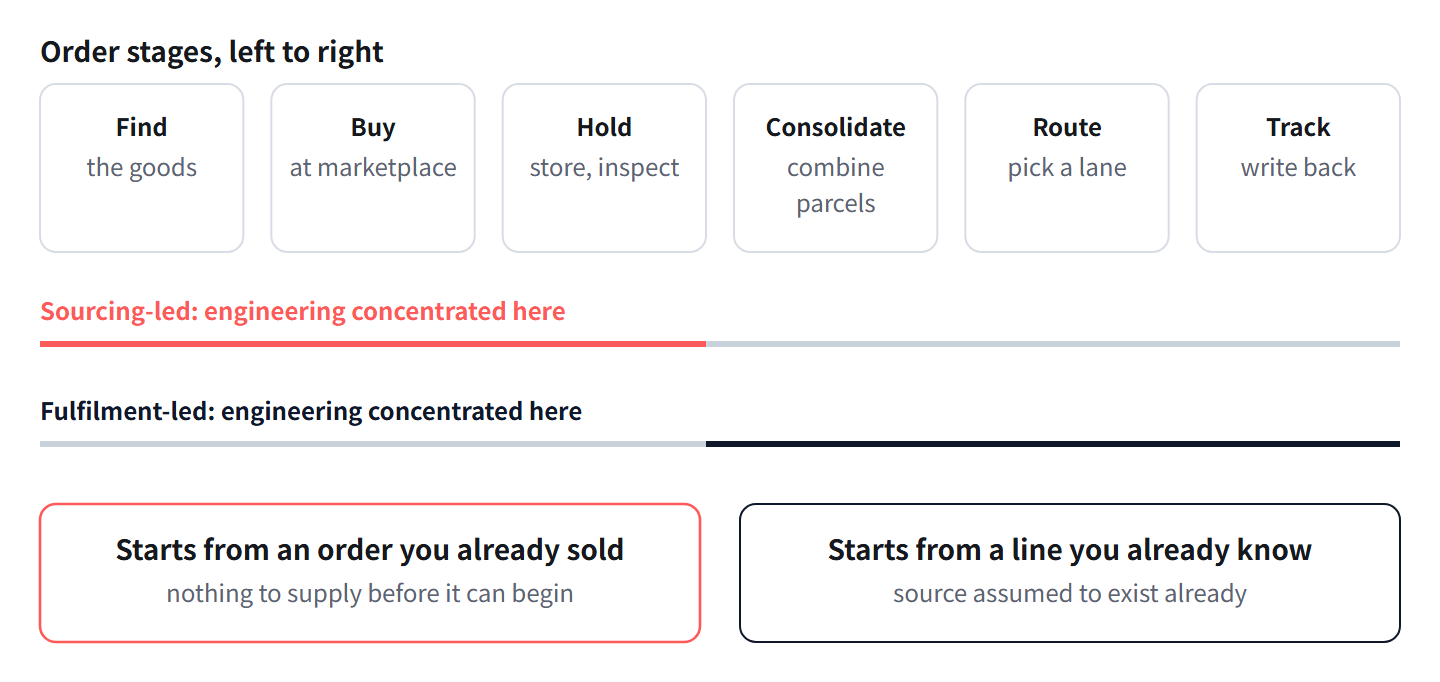
HyperSKU is fulfilment-led. Its centre of gravity sits at the back of the order: receiving, inspection, storage, consolidation, routing and tracking, for a merchant whose product line is already decided and whose problem is moving units efficiently and predictably. Lovegodrop is sourcing-led. Our centre of gravity sits at the front: finding the item, deciding which seller to buy it from, purchasing it, and only then doing the warehouse work.
Both engines eventually touch the same six functions. The order in which they touch them, and which one each has spent its engineering on, is the difference.
Put it as a sentence you can test. A fulfilment-led provider asks you to arrive with a source. A sourcing-led provider asks you to arrive with order data. Anything you have to supply before the engine starts is friction, and whatever you cannot supply stops the engine entirely.
That is not a criticism of either design. If your product line is settled, ten SKUs deep, replenishing on a known cycle, arriving with a source costs you nothing, and the place where your money actually leaks is freight, consolidation and stock holding. Optimising logistics is then the highest-value thing anyone can do for you, and a service built around that will beat one built around search.
If your problem is that nine paying customers are waiting for an item nobody can currently buy, a logistics engine has nothing to receive. That is the whole comparison, stated once so the rest of the page can be useful rather than promotional.
Six functions, and where the weight sits in each
Read the HyperSKU column as the structural expectation for a fulfilment-led provider plus what you should verify with them, because product lines and terms change and we are not in a position to assert them. Read our column as how the service is documented today.
| Function | Fulfilment-led expectation | Lovegodrop as documented |
|---|---|---|
| Sourcing | Assumed to be solved already; expect a request for a product link or a supplier contact. Verify whether search exists at all, and whether it works from an image | Search by keyword, link or image across 1688, Taobao, Weidian, Yupoo, Xianyu and Dewu. Route B2 returns candidates from a photo or another site's page for you to choose from |
| Purchasing | Strong: purchasing at volume against known links is routine work. Verify how many marketplaces they can transact on directly | We purchase at the marketplace on your behalf, one goods payment to start it. No minimum quantity, no sourcing fee |
| Storage | Strong and central: this is what the warehouse exists for. Verify the included window and whether it starts at goods-in or at first order | 90 days of storage included |
| Consolidation | Strong and central: combining replenishment stock and multi-line orders is the daily work of this model. Verify how they decide when to combine | Multi-order consolidation, relabelling and repacking are included |
| Routing | Strong and central: twenty-four possible lanes means route selection is itself an optimisation problem | 24 routes across postal, commercial express and dedicated line. Route names may be published; prices and guaranteed timings may not |
| Tracking | Strong, because write-back to Shopify or WooCommerce is mature across this category. Verify what exactly is written to the order | Tracking is written back to the store order; nothing else in the store is modified |
Read the table as a diagonal rather than a scoreboard. The three functions on the left belong to a sourcing engine and the three on the right belong to a fulfilment engine. Both providers do all six; they have simply spent their effort on different halves.
Published figures, checked 2026-11. HyperSKU's published terms (checked 2026-11): no subscription — both the free and Premium plans are $0/month — with 30 days (free) / 60 days (Premium) of included China-warehouse storage, and a 4.9 rating across 312 Shopify App Store reviews. On this side: no subscription and no sourcing fee, 90 days of included storage, three free QC photos per item before freight is approved, and goods at the marketplace's live price. One further row no other comparison on this site lists: individual buyers, not only merchants, can also buy through the platform, with or without a store.
Two rows carry more decision weight than the others. Storage decides economics once you are holding stock deliberately rather than accidentally, and it is where a fulfilment-led provider is structurally advantaged. Sourcing decides what happens on your worst day, and it is where a sourcing-led provider is.
What each one loses when it crosses onto the other's ground
Every provider can be pushed across its own boundary. Knowing the cost of that push is more useful than any feature row.
A fulfilment-led provider, asked to source. Three things degrade. First, the request changes shape: it becomes a support conversation rather than a transaction, and conversations take longer than clicks. Second, the input changes shape: instead of a link, the operator receives a description or a photo, and every round trip adds a cycle. Third, accountability blurs, because whoever recommends a seller usually ends up owning the outcome of that seller, and a provider whose value is logistics has no incentive to become responsible for merchandise selection. That last point is structural, not a complaint about any particular vendor.
A sourcing-led provider, asked to optimise logistics at scale. Our own constraints are worth stating plainly here, in the same tone. Keyword, link and image search run on the automated line and return candidates and goods pricing. A freight quote requires our human sourcing line, because it depends on packed dimensions and the destination route. That is slower than a precomputed logistics plan, and if your operation ships hundreds of identical parcels a week against a fixed plan, our model will feel heavier than it should.
There is a third crossing, and merchants fall into it more often than either of the first two. A store with a settled line sometimes asks a sourcing service to behave like inventory management: hold stock permanently, forecast replenishment, bundle across orders automatically. We include 90 days of storage and consolidation, so there is room to do real inventory work, but we do not pretend to be a forecasting tool. If your requirement is a standing inventory programme with replenishment triggers, the fulfilment-led model is the honest answer, and no amount of sourcing capability changes that.
Where the fulfilment-led provider wins outright
Say this clearly, because it is true and it is the reason this page exists rather than a generic pitch.
A settled product line. Twenty, forty or two hundred SKUs you have already tested, with a known supplier for each and a replenishment rhythm you can describe. You do not need search. You need the goods moved well, and a provider that treats inbound stock as its primary workload will do that better than a provider whose primary skill is finding things.
Predictable replenishment. If you buy in batches and hold stock rather than buying per order, freight per unit becomes a function of consolidation quality and route selection, which is exactly what this model optimises. Consumption predictability is what lets the provider batch intelligently, and batching is where savings come from.
Logistics as the main lever. When sourcing is solved and organic traffic is flat, the remaining profit levers are freight, packing, damage rates and returns. Each of those lives in the warehouse. A provider whose engineering is concentrated there will find savings that a sourcing engine will not bother looking for.
A single operational counterparty. One account, one support line, one stock view for everything you hold. For a merchant in a growth phase with volume but no operations staff, consolidation under one counterparty has real value beyond any line item.
Holding stock deliberately. If you have decided to buy ahead of demand rather than after it, storage terms, stock visibility and consolidation beat any sourcing feature you could name.
If you recognise your store in three or more of those five, this comparison resolves against us on the merits, and you should pursue the fulfilment-led route while keeping a sourcing line available for exceptions. That last clause is not a hedge, it is the recommendation: even a fully covered line loses a supplier, and when that happens you will want someone who can find a replacement from a photo.
Where sourcing-led wins
Four situations, and the first one is why most merchants read this page.
Existing orders with no confirmed source. The order exists, the variant exists, the page earns traffic, and nothing can currently buy the item. There is no link to hand to a fulfilment engine, and asking one to go shopping is asking it to work outside its design.
A supply that lives only on the marketplaces. Sellers on Weidian publish shop pages, sellers on Yupoo publish albums, and most of them have never produced anything resembling a catalogue feed. Available but unpublished is the normal condition rather than the exception, and reaching it requires search rather than receiving.
Multi-marketplace baskets. A customer order containing three items that naturally come from three different sellers means three purchases with different dispatch times, arriving separately, to be consolidated into one parcel. Deciding when that box closes is a judgement call, and it belongs to whoever has visibility of all three purchases.
Recovery weeks. A supplier raised prices, went quiet, or changed specification. Whatever you do next, you have to find goods first. During that week, the engine you can actually use is the one that starts with nothing.
Decide with this table
Answer honestly rather than aspirationally. The rows describing where you are now, not where you plan to be in two quarters.
| If this is true | Choose | Because |
|---|---|---|
| Every SKU has a confirmed supplier link you can hand over | The fulfilment-led provider | You lose nothing by starting at the warehouse, and gain consolidation and route optimisation |
| Some SKUs have no link and orders are already in for them | Lovegodrop | Something must be found before something can be shipped |
| Your weekly lever is freight per unit, not finding products | The fulfilment-led provider | That lever lives in the warehouse and in route selection |
| Your weekly lever is "can we get this at all" | Lovegodrop | Nothing downstream matters until that is answered |
| You buy ahead of demand and hold stock deliberately | The fulfilment-led provider | Storage and stock handling are the point of that model |
| You buy after the customer pays | Either, but check the quote sequence | Per-order purchasing puts the whole decision into the quote-approve-pay sequence |
| Your catalogue crosses several marketplaces in one basket | Lovegodrop | Multi-source consolidation needs visibility of every purchase, not of one supplier |
| The top three SKUs by revenue changed supplier twice this year | Lovegodrop first, logistics second | Stability has to be created before it can be optimised |
The last row is the one people argue with. Instinct says stabilise then optimise, which is correct in sequence but wrong in practice when your best SKUs currently have no source at all. Find first, then optimise, then revisit this table in a quarter.
A two-week trial that produces data, not impressions
Comparações in this category usually fail because they are run as feelings. Run it as measurement instead, and it takes fourteen days.
- Pick ten units across five SKUs, specifically the SKUs that account for your most recent complaints, and split them into three batches. Artefact: a trial manifest with SKU, quantity and expected difficulty per line.
- Give both providers the same inputs. Batch one gets a confirmed link, batch two gets a photo only, batch three gets a deliberately hostile input: a bundle across two sellers, or a variant nobody lists. Artefact: the same three briefs, sent the same day.
- Record the time from brief to goods pricing, in hours, for each batch. Artefact: three response figures per provider.
- Record whether each batch was sourced, substituted, or refused. Do not grade the substitution yet; only record whether you were asked before it happened. Artefact: an outcome per line, plus whether you were consulted.
- When the goods reach the warehouse, record the measured actual weight and the measured dimensions against whatever the listing claimed. Artefact: a listing-versus-measured variance per line, expressed as a percentage.
- Record the QC result per unit: pass, fail, or queried, with the number of photos supplied. Artefact: a pass rate for each provider.
- Compute the coverage figure per provider: how many of the ten lines each could actually turn into a shipment, expressed over ten. Artefact: the single number that decides most of these comparisons.
- Score both providers with the trial numbers rather than with impressions, and date the whole document. Anything you cannot point to in that document did not happen.
The third batch matters most and gets skipped most often. Nearly every provider handles a clean link well. The differences appear on inputs nobody prepared for.
The coverage arithmetic: why the cheaper parcel often loses
Assumptions, stated before any arithmetic so the whole thing can be checked.
Express costs as shares of the goods price for one unit, so no currency enters the calculation. Set goods at 100 percent by definition. Assume that when both providers buy the same item from the same marketplace seller and ship it on the same route, the measured freight comes to 34 percent of goods for each. Assume the fulfilment-led provider, pooling ten units into one outbound parcel, gets that per-unit freight down to 29 percent, which is the consolidation effect we assumed above. Assume you test ten SKUs and that you are able to supply confirmed links for six of them, leaving four that only a sourcing line can reach. Assume one order arrives per SKU in the test window.
Both providers shipping the six covered SKUs:
Sourcing-led, per unit: 100 + 34 = 134.
Fulfilment-led, per unit, consolidated: 100 + 29 = 129.
On those six lines, the fulfilment-led provider is ahead by 5 units of cost per 129, which is a 3.9 percent advantage. That is real, and it is why a settled line belongs with a logistics engine.
Now count the uncovered four. Each one either does not ship or ships late. Express that as zero shipped units against ten attempts.
Sourcing-led, ten attempts, ten shipped: effective cost per attempted unit is 134 / 1.00 = 134.
Fulfilment-led, ten attempts, six shipped: effective cost per attempted unit is 129 / 0.60 = 215, which is 60.4 percent above 134.
Break-even. How high must coverage climb before the cheaper freight outweighs the uncovered remainder? Solve 129 / c = 134 for c, and c = 129 / 134 = 0.963. The fulfilment-led model only comes out ahead once you can supply confirmed sources for at least 96.3 percent of the SKUs you are testing. Below that line, the cheaper parcel loses to the missing parcel, every time, with these assumptions.
Change one assumption and watch the threshold move. If consolidation only brings freight from 34 percent to 32 percent rather than to 29, then c = 132 / 134 = 0.985, and you need 98.5 percent coverage. The less dramatic the consolidation saving, the more brutally coverage dominates. Conversely, if the consolidation saving were large enough to bring freight to 20 percent, then c = 120 / 134 = 0.896, and roughly 90 percent coverage would suffice. Everything here follows from the two numbers you can actually measure in the trial above: your own freight share, and your own coverage.
There is a second term worth adding, because it affects both providers equally and gets forgotten. Assume 2 units out of 30 fail inspection. The failure rate is 2 / 30 = 6.7 percent. To ship 100 good units you must buy 100 / (1 - 0.067) = 107.2 units, which adds 7.2 percent to goods spend and one repurchase cycle per failure. Include this in your trial scoring, because a provider that catches failures before dispatch saves you more than a provider that quotes a slightly lower freight figure.
Perguntas frequentes
I have a settled line and my problem is purely freight. Who should I use?
The fulfilment-led provider, on the merits. Logistics optimisation for an established line is exactly what that model is built to do, and it is the honest answer for that merchant. Keep a sourcing line on standby for the day one of those suppliers disappears.
Can a fulfilment-led provider source something from a photo?
Ask rather than assume. Their request flow normally expects a link or a supplier contact, and anything arriving as a description or an image becomes a manual conversation. Ask them directly what inputs their sourcing path accepts, and how many candidates you get back.
Does the sourcing-led route handle holding stock?
It handles storage rather than forecasting. We include 90 days of storage, inspection, consolidation, relabelling and repacking, so there is room to buy ahead and hold deliberately. There are no automatic replenishment triggers, so the reorder decision stays with you.
What makes freight hard to quote before the goods arrive?
A quote needs packed dimensions and a destination route, and neither is knowable from a listing, which is why marketplace listings routinely understate both. We quote after the warehouse weighs and measures, and any amount prepaid above the measured figure is returned.
How should I weight cost against coverage when scoring a trial?
Coverage first. The break-even arithmetic above puts it at about 96 percent coverage for a modest consolidation advantage, and nothing below that threshold makes up for orders that cannot ship. After coverage, compare failure rates, then freight.
O que fazer esta semana
- Split your next ten units into three batches: one with a confirmed link, one with only a photo, one deliberately awkward, and send the same three briefs to both providers.
- Record the listing-claimed weight against the measured weight for every line, as a percentage variance.
- Compute your own coverage figure per provider, expressed as shipped units over attempted lines.
- Run the break-even sum with your own freight share rather than the 34 percent assumed here.
- Reopen this comparison once coverage stops moving, because the answer changes when the sourcing problem is solved.
Escrito e mantido pela equipa de sourcing da Lovegodrop. Como estas páginas são escritas e verificadas.
Comece por um pedido que já vendeu
Ligue uma loja Shopify ou WooCommerce, escolha um pedido já pago e veja o orçamento de sourcing e de envio para esse pedido específico antes de assumir qualquer compromisso.