
Lovegodrop vs CJdropshipping: catálogo primeiro vs pedido primeiro
Um parte de um catálogo que importa; o outro, de um pedido que já vendeu. Essa ordem decide o que se segue.
Pontos-chave
- CJdropshipping starts from a catalogue you import from; Lovegodrop starts from an order you already have.
- When a listing is pulled, the catalogue model has a broken record to repair and the order model has a sourcing brief to fill.
- Lovegodrop binds a source to a variant that already sells: B1 when you hold the link, B2 when you do not, A when you are still building.
- Goods and freight are two separate payments approved at two different moments, and freight is quoted after the warehouse measures the parcel.
- The catalogue model is genuinely better at discovery, at consolidating many SKUs behind one counterparty, and at established integrations.
The entry point, and everything that follows from it
Two of your best-selling SKUs came from a supplier who has stopped answering, and the catalogue you built them from no longer lists them. Your store is still taking money for them. Every hour you spend deciding what to do is an hour those paid orders sit still, and the outcome slides from a late parcel to a refund, and then from a refund to a dispute.
CJdropshipping and Lovegodrop sell fulfilment to the same merchant, and they enter that week from opposite ends. CJdropshipping starts from a catalogue you import from. Lovegodrop starts from an order you already have.
That ordering is the structural difference. Every other difference on this page is a consequence of it.
If a product must exist in a catalogue before it can be routed, then a listing that has been pulled is a broken record, and the repair is to find another record in the same catalogue. If a product only has to exist as a sold line item, then a listing that has been pulled is a sourcing brief, and the work is to find the goods again.
Two consequences show up in the same week. The first is what you must do before you can ship. Catalogue-first means the store product and its source record are created together, which makes the building phase fast and the repairing phase slow. Order-first means the store product already exists and only the source is missing, which makes the building phase slower and the repairing phase direct.
The second consequence is where the freight number gets measured. A catalogue entry has to publish a freight figure at the moment of product selection, because the merchant is choosing a product and not fulfilling a parcel. An order entry can weigh and measure the real parcel first and quote afterwards. Neither arrangement is a matter of taste; each one follows from what the tool is for.
| What the entry point decides | Catalogue-first | Order-first |
|---|---|---|
| The unit of work | A product you might sell | An order someone already paid for |
| What breaks when a listing is pulled | The route from the store product to its source | Nothing; the order still carries the variant |
| What must exist before fulfilment | A catalogue record for that SKU | A sold line item |
| When the freight figure is produced | At product selection, before packing | After the warehouse weighs and measures |
| What the merchant spends the week doing | Choosing products | Rescuing orders |
| What happens to sales history on a re-source | Often lost with the product page | Retained, because the page does not move |
The last row is the one that quietly costs the most. A re-source that creates a new product page abandons the reviews, the sales history and the search position attached to the old one. A re-source that attaches a source to the page you already have keeps all three.
Published figures, checked 2026-11. CJdropshipping's basic account is free to open, with paid tiers around VIP agents and warehousing programmes, and their Shopify App Store listing stands at 4.6 across 8,000+ ratings. On this side: no subscription and no sourcing fee, 90 days of included storage, three free QC photos per item before freight is approved, and goods at the marketplace's live price. One further row no other comparison on this site lists: individual buyers, not only merchants, can also buy through the platform, with or without a store.
Nine axes, side by side
The table below carries the comparison. Read the CJdropshipping column as what to verify on their side, because product lines and plan terms move; read the Lovegodrop column as how the service is documented today.
| Axis | CJdropshipping: what to verify | Lovegodrop: as documented |
|---|---|---|
| How a product enters your store | You pick an entry in their catalogue and push it into the store as a product | Three routes: A import from one of six marketplaces, B1 bind a source to a variant that already sells, B2 find a source from a photo or another site's product page |
| Can a selling product be fulfilled without importing it | Only if the SKU resolves to a catalogue entry. If it was never imported, ask what their non-catalogue sourcing path does | Yes. That is the B1 and B2 case, and it is the normal case for us |
| Can an existing variant be bound to a source | Import creates the variant and its source together. Ask whether a variant created another way can later be pointed at one | Yes, that is B1. The supply link is bound to the store variant; the store product is not rebuilt |
| Goods and freight payment structure | Ask whether goods and freight appear as one figure at checkout or as two itemised components | Two separate payments, approved at two moments: goods first to start the purchase, then shipping |
| When freight is measured | Ask whether the published figure is recomputed after packing or fixed at product selection | After the warehouse weighs and measures the parcel; any amount prepaid above the measured figure is returned |
| Storage terms | Storage follows their warehousing and inventory programme; verify the included window and the unit conditions | 90 days included |
| Minimum quantity | No minimum on a standard catalogue order; verify for wholesale and custom lines | None |
| Subscription | Account access is free to open; verify whether a paid plan exists and what it gates | None. No sourcing fee either |
| QC scope | Ask what inspection covers, how many photos are produced, and whether it is included or charged per item | 3 QC photos per item included, plus relabelling, repacking, consolidation and a 7-day return window on purchases |
Read across the rows and the pattern is consistent rather than competitive. The catalogue column is strongest on the first row, because importing is the thing it was built to do. The order column is strongest on the second and third rows, because a store that already sells does not need to be rebuilt.
Two rows deserve their own sentence, because they are the ones merchants discover late.
The second row decides what happens on the worst day of the month. If a supplier goes silent on a SKU that carries your volume, the question is not which tool imports faster; it is whether your fulfilment method has any path to goods that were never in a catalogue.
The fifth row decides whether your freight number is an estimate or a measurement. Marketplace listings routinely understate weight and dimensions, so a freight figure produced before packing inherits whatever the listing claimed.
Three merchants, three answers
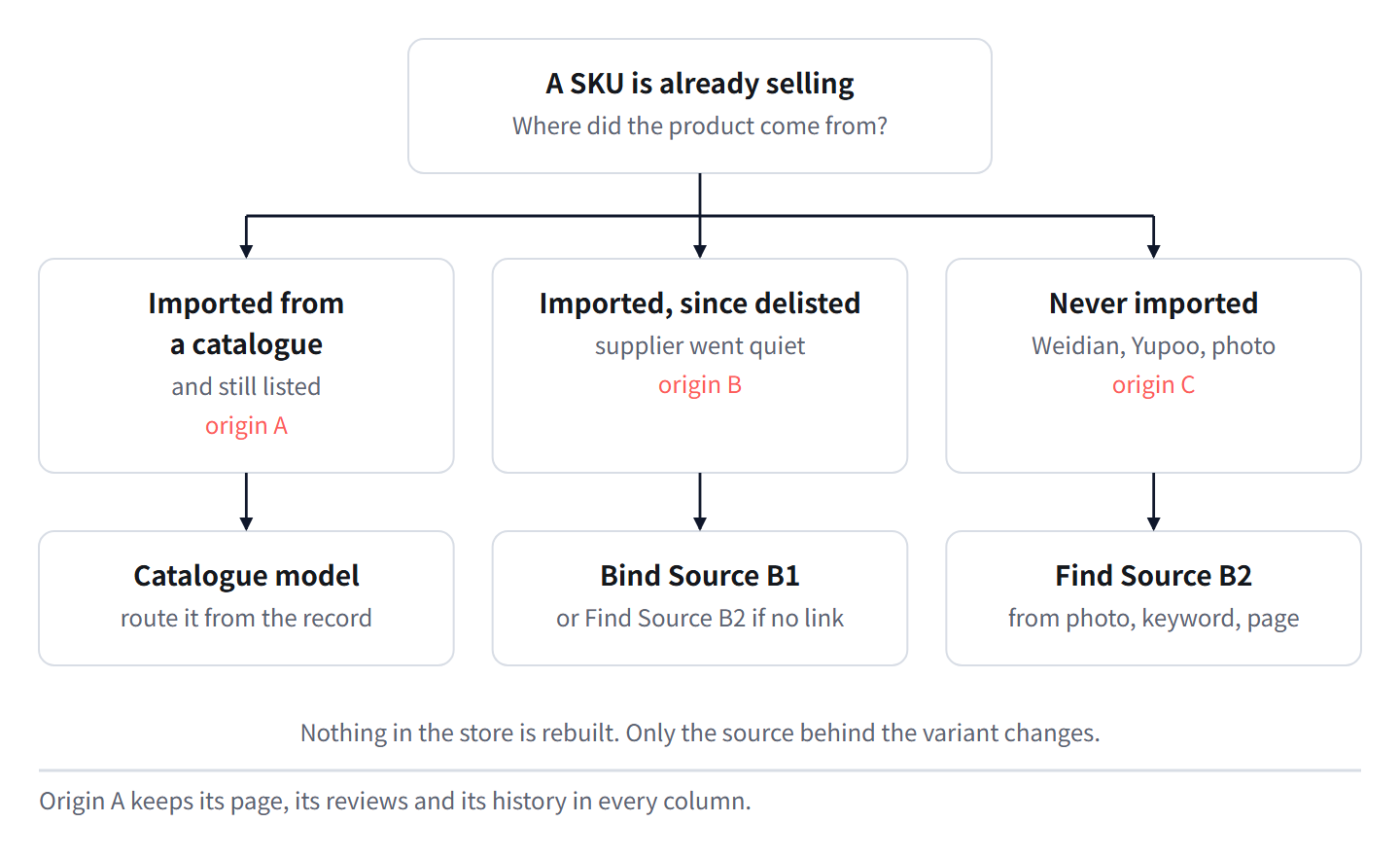
The abstract comparison resolves quickly once you attach it to a store. Here are three stores we see, and the honest answer for each.
| The merchant | What breaks this week | Better fit now | Why |
|---|---|---|---|
| A: the catalogue-built store. Dozens of SKUs, all imported from one catalogue, all still listed, orders arriving daily | Nothing structural. Volume is the problem, not supply | The catalogue model | Every SKU already has a record. There is nothing to re-source, and the consolidation conversation is one conversation with one counterparty |
| B: the delisted-winner store. Same origin, but the three SKUs carrying most of the orders were pulled last week | Three paid orders a day with no route to goods | Lovegodrop | The missing thing is a source, not a listing. Importing a substitute creates a new page and abandons the history attached to the old one |
| C: the hand-built store. Products came from a Weidian seller or a Yupoo album and were written into the store by hand | The seller raised prices, and there is no record to fall back on | Lovegodrop | There is no catalogue entry and never was. The catalogue model would ask this merchant to re-derive a product they already sell |
Merchant A should not move. The work that merchant does is choosing and pricing products, and a catalogue is a better instrument for that than a sourcing box. Consolidation across many SKUs is also cheaper with one counterparty holding all of them, because it is one packing decision and one support thread rather than a thread per SKU.
Merchant B has a different problem. The store page works, the traffic works, the reviews work, and only the supply link is dead. What that merchant needs is a way to attach a new source to a variant that is already selling, which is route B1 when they hold a link and route B2 when they have only a photo or the product page of the site they originally copied.
Merchant C is the case the catalogue model cannot address at all, and it is the case where the entry point argument stops being theoretical. If the goods live in a Weidian shop or a Yupoo album, there is no import to perform. The supply has to be found first, from a photo or a keyword, and only then can anything be fulfilled.
Where the catalogue is a real advantage, and when to stay there
CJdropshipping is the better answer in three situations, and none of them are situations to argue with.
The first is discovery. A catalogue is a searchable shortlist of things you did not know existed. If your problem is that you have a store and no products, a catalogue solves that in an afternoon, and a sourcing service cannot, because a sourcing service needs something to source. Every sourcing box on the market, including ours, asks you for a photo, a keyword or a link before it can do anything.
The second is consolidation of many SKUs behind one counterparty. If you sell forty SKUs and they all come from one place, then one conversation covers packing standards, one conversation covers a stock question, and one conversation covers the freight basis. With per-order sourcing across Chinese marketplaces, each SKU may sit with a different seller, and the consolidation decision has to be made per parcel. That is real operational work, and a merchant with a wide catalogue does less of it with a catalogue model.
The third is established integrations. A mature connector to Shopify or WooCommerce, with order sync and tracking writeback already working for you, is worth a great deal when your volume is high and your intervention budget is low. Verify the current state of the integration you would actually use rather than relying on what either vendor says about it.
There is a fourth that belongs on the list: inventory programmes. Holding units ahead of demand changes the shape of the fulfilment problem, and a service that operates its own warehousing can offer that. If your SKUs have a stable demand curve, ask what the catalogue model offers on holding stock, and compare it against the 90 days of included storage on our side.
None of these are weaknesses to be argued with. They are the reasons a catalogue-built store should stay where it is.
Migration cost, in both directions
Migration is where comparison pages usually cheat. Here is the work in both directions.
| Direction | The work | What you lose | What survives |
|---|---|---|---|
| Catalogue model to Lovegodrop | Export the SKU list. Test each SKU against the catalogue. For the ones that fail, open a Find Source request with a photo or the old product page | The automatic link per SKU, and any per-SKU freight figure you had recorded | Store pages, variants, reviews, sales history, customers and traffic |
| Lovegodrop to the catalogue model | For each SKU, find the equivalent catalogue entry and import it | Every SKU with no equivalent, which usually means the interesting ones | Store pages and variants, but the sourced SKUs have to be re-listed or dropped |
| Both | Re-point tracking writeback and re-test one live order end to end | One afternoon | Everything else |
The honest part is the asymmetry. Moving towards a model that requires a catalogue record is cheap when your catalogue is ordinary and expensive when your catalogue contains items that were sourced outside one. The SKUs that carry your volume are disproportionately the ones with no catalogue equivalent, because they are the ones you went looking for.
Moving the other way is mostly a sourcing exercise, and its cost is proportional to the number of SKUs where you do not hold a link. If you hold the link, B1 is a binding job. If you do not, B2 needs a photo or a product page and a human on our sourcing line, because candidates have to be judged rather than matched.
The part nobody budgets for is the freight re-baseline. Whatever per-SKU freight figure you recorded under the old arrangement was produced at a different moment, possibly before packing. After the move, the first ten parcels give you measured figures, and those replace your old numbers. Plan for a month where your freight assumptions are being rewritten.
Decide by how your store was built
The decision keys on origin, not on preference. This procedure takes an hour and produces a sheet you can hand to either vendor.
- Pull the orders from the last 90 days and list the SKUs that produced them, sorted by order count, not by revenue.
- For each of the top 20, write its origin in one word: imported, delisted, or hand-built. Artefact: one sheet with three columns, which is the only input the decision needs.
- Compute the share of delisted plus hand-built twice, once in SKU terms and once in order terms. The two numbers differ, and the order-weighted one is the one that matters.
- Take the three worst SKUs by origin and ask each vendor the measurement question from the next section, in writing.
- Choose by the order-weighted share: under a small share, stay with the catalogue model and use a sourcing service only for the exceptions; above it, move the sourcing line and keep the catalogue for discovery.
| How your store was built | Where the top SKUs should be fulfilled | Where the tail should be fulfilled | Where new products should come from |
|---|---|---|---|
| All imported, all still listed | The catalogue model | The catalogue model | The catalogue |
| Imported, some since delisted | Lovegodrop, bound to the existing variant | The catalogue model | Either |
| Hand-built from Weidian or Yupoo sellers | Lovegodrop | Lovegodrop | The six marketplaces |
| Built around a private supplier who vanished | Lovegodrop, via Find Source | Lovegodrop | The six marketplaces |
| No products yet, store empty | Not applicable | Not applicable | The catalogue; a sourcing box has nothing to work from |
The second row is the most common and the most useful, because it is also the answer most merchants expect to be told is impossible. You do not have to choose one service for the whole store. The split is by SKU origin, and the two arrangements do not interfere with each other as long as each variant has exactly one source.
One SKU through both entry points: the arithmetic
The freight difference between the two entry points is measurable, and you can run it on your own SKU today. Every input below is stated, and you should replace each one with your own.
Assumptions. Item A packs to 24 × 18 × 8 cm and weighs 300 g. Item B packs to 20 × 15 × 6 cm and weighs 120 g. The marketplace listing for each states 320 g and 150 g with no dimensions. Freight on the chosen route is charged on chargeable weight, which is the greater of actual weight and volumetric weight, and the volumetric divisor is 5000. Freight scales linearly with chargeable weight on this route for the range we are using.
Step 1, the listing figures. The catalogue entry path has only the stated masses to work from: 0.32 kg for A and 0.15 kg for B.
Step 2, the measured figures. Volumetric for A is 24 × 18 × 8 ÷ 5000, which is 3456 ÷ 5000, or 0.69 kg. Actual is 0.30 kg, so chargeable is 0.69 kg, which is 2.16 times the stated figure. Volumetric for B is 20 × 15 × 6 ÷ 5000, which is 1800 ÷ 5000, or 0.36 kg, and chargeable is 0.36 kg, which is 2.4 times the stated 0.15 kg.
Step 3, the understatement. Both listings understated the freight basis by a factor above 2. If your freight line was budgeted as 0.10 of the selling price from the listing figures, the measured freight is 0.216 and 0.24 respectively, a combined overrun of 0.14 of the selling price on a two-item basket.
Step 4, the correction that the entry point makes possible. With the goods already at the warehouse and measured, two options are open before the shipping payment. The first is repacking: both items de-boxed into a 28 × 20 × 6 mailer gives 3360 ÷ 5000, or 0.672 kg, against 1.05 kg for the two items handled separately. That is a reduction of 36 percent in the chargeable weight of the combined parcel. The second is cancellation inside the 7-day return window on purchases, which is available because the goods have been bought but not yet dispatched.
Step 5, the consolidation arithmetic. Two separate parcels would be billed at 0.69 plus 0.36, or 1.05 kg of chargeable weight, and would carry two first-piece charges. One consolidated parcel at 0.672 kg carries one. The volumetric weight of a combined parcel is not the sum of the two, because they share a carton, and that is the entire reason consolidation is worth doing on light, bulky goods.
The same arithmetic runs under either entry point. The difference is when you get to act on it. Under the catalogue model the freight figure was produced at product selection, so the overrun lands as a cost you discover after dispatch. Under the order model, the figure arrives as a quote you approve or reject, with the QC photos already in your inbox and the goods physically held.
The eight questions to ask either vendor
Ask the same eight of both, in writing, and treat the ones you cannot get an answer to as the answer.
- Must a SKU exist in your catalogue before an order for it can be routed?
- Can I attach a supply link to a variant that already exists in my store, without recreating the product?
- Is the freight component itemised separately from the goods, and is it recomputed after the parcel is weighed and measured?
- What is the included storage window, and what happens on the day after it ends?
- Is there a minimum quantity, a subscription, or a separate sourcing fee?
- What does inspection include, how many photos do I receive, and is it included or charged per item?
- When a catalogue listing I depend on is removed, what happens to my open orders that day?
- What is the return window on the purchase itself, before dispatch, and what does it cost me?
The artefact is a one-page scorecard with two columns and eight rows. The row that decides the comparison for a merchant with delisted SKUs is row 2, and the row that decides it for a merchant with bulky goods is row 3.
Two of the eight are worth a follow-up question. On row 3, ask whether the refund of an over-measured prepayment is automatic or has to be claimed, because a policy that requires a claim is a policy you will not use. On row 7, ask for the specific mechanism, not the reassurance.
Perguntas frequentes
Can I use CJdropshipping for some SKUs and Lovegodrop for others?
Yes, and it is the most common arrangement among merchants moving between the two. Split by origin: SKUs with a live catalogue record stay on the catalogue route, and SKUs without one move to bind or find source. The discipline that keeps it clean is one source record per variant, so no order can be sent twice.
Is the catalogue model wrong for a store with delisted SKUs?
No. It is incomplete for that store, which is different. If the delisted SKUs are a small share of orders, the catalogue model is still the right home for the business and a sourcing service handles the exceptions. If they are a large share, the sourcing line has moved to the centre.
Does starting from an order mean I cannot build a catalogue?
No. Route A exists and works the same way: pick a product from 1688, Taobao, Weidian, Yupoo, Xianyu or Dewu and push it into the store as a draft or a live product. The order-first entry is an additional path, not a replacement for the catalogue path.
What happens when a Weidian seller I depend on disappears?
You still hold the product page, the photos and the variant list, which is what the Find Source route needs. Send the product page or a photo, candidates come back from the six marketplaces, and you pick one. The store page does not move and the sales history stays attached to it.
Which number should I watch after splitting the catalogue?
The order-weighted share of SKUs fulfilled outside the catalogue, recomputed monthly. If it falls, the catalogue is absorbing the sourcing work and your operational load is dropping. If it rises, the sourcing line has become the business and you should plan for it rather than treating it as an exception.
O que fazer esta semana
- Take your top 20 SKUs by order count and write one origin word beside each: imported, delisted, hand-built.
- Compute the share of delisted plus hand-built in order terms, not SKU terms, and write that single number at the top of the sheet.
- Send the measurement question to whichever vendor you are considering, in writing, and keep the reply with the sheet.
- Take one bulky SKU and run the five-step arithmetic on it with your own dimensions, then compare the result against what your listing claims.
- If the number in step 2 is above a third of your orders, move the worst three SKUs first rather than planning a migration.
Escrito e mantido pela equipa de sourcing da Lovegodrop. Como estas páginas são escritas e verificadas.
Comece por um pedido que já vendeu
Ligue uma loja Shopify ou WooCommerce, escolha um pedido já pago e veja o orçamento de sourcing e de envio para esse pedido específico antes de assumir qualquer compromisso.