
Heretiketteren en herverpakken: wat verandert en wat het u aan tijd kost
Vier klussen schuilen in één instructie. Wat elk beschermt, wat het niet kan oplossen, en waarom de verpakkingsbeslissing de vrachtofferte verplaatst.
Kernpunten
- Four jobs: strip the supplier's paperwork, replace the brand label, replace the outer bag or box, insert your own card.
- A label protects the brand and the repeat purchase. It cannot fix a wrong or damaged unit, and it should never be used to hide one.
- Repacking changes the bounding box, so it changes the chargeable weight. In the worked example it cut it by about 64%.
- Sequence: instruct, inspect, do the jobs, measure, quote, approve. A quote built before the jobs bills you for a box that is gone.
- Two mistakes get a parcel rejected downstream: a barcode that resolves to the wrong variant, and a label placed where it cannot be scanned.
"Please relabel and repack" is four instructions, not one
You send one line to the warehouse: relabel and repack. It reads like a single job. It is four, they have four different failure modes, and only one of them changes what you pay for freight. Treating them as one is why merchants end up with a parcel that carries their label, the supplier's invoice, and a carton sized for a product twice as large as the one inside.
Relabelling and repacking are included with us, alongside 90 days of storage, three QC photos per item and consolidation. The cost is not a line on an invoice. It is the time the jobs take, the sequence they happen in, and the freight consequence of getting that sequence wrong.
The four jobs, and what each one is actually for
| # | Job | What it is | What it costs you in time |
|---|---|---|---|
| 1 | Remove supplier paperwork | Strip the invoice, the seller's promotional inserts, their branded card, price stickers, and any code pointing back at the marketplace | Minutes per unit, and it has to be done before the unit is sealed |
| 2 | Replace the brand label | Your label replaces the supplier's: the sewn label, the hang tag, the sticker on the box | Minutes per unit, plus the time to supply correct artwork |
| 3 | Replace the poly bag or box | The outer packing changes from what the seller used to what you specified | Minutes per parcel, and it is the one that must happen before measurement |
| 4 | Insert your own card | Your card, carrying your brand and the route back to you | Seconds per unit, and it is the one most often forgotten |
Jobs 1 and 4 are about what the customer sees and where they go next. Job 2 is about whether the purchase builds your brand or somebody else's. Job 3 is about the parcel surviving the journey, and about the number on the shipping quote.
What each job protects against, and what it cannot fix
| Job | Protects against | Cannot fix | Effect on the parcel |
|---|---|---|---|
| Remove supplier paperwork | The customer seeing the origin, the source price, or a return route that leads away from your store | A unit that is wrong, damaged, or not what the listing described | No dimensional change, a small reduction in mass |
| Replace the brand label | Receiving an unbranded unit, or one carrying a brand that is not yours, and losing the repeat purchase | A build defect. A label on a bad unit makes it a branded bad unit | Negligible mass, no dimensional change |
| Replace the poly bag or box | A crushed or scuffed arrival, and a carton whose volume inflates the freight | Damage that already happened before the parcel reached the warehouse | Changes the bounding box, therefore the chargeable weight |
| Insert your own card | A customer who does not know who they bought from and has no route back to you | A service problem that needs a person to answer it | A few grams, and one more item that can be left out |
The "cannot fix" column is the one to read before you ask for any of this. Relabelling is not a quality control step and should never be used as one. If the QC photographs show a unit you would not ship, the answer is the purchase return window, not a new label.
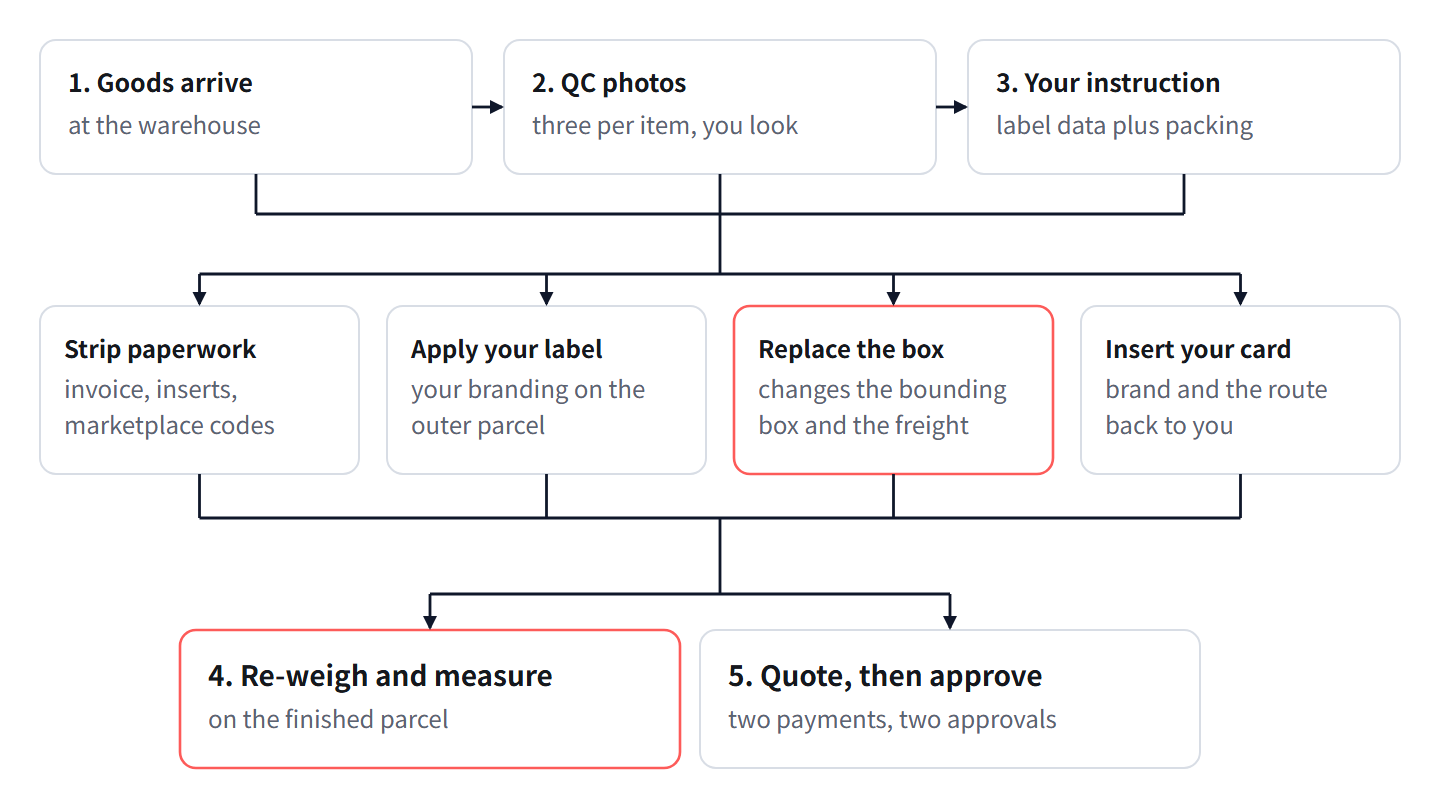
Repacking changes the chargeable weight, so sequence the two
Assumptions: an item with an actual weight of 420 g, arriving in a supplier carton measuring 32 × 24 × 12 cm. Divisor 5000. Freight rate 9% of the selling price per chargeable kilogram, plus a per-parcel component of 2%.
As received:
- Volumetric = 32 × 24 × 12 = 9,216 cm³ ÷ 5000 = 1.843 kg
- Actual 0.42 kg. Chargeable is the greater: 1.84 kg
- Freight = 1.84 × 9% + 2% = 16.6% + 2% = 18.6% of the selling price
After de-boxing and repacking into a poly mailer at 26 × 18 × 7 cm, with your card inserted:
- Volumetric = 26 × 18 × 7 = 3,276 cm³ ÷ 5000 = 0.655 kg
- Actual 0.42 kg plus the card, say 0.44 kg. Chargeable is the greater: 0.655 kg
- Freight = 0.66 × 9% + 2% = 5.9% + 2% = 7.9% of the selling price
The chargeable weight fell by 1 − 0.655 ÷ 1.843, which is about 64%, a ratio of 2.81 times smaller. The freight share of the selling price fell by 10.7 points. Same product, same route, one instruction.
The sequence is where this goes wrong. A freight quote is issued after the parcel has been weighed and measured at the warehouse. If the jobs happen after the measurement, the quote is built on the pre-job carton, and you are either billed for a box that no longer exists or you pay in time for a re-measure and a second quote.
The procedure, five steps, one artefact:
- Send the packing and labelling instruction with the goods approval, in the same message. Do not send it as a follow-up after the purchase has started.
- Wait for the QC photographs before anything is sealed. Three per item is what is included; ask for the label position and the outer packing to be in frame.
- Confirm the jobs have been done in the order above, with the repack last of the four, because it is what closes the parcel.
- Let the measurement happen on the finished parcel. The quote is built on it.
- Approve the shipping payment against the measured figure, and record it as the planning figure for the SKU.
The artefact is a quote built on the parcel you are actually shipping, not on the carton it arrived in.
The labelling data you have to supply, and what a barcode mismatch does
| Data you must supply | What it has to match | What happens when it does not |
|---|---|---|
| Label artwork or text | Your brand, exactly as you want it on the unit | The unit ships with the wrong brand or with none, and you discover it from a customer photograph |
| The store's SKU or variant identifier | The variant in your store, character for character | The unit cannot be tied back to the order that bought it |
| The barcode | The code your store or your fulfilment centre scans | It scans as nothing, or it scans as a different variant |
| Content or origin declaration where the destination requires it | The destination's requirement | The parcel is held, at inbound or at the border |
| Card artwork | Your returns route and your brand | The customer's only route back is the marketplace they did not buy from |
A barcode mismatch is the expensive one, because the failure is silent until someone scans. If the code resolves to no record, the unit becomes unidentified stock: it exists, it is paid for, and nobody can sell it until a person reconciles it by hand. If it resolves to a different variant, the receiving system books it against the wrong SKU, and your stock record is now wrong in two places at once. Either way the cost is manual reconciliation, and the reconciliation is the whole cost.
The check is cheap and it happens early: reconcile the barcode to the store's variant before the label is printed, then verify it in the QC photographs before the parcel is sealed. Two checks, minutes each.
Retail labelling and a fulfilment centre's inbound labelling are not the same job
| Labelling for retail | Labelling for a fulfilment centre's inbound | |
|---|---|---|
| Purpose | Brand, and what the customer sees when they open it | Machine identification and put-away |
| What must be scannable | Nothing, necessarily | Every unit, with a code the receiving system already knows |
| Where the label goes | Where the customer will see it | A specified face and position, not on a seam, not over a curve |
| Unit versus carton | Per unit | Per unit, and usually per carton too, with both codes agreeing |
| Tolerance for error | Aesthetic. A slightly crooked label is fine | None. A unit that cannot be identified is not received |
| Consequence of failure | A mildly annoyed customer | The parcel is rejected or quarantined at inbound |
| What you must supply in advance | Artwork | Artwork, the exact SKU code, and the placement rule |
The two are not in conflict, and you can satisfy both on one unit: a brand label where the customer sees it, and a scannable code in the position the receiving process expects. The mistake is assuming one label does both jobs. It usually does not, because the position that reads well on a shelf is not the position a scanner is presented with.
From instruction to verified packed parcel
- Write one instruction document per SKU: label artwork, the store's variant identifier and barcode, the packing specification with target dimensions, and the card. Check: the document names the variant, not only the product.
- Send the instruction with the goods approval, in the same message. Check: the approval and the instruction carry the same order reference.
- Receive the QC photographs, three per item. Check: the photographs show the label placement and the outer packing, not just the product on a table.
- Confirm each of the four jobs against the instruction, one by one. Check: four confirmations, not one word saying done.
- Confirm the barcode resolves to the store's variant. Check: the code in the photograph is the code in your store, character for character.
- Let the parcel be weighed and measured after the jobs. Check: the measured dimensions in the quote are close to the packing you specified. A large gap means the packing instruction was not followed, and that is the moment to ask.
- Approve the shipping payment against the measured figure. Check: the divisor and the chargeable weight are both stated on the quote.
- Record the measured figures against the SKU. Check: the planning figure has been replaced, so the next parcel starts from a measurement rather than a listing.
The artefact is a verified parcel plus an updated planning figure. Step 8 is the one that pays for the other seven, because it is what makes the next order quicker than the last.
Two mistakes that get a parcel rejected downstream
The first is a barcode that resolves to the wrong variant, or to nothing. At a fulfilment centre the receiving system has no opinion and no patience: it either books the unit against whatever the code says, or it cannot book it at all. Both outcomes leave you with stock records that are wrong and a reconciliation that has to be done by hand. A supplier barcode left visible under yours makes this worse, because two codes are then scannable on the same unit and the scanner will sometimes read the one you did not mean it to.
The second is a label placed where it cannot be scanned. On a seam, across a curve, under a strap, or on a face the receiving process never presents to the scanner. The label is present, the artwork is correct, and the unit still fails, which is why "the label is on it" is not a sufficient check. Specify the face and the position in the instruction, and confirm it in the photographs.
Both mistakes have the same shape: the work was done, and the result still failed. That is the argument for checking the outcome rather than the effort.
Veelgestelde vragen
Does relabelling replace quality control?
No. It changes what the customer sees, not what they receive. If the QC photographs show a unit you would not ship, use the purchase return window rather than labelling around the problem.
How much does repacking change the freight?
It depends entirely on the volume ratio. In the worked example, moving from a 32 × 24 × 12 carton to a 26 × 18 × 7 mailer cut the chargeable weight by about 64%, which is 10.7 points of the selling price on that route.
Can I ask for the jobs after the parcel has been measured?
You can, and it costs you. The quote is built on the measurement, so a later repack means either paying for a carton that is no longer there or paying in time for a re-measure and a second quote. Send the instruction with the goods approval.
What if my barcode does not match the store's SKU?
Reconcile it before the label is printed. A code that resolves to nothing makes the unit unidentified stock; a code that resolves to another variant makes your stock record wrong in two places.
Is one label enough for both retail and a fulfilment centre?
Usually not. Retail wants a label the customer sees, and inbound wants a scannable code on a specified face in a specified position. Specify both and check both in the photographs.
Wat deze week te doen
- Take your highest-volume SKU and write one instruction document: artwork, variant identifier, barcode, target dimensions, card.
- Send that instruction with your next goods approval, in the same message, and see whether it changes the measured dimensions.
- Check the barcode in the QC photographs against the code in your store, character for character.
- Specify the face and position for any label that has to be scanned, and confirm it in the photographs.
- Record the measured dimensions from your last three parcels next to the dimensions you specified, and note any gap.
Geschreven en onderhouden door het sourcingteam van Lovegodrop. Hoe deze pagina's worden geschreven en gecontroleerd.
Begin met een order die u al heeft verkocht
Verbind een Shopify- of WooCommerce-winkel, kies een betaalde order en bekijk de inkoop- en verzendofferte voor precies die order voordat u iets vastlegt.