
공급처가 품절했다면: 진행 중 주문 대처법
서로 다른 4가지 고장이 품절처럼 보입니다. 자기 것이 무엇인지 파악한 뒤 재소싱과 환불 중 무엇을 고를지 계산으로 결정.
핵심 요약
- Sold out, temporarily delisted, listing removed and price moved out of range are four different failures requiring four different responses.
- Collect evidence before searching: the variant, the listing state, the seller's own answer, and the date you need a decision by.
- Re-sourcing from the original listing beats a photo, and a photo beats a keyword, which is the input that fails most often on differentiated goods.
- Five checks separate an equivalent from a lookalike: material, dimensions, hardware and trim, print or colour match, packaging.
- Switching source beats refunding whenever the new goods line stays inside the break-even increase, which for a typical order is close to double.
Four failure modes that all look like out of stock
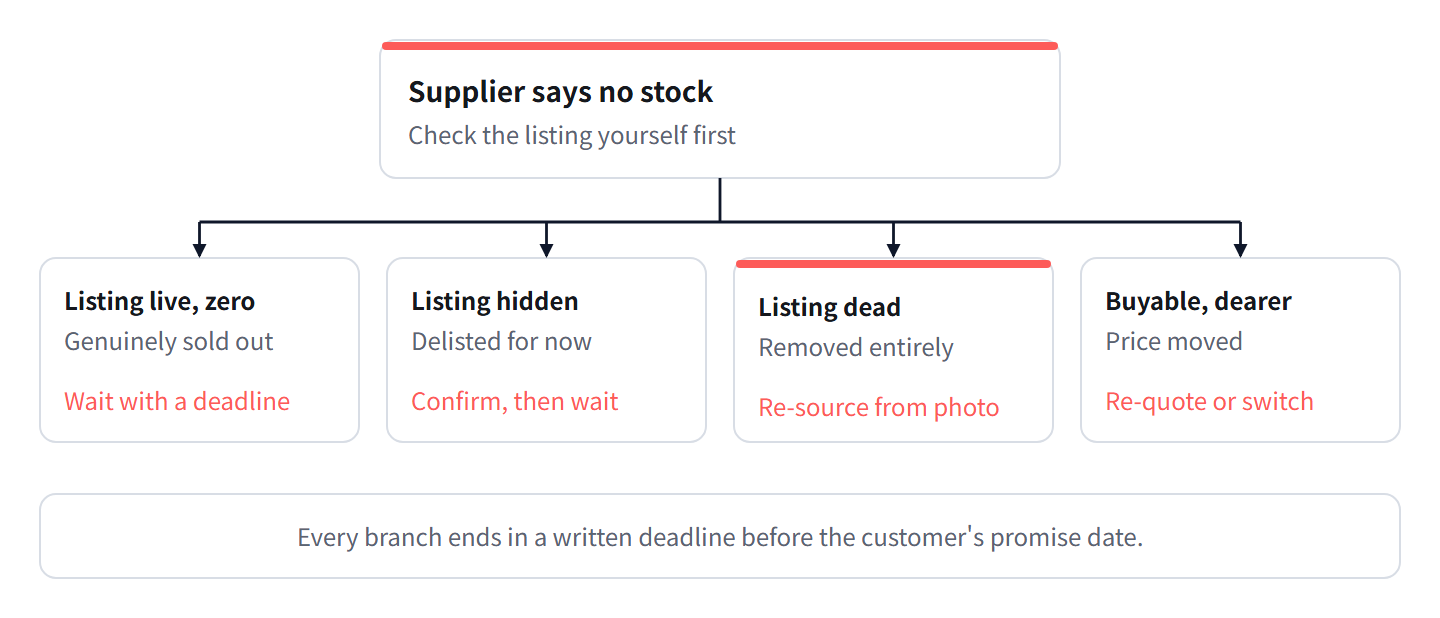
The message from the supplier says no stock. Four quite different things could be true, and they do not share a response.
The first is genuinely sold out. The listing is live, the variant shows zero available, and the seller expects more. Waiting is a real option here, and it is often the cheapest one.
The second is temporarily delisted. The listing is hidden, either by the seller or by the platform, and it may come back unchanged. This looks identical to the first from the outside and behaves completely differently.
The third is removed entirely. The URL returns nothing, the seller is gone or the item has been withdrawn from the range. No amount of waiting helps, and every day spent waiting makes the customer's position worse.
The fourth is not a stock problem at all. The item is available, but the price has moved far enough that the order no longer works at the margin you sold it. The listing is fine and the economics are broken.
| Mode | What you observe | What it actually means | Response |
|---|---|---|---|
| Genuinely sold out | Listing live, variant at zero, seller active | Stock will return on a restock cycle | Ask for the restock answer, set a deadline, hold the order |
| Temporarily delisted | Listing unreachable or hidden, seller still active | Platform or seller pause, often reversible | Confirm with the seller, then wait or re-source |
| Listing removed | URL dead, seller unreachable or withdrawn | The source is gone | Re-source from photo or from the original product page |
| Price moved out of range | Listing live and buyable at a higher figure | The order's economics changed, not its availability | Re-quote, change the store price, or find an equivalent |
Treating these as one problem is how a solvable order becomes a refund. Waiting on a removed listing burns the customer's patience. Re-sourcing a genuinely sold-out item that restocks tomorrow buys you a second supplier relationship you did not need and a goods line you have not validated.
Triage: what evidence to collect, and the time budget for each
Before you search for anything, collect four pieces of evidence. The search is cheap once they are in hand and expensive without them.
| Mode | Evidence to collect | Time budget | Decision at the deadline |
|---|---|---|---|
| Genuinely sold out | Restock answer from the seller, plus the variant and quantity you need | Two working days | Restock date inside your promise window means wait, otherwise re-source |
| Temporarily delisted | Whether the seller or the platform pulled it, and whether other variants are still live | One working day | Seller confirms a return means wait, silence means re-source |
| Listing removed | Screenshot or saved page of the original listing, plus a photo of the item | Start immediately, no waiting | Re-source, no wait option exists |
| Price moved out of range | The new listing figure, your current goods line, and your contribution on the order | One working day | Re-quote and change the store price, or find an equivalent |
- Open the order and write down the variant exactly as your store states it, including the attribute name your store uses rather than the one the marketplace uses.
- Check the listing state yourself. Live-at-zero, hidden and dead are three different observations and they take thirty seconds to distinguish.
- Send the seller one message asking a single closed question: is this variant coming back, and if so, when. A yes-or-no question gets answered; a paragraph does not.
- Save the listing page and any photo of the item you already hold, before the URL goes dead.
- Set the decision deadline on your own calendar, using the budgets above. Artefact: one page with the variant, the listing state, the seller's answer if any, and the date you decide by.
The deadline matters more than the evidence. An order with no decision date drifts, and drift is what turns a stock problem into a dispute.
Re-sourcing from a photo, a keyword, or the original listing
Three inputs start a search, and they are not equally reliable.
The original listing is the strongest input when it is still reachable. It carries the seller's own specification, the variant structure and usually the real dimensions, which is exactly the information a photo cannot give you.
A photo is the workhorse when the listing is gone. It carries shape, colour, hardware and print, and it is enough to find candidates across the six supported marketplaces, 1688, Taobao, Weidian, Yupoo, Xianyu, Dewu.
A keyword is the weakest of the three, and it is the one that fails most often. The reason is structural: your store names products for buyers, and the marketplace names them for search. "Brushed Cotton Overshirt" finds garment listings by material and shape; the marketplace lists the same item under a factory term with a colour code. The keyword search returns candidates that share a category rather than a specification.
| Input | Works best for | Fails when | Relative reliability |
|---|---|---|---|
| Original listing | Anything still reachable | The listing is dead, which is why you are here | Highest, it carries the spec |
| Photo | Items distinguished by shape, hardware or print | Many sellers reuse the same studio image for different goods | High, but needs the five checks |
| Keyword | Commodity items with a stable trade name | Differentiated goods where the store name carries no spec | Lowest, search matches category not spec |
Use more than one input when you can. A photo plus the original listing's dimensions beats either alone, and a keyword plus the variant line beats a keyword alone.
Five checks that a candidate is the same item, not a lookalike
Candidates come back from the search. Most of them are not your product. They are products photographed in the same room, or built from the same pattern, or named with the same words.
Run five checks, in this order, and stop at the first failure.
- Material. Compare the stated composition against your listing's claim, not against the photo. A product that looks identical in a picture and is a different material is the most common lookalike there is, and the customer will feel it in the first ten seconds.
- Dimensions. Compare every dimension your listing states. A difference in one axis is a different product, even when the photograph is the same image.
- Hardware and trim. Zips, buckles, buttons, stitching density, edge finishing. These are where a cheaper build shows first, and they are visible in a QC photo if you ask for the angle.
- Print or colour match. Ask for a photo of the exact print area at close range, then compare it against your own product page. Colour shift between production runs is normal; a different graphic is not.
- Packaging. If your listing promises retail packaging, a poly bag is a substitution the customer will notice and you should not ship without asking.
| Check | How to verify it | What a lookalike does | Pass condition |
|---|---|---|---|
| Material | Stated composition versus your listing claim | Matches visually, differs on the label | Same stated composition |
| Dimensions | Every axis, against your listing | Two of three axes match | All axes within the stated tolerance |
| Hardware and trim | Close-range QC photo of each fitting | Similar shape, lighter build | Same fitting type and finish |
| Print or colour match | Close-range photo of the print area | Same layout, different colour values | Acceptable to your own eye on screen |
| Packaging | Photo of the packed unit | Poly bag where you promised a box | Matches what your listing claims |
Order the QC photo angles you need at the same time as you approve the goods payment, not after. Three QC photos per item are included, so spend them on material, hardware and print rather than on three views of the same silhouette.
Switching source versus refunding: the arithmetic
Refunding feels safe because it is final. It is also the option that destroys the whole contribution on the order, plus the acquisition cost behind it, plus the staff time in the support thread. The comparison is worth doing on paper before you choose.
Assumptions, all stated. Take an order with a value indexed at 1.00. The goods line is 0.38 of that value. Freight is 0.22. Payment processing is 0.03. Contribution on the order is therefore 1.00 − 0.38 − 0.22 − 0.03 = 0.37.
- Refund. Contribution falls to zero. You also absorb the support thread and whatever the acquisition cost was, neither of which appears in the 0.37.
- Switch source at a goods line 12% higher. New goods line is 0.38 × 1.12 = 0.4256. New landed cost is 0.4256 + 0.22 + 0.03 = 0.6756. New contribution is 1.00 − 0.6756 = 0.3244.
- Break-even goods-line increase. The order turns negative when the goods line increase equals the whole contribution, so the maximum tolerated increase is 0.37 ÷ 0.38 = 0.974, or about 97%. The substitute source can cost nearly double on the goods line before this order loses money on cost alone.
- Adjust for quality risk. Assume a return costs you 1.10 of order value once the refund and the unrecovered freight are counted, and assume the substitute pushes return probability up by 5 percentage points against your historical rate. Expected contribution becomes 0.3244 − (0.05 × 1.10) = 0.2694, still clearly positive.
- The break-even quality risk. Setting expected contribution to zero gives a tolerated return probability of 0.3244 ÷ 1.10 = 0.295, about 30%. A substitute would have to be returning roughly three in ten orders before refunding wins on this arithmetic.
Those bounds are wide, and that is the finding. Within cost alone, switching almost always beats refunding for an order that is already sold. What actually decides the case is not the goods line, it is whether the substitute passes the five checks. A lookalike that generates a return is worse than a refund, because it costs the refund plus two freight legs.
When substitution is acceptable, and the message structure
Substitution means shipping something other than exactly what the customer ordered. That is a decision the customer makes, not you.
| Substitution | Acceptable? | Condition |
|---|---|---|
| Same item, different production run, identical spec | Yes, no message needed | Passes all five checks |
| Same item in packaging that differs from what you promised | Only with consent | Ask before dispatch, expect some refusals |
| Equivalent item with one visible difference, such as a trim colour | Only with consent | Offer it as a choice with the wait option beside it |
| Different material or different dimensions | No | This is a different product; refund or re-source again |
| Anything that changes a regulated claim, such as a safety or composition statement | No | Never substitute on a claim |
Structure the message in five parts, in this order.
- One sentence stating what happened to the original item, with no blame and no supplier name.
- One sentence on what this means for the date they were given.
- One sentence describing the substitute, naming the single difference plainly.
- The choice, stated as a choice: accept the substitute and ship now, or wait for the original with a date, or cancel with a full refund.
- The date you will act if they do not answer, and what you will do on that date.
That last part is what stops the thread from stalling. A message with no default action generates a second message, and the second message arrives after the promise date has already passed.
If the customer does not answer and the substitution was minor and passes the five checks, ship the original-spec item and say so. If the substitution changes anything the customer can see, wait for the answer.
Keep a second source bound before you need it
The failure above was expensive because it happened under time pressure, with a customer waiting and no validated alternative in hand. The prevention step is boring and it is the whole job.
- For every variant that sells more than a handful of units a month, hold two confirmed sources: the one you use and one that has passed the five checks at least once.
- Bind the primary source to the store variant so returning orders fulfil without a fresh search. This is route B1, and it turns a sourcing job into a fulfilment job.
- Once a quarter, buy one unit from the second source and run the five checks again. Production drifts, and a source that matched in one season may not match in the next.
- Store the evidence with the variant: dimension table, material statement, and the QC photos from both sources. Artefact: a comparison you can read in two minutes when something breaks.
- When the primary fails, you now have a decision rather than a search: switch, wait, or refund, with the arithmetic already done.
Storage is included for 90 days, so holding a validation unit costs nothing beyond the unit itself. That is a cheap insurance policy against the week described at the top of this page.
자주 묻는 질문
How do I tell sold out from delisted?
Open the listing yourself. If the page loads and the variant shows zero available, it is sold out and waiting is a real option. If the page does not load or the seller's other listings are live while this one is not, treat it as delisted and confirm with the seller before waiting.
Is a photo or a keyword better for finding a substitute?
A photo, for anything differentiated by material, hardware or print. A keyword reliably finds the category rather than the specification, which is why it returns the most candidates and the fewest usable ones.
When is refunding better than switching?
When the substitute fails any of the first three checks, material, dimensions or hardware. On cost alone, switching usually wins, because the tolerated goods-line increase is close to double for a typical order.
Can I ship an equivalent without asking?
Only when it passes all five checks and nothing the customer can see has changed. If packaging, colour or trim differs from what your listing promised, ask first and wait for the answer.
How many sources should a selling variant have?
Two that have both passed the five checks: one bound and in use, one validated and idle. Re-validate the idle one once a quarter, because production drifts.
이번 주 할 일
- Open your three best-selling variants and check whether each has a second source that has passed the five checks.
- Save a copy of every listing page you depend on today, before any of them go dead.
- Set a written restock deadline for any order you are currently holding, using the two-day and one-day budgets above.
- Write your substitution message once, in the five-part structure, so it is ready before you need it rather than during a dispute.
Lovegodrop 소싱 팀이 작성하고 관리합니다. 이 페이지는 어떻게 작성되고 검증되는가.
이미 판매한 주문 하나로 시작하세요
Shopify 또는 WooCommerce 스토어를 연결하고 결제된 주문 하나를 선택하면, 확정하기 전에 해당 주문의 소싱 및 배송 견적을 확인할 수 있습니다.