
仕入先が値上げした。出品価格ではなく着地コストで判断する
商品行の8%上昇は着地コストの8%上昇ではない。再計測し、吸収・価格変更・乗り換えから選ぶ。
要点
- A goods-line increase dilutes across freight and processing, so the landed-cost rise is smaller than the headline and the contribution fall is larger.
- Three responses exist: absorb, change the store price, or switch source. Each is correct under a specific condition, not by preference.
- Re-measure packed weight, route and consolidation before deciding, because freight often moves more than the goods line did.
- A source switch must pass the same validation as any new source, or you have exchanged a price problem for a returns problem.
- Open orders keep the price they were sold at; a store price change applies to future orders and should not disturb the listing's identity.
Why a goods-line percentage is the wrong denominator
The supplier's message is short: materials went up, the item is 8% dearer, effective immediately. Eleven open orders were sold at the old figure, and the product page is still advertising the old margin to anyone who loads it today.
The decision is not whether 8% is acceptable. It is what 8% on one line does to the whole order.
Freight and payment processing do not move when the supplier moves. They sit still while the goods line rises, which means the landed cost rises by less than 8% and the contribution left to you falls by more than 8%. Same event, three different percentages, and only one of them decides anything.
Assumptions, stated. Take an order with value indexed at 1.00. Goods line 0.40, freight 0.25, payment processing 0.04. Landed cost is 0.69 and contribution is 0.31.
Line one, goods at 0.40 and freight at 0.25. An 8% goods increase makes the goods line 0.432. Landed cost becomes 0.722, which is a rise of (0.722 − 0.69) ÷ 0.69 = 4.6%. Contribution becomes 0.278, which is a fall of (0.31 − 0.278) ÷ 0.31 = 10.3%.
Line two, the same item on a lighter parcel where freight is 0.15 of order value. Landed cost is 0.59 and contribution is 0.41. The same 8% goods increase takes landed cost to 0.622, a rise of 5.4%, and contribution to 0.378, a fall of 7.8%.
| Line one, freight at 25% of order value | Line two, freight at 15% of order value | |
|---|---|---|
| Goods line before | 0.40 | 0.40 |
| Landed cost before | 0.69 | 0.59 |
| Contribution before | 0.31 | 0.41 |
| Goods line after an 8% increase | 0.432 | 0.432 |
| Landed cost after | 0.722 | 0.622 |
| Landed cost change | +4.6% | +5.4% |
| Contribution change | −10.3% | −7.8% |
Two things fall out of that table. The headline number always understates the damage to contribution, and the damage is worse when freight is a larger share of the order. A variant that looked comfortably profitable at a freight share of 15% can be thin at 25%, with no change to the goods line at all.
The third number you need is the price change that holds contribution steady. On line one: revenue must satisfy revenue − 0.722 = 0.31, so revenue = 1.032, a store price increase of 3.2%. That is the figure to compare against your own sense of what the market tolerates, not the 8% in the supplier's message.
Three responses, and the condition under which each is correct
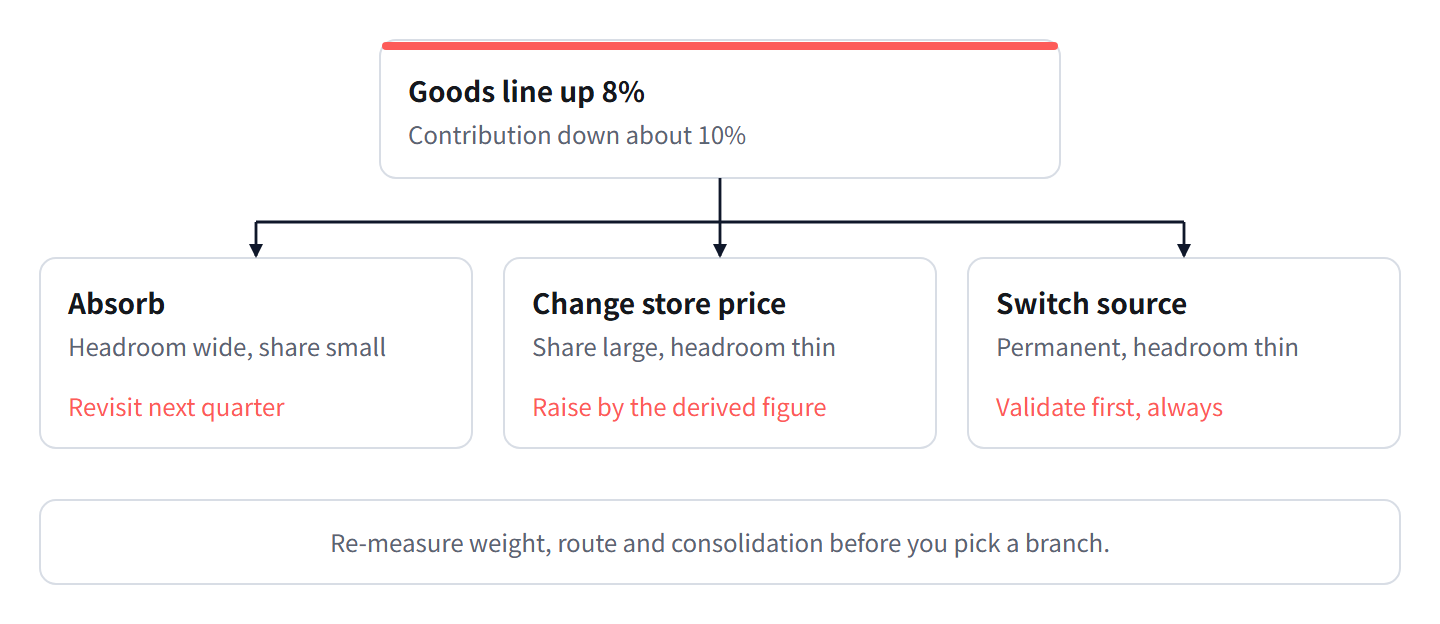
There are only three things you can do, and each one is correct under a condition rather than by temperament.
Absorb means you keep the store price and take the contribution hit. It is correct when the variant's share of your orders is small, when remaining headroom is wide, and when the increase looks temporary.
Changing the store price means the customer pays more from now on. It is correct when the variant carries a large share of orders and headroom cannot absorb the change, and it must be done without disturbing the listing's identity.
Switching source means finding the same specification elsewhere. It is correct when the increase is permanent, when headroom is thin, and only after the substitute has passed validation.
What to re-measure before you decide
The goods line moved. Before you accept that as the whole story, check the other two components of landed cost, because they move quietly and often by more.
| What to re-measure | Why it drifts | What it can change |
|---|---|---|
| Packed weight and dimensions | Listing figures understate the carton, and packaging changes between runs | Chargeable weight, and therefore the whole freight line |
| Chargeable weight versus scale weight | Carton size changes the ratio even when the item does not | The volumetric multiplier you are billed on |
| Route | Twenty-four routes exist across postal, commercial express and dedicated line | Freight per chargeable unit, and the service type you are selling |
| Consolidation | Multiple orders can travel as one parcel | Chargeable weight falls when cartons merge |
| Storage window | Ninety days of storage is included | Time to wait for a consolidation partner order |
- Pull the last three dispatched parcels for this variant and read their measured chargeable weight, not the listing weight. Artefact: the real multiplier between scale weight and billed weight.
- Ask for the freight figure on two different route types for the same measured parcel. Artefact: the spread between postal, commercial express and dedicated line on your actual carton.
- Check whether this variant's orders ever travel with another item to the same customer. If they do, the consolidated chargeable weight, not the single-parcel weight, is the number to use.
- Recompute contribution with the measured freight rather than the assumed one. Artefact: a contribution figure you can defend.
This step sometimes reverses the decision. A goods line that rose 8% next to a freight line that can fall 12% by changing route is not a crisis, it is a routing question.
Switching source without trading a price problem for a quality problem
A cheaper source is not a solution until it is the same product. Run this before you move a single order.
- Compare the stated material against your listing claim. Not the photo, the stated composition.
- Compare every dimension your listing states. Two axes out of three is a different product.
- Compare hardware and trim: zips, buckles, buttons, edge finish, stitching density.
- Compare print or colour against your own product page at close range.
- Compare packaging against what your listing promises.
- Buy one unit and let it reach the warehouse. Three QC photos per item are included; spend them on material, hardware and print.
- Check whether the new source can hold your monthly volume, not just one unit.
- Only then move one order across, and hold the rest on the old source until that order is delivered and not returned.
| Failure this prevents | Symptom if skipped |
|---|---|
| Material substitution | Customer feels the difference immediately, return follows |
| Dimension drift | Item does not fit the use case the listing described |
| Weaker trim | Return within weeks rather than days |
| Print or colour shift | Dispute about whether it is the advertised product |
| Packaging downgrade | Complaint even when the item is correct |
Skipping step eight is the common mistake. Moving the whole book of orders to a new source in one day converts a validation exercise into a returns event.
Changing the store price without breaking the listing or open orders
Two fears sit behind most reluctance here: losing search position, and breaking the promise already made to people who bought at the old figure. Both are manageable if you change one thing at a time.
| Change | Risk | Safe way to do it |
|---|---|---|
| Price only | Lowest | Change the price and nothing else on that day |
| Price plus title | Higher | Search indexes read the change as a new entity; separate the two edits |
| Price plus handle or URL | Highest | Breaks inbound links and any feed pointing at the old address |
| Variant structure change | High | Existing orders and feeds can lose their variant reference |
| Retroactive change to open orders | Not applicable | Orders hold the price they were sold at |
- Compute the figure first, using the contribution arithmetic above, and round it to a price your market reads as deliberate rather than accidental.
- Change the price on the variant and nothing else. Artefact: one diff on the listing, easy to revert.
- Leave the title, handle and variant structure alone for at least a week, so any movement in traffic can be attributed to the price alone.
- Confirm open orders still show the price the customer paid. The order carries its own line price, so a listing change does not rewrite it, but verify it once on your own platform.
- Watch conversion for two weeks before touching anything else. Artefact: a measured answer to whether the market accepted the new figure.
If the derived increase is above roughly 10% of the store price, consider whether the listing should carry a new price at all or whether the variant should be retired and swapped out. A jump that large usually means the product's economics changed, not just its cost.
Questions worth putting to a supplier, and the ones that waste the call
Ask about causes and tiers. Do not ask about feelings.
| Question | Worth asking? | Why |
|---|---|---|
| What specifically changed: material, packaging, labour, or a quantity tier? | Yes | The answer tells you whether it is permanent |
| Is this tied to one production batch or to the ongoing price? | Yes | Batch-linked increases sometimes revert |
| Would a larger quantity restore the previous tier? | Yes | Tiering is the most common cause and the easiest to fix |
| Is there a plainer packaging option at the lower figure? | Yes | Packaging changes are often the whole increase |
| Does the increase apply to every variant or only some? | Yes | Variant-level pricing is frequently uneven |
| Can you hold the old price because we have been loyal? | No | Unenforceable and it spends goodwill on nothing |
| Your competitor is cheaper, match them | No | They know; it invites a defensive answer |
| We will leave if you do not | Only if true | An unrealised threat ends the relationship and changes nothing |
Phrase every question so it can be answered in one line. A supplier who answers in one line has told you something; a supplier who answers in a paragraph has usually told you nothing.
Decision table keyed on volume and remaining headroom
Read the variant's share of monthly orders down the side, and the contribution headroom still left after the increase across the top. Both are percentages.
| Variant share of monthly orders | Headroom above 25% | Headroom 10 to 25% | Headroom below 10% |
|---|---|---|---|
| Up to 10% | Absorb, revisit next quarter | Absorb, re-measure freight first | Switch source, or retire the variant |
| 10 to 30% | Absorb while renegotiating | Change store price, renegotiate in parallel | Switch source, validate on one order |
| Above 30% | Renegotiate first, then change store price if the answer is no | Change store price now, renegotiate alongside | Switch source urgently, change the price only if the switch fails |
Two notes on reading it. Headroom below 10% means there is no decision to make about absorbing, because absorbing removes the reason to sell the item. And a variant above 30% of monthly orders is a dependency, which is the strongest argument for holding a second validated source whatever the price does.
よくある質問
Does an 8% supplier increase mean an 8% price rise for customers?
No. Compute the increase that holds contribution steady instead. In the worked example, an 8% goods increase is a 4.6% landed-cost rise and needs a store price rise of about 3.2% to restore the previous contribution.
Can I apply the new price to orders already placed?
No. An order carries the price it was sold at. Change the listing for future buyers and verify once on your own platform that open orders still show the original line price.
When is absorbing the right answer?
When the variant is a small share of monthly orders and headroom after the increase is above 25%. Absorbing a large-share variant with thin headroom converts a supplier problem into a cash flow problem.
Should I switch source immediately after a price rise?
Only after the substitute passes material, dimension, hardware, print and packaging checks on one bought unit, and only move one order across before the rest.
How often should landed cost be recomputed?
Whenever the goods line changes, and otherwise once a quarter, because packed weight and route drift quietly and move freight more than a supplier message moves the goods line.
今週やること
- Recompute contribution on your three highest-volume variants using measured freight, not listing freight.
- Derive the store price increase that holds contribution steady, and compare it with the supplier's headline number.
- Ask the supplier three closed questions: what changed, is it permanent, and does quantity restore the old tier.
- If you change a price, change the price only, and leave the title, handle and variant structure alone for a week.
Lovegodropのソーシングチームが執筆・管理しています。このページの作成と検証方法.
まずは販売済みの注文から始める
ShopifyまたはWooCommerceストアを接続し、支払い済みの注文を1件選ぶと、コミットする前にその注文の調達・配送見積もりを確認できます。