
容積重量:荷物が重さより高くつく理由
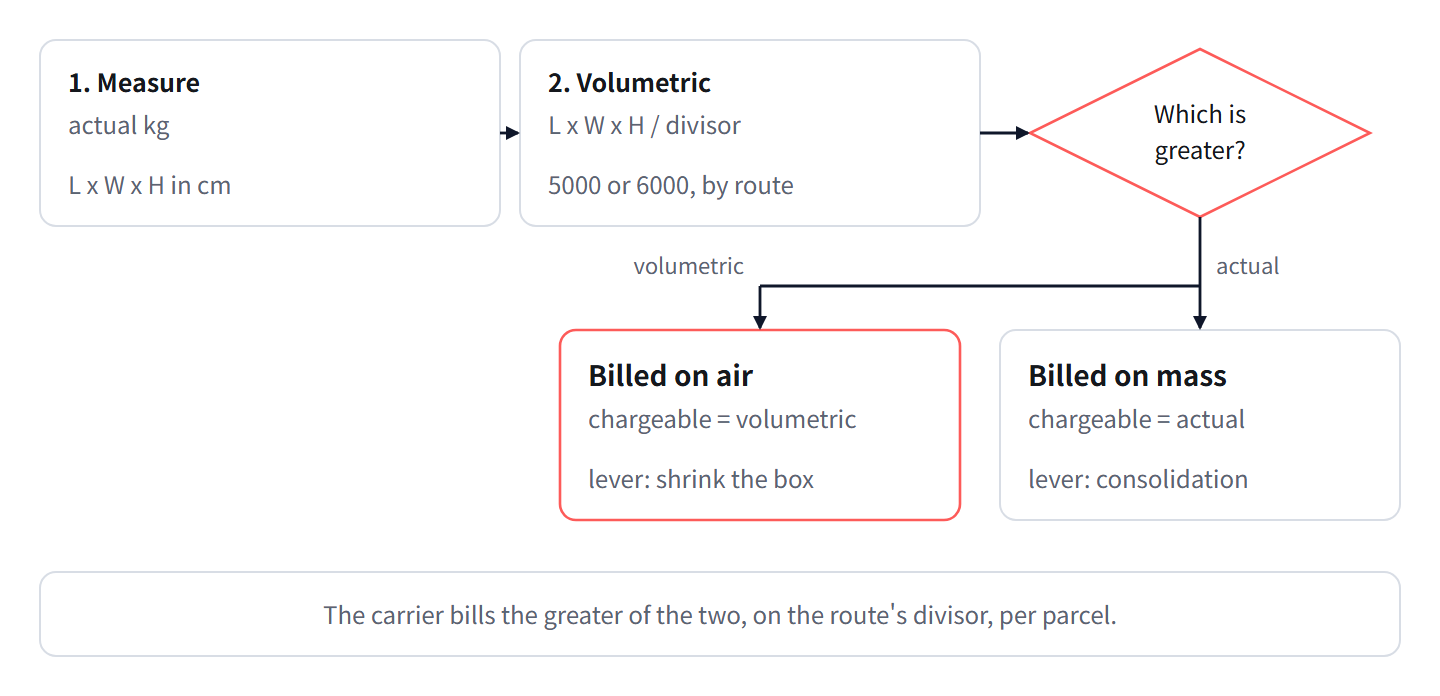
課税重量は実重量と容積重量の大きい方。係数、梱包、配送ルートがどちらで請求されるかを決める。
要点
- Chargeable weight is the greater of actual weight and volumetric weight. Volumetric is length times width times height divided by a divisor.
- The divisor is 5000 on some routes and 6000 on others, because the two recover different space costs. It changes which of the two numbers wins.
- Compute the volume ratio, volumetric over actual. Below 1 you are billed on mass, above 1 on air, and the packing only matters in the second case.
- Six packing changes lower volume without lowering protection, and every one of them works by shrinking the bounding box.
- Plan at divisor 5000 with a ten percent margin, then replace the plan with the measured figure after the first parcel.
The parcel weighs 900 grams and is billed at 1.85 kilograms
You approve a shipping payment and the chargeable weight is roughly double what the listing said the item weighs. Nothing was added to the parcel. Nobody made an error at the scales. The carrier is charging for the space the parcel occupies in a container or an aircraft hold, and space is billed through a weight-equivalent derived from the box.
Once you accept that, the number stops looking arbitrary. It is the product of three measurements and one constant, and two of those four things are decisions you can change before the parcel is sealed. This is the component of freight that most merchants never touch, because it sits with whoever packs the box rather than with whoever sets the price.
Chargeable weight is the greater of two numbers
| Term | What it is | How it is obtained | Who sets it |
|---|---|---|---|
| Actual weight | What the parcel weighs on a scale | Weighed at the warehouse, per parcel | The item plus the packing materials |
| Volumetric weight | A weight-equivalent for the space the parcel occupies | Length × width × height ÷ divisor | The packing decision |
| Chargeable weight | The greater of the two | A comparison, nothing more | The carrier's rule |
| Divisor | Cubic centimetres billed as one kilogram | A constant attached to the route | The route you choose |
| Volume ratio | Volumetric ÷ actual | Division | Yours to change. Under 1 means mass decides, over 1 means air decides |
The volume ratio is the figure worth keeping. Below 1, the carrier is billing you for the product and the packing effort is wasted. Above 1, the carrier is billing you for air, and every centimetre you remove from the box comes straight out of the charge.
The formula, and why both 5000 and 6000 exist
Volumetric weight in kilograms equals length in centimetres times width times height, divided by the divisor:
- At divisor 5000, every 5,000 cm³ is billed as one kilogram.
- At divisor 6000, every 6,000 cm³ is billed as one kilogram.
So the smaller divisor produces the larger volumetric weight, and the larger divisor is the more generous one. A 40 × 30 × 25 box is 30,000 cm³, which is 6.0 kg at 5000 and 5.0 kg at 6000: a 1.2× difference on the same parcel.
Why two constants exist at all is a question about what the carrier is recovering. Commercial express buys priority space on scheduled flights, where a cubic metre is scarce and expensive, so it prices volume more sharply and tends to use 5000. Postal and dedicated-line services move consolidated freight that is built up over days and loaded into containers in bulk, where a cubic metre costs less, so they price volume more gently and tend to use 6000. The mechanism is the cost of the space, not the preferences of the carrier.
Two practical consequences follow. The divisor is attached to the route, so changing route changes the divisor as well as the rate, and the two do not always point the same way. And a parcel that is borderline between actual and volumetric can flip from one to the other on the divisor alone, which is why you should plan at the conservative constant and verify with a quote.
Rounding matters too, and it is usually in the carrier's favour. Assume dimensions are rounded up to the next whole centimetre and the resulting weight up to the next half kilogram until you have seen an actual quote that says otherwise. On a parcel sitting just under a half-kilogram step, one centimetre of rounding can move the chargeable weight by the whole step, which is why the borderline case below deserves more of your attention than either of the clear ones.
There is a second measurement convention to know about. A soft parcel is measured at its widest points, not at its intended shape. A mailer that bulges in the middle is measured across the bulge, and because volume is a product, that single bulge is billed on all three axes at once. Taping a soft parcel square, so the faces are flat and the corners are defined, is the cheapest volumetric reduction available, and it costs nothing but thirty seconds at the bench.
And a third: the measurement happens on the parcel as sealed. If a strap is added, if the mailer is folded over rather than cut, or if a card is inserted that lifts one face, the measurement includes it. Every one of those is a decision made at the bench, which is another way of saying that chargeable weight is a decision made at the bench.
Three parcels: dense, bulky, and a case that tips
| Dense small item | Light bulky item | Borderline | |
|---|---|---|---|
| Product | Metal phone accessory | Plush toy | Folded hoodie |
| Actual weight | 0.18 kg | 0.55 kg | 0.90 kg |
| Packed dimensions | 18 × 12 × 3 cm | 40 × 30 × 25 cm | 28 × 22 × 8 cm |
| Volume | 648 cm³ | 30,000 cm³ | 4,928 cm³ |
| Volumetric at 5000 | 0.13 kg | 6.00 kg | 0.986 kg |
| Volumetric at 6000 | 0.11 kg | 5.00 kg | 0.821 kg |
| Chargeable at 5000 | 0.18 kg, actual wins | 6.00 kg, volumetric wins | 0.99 kg, volumetric wins |
| Volume ratio at 5000 | 0.72 | 10.9 | 1.10 |
The dense item costs you nothing to pack badly in volumetric terms, because mass is already the larger number. Spending time compressing a metal accessory is time spent on a component that is not binding.
The plush toy is the opposite. At a volume ratio of 10.9, roughly nine tenths of the chargeable weight is air. Nothing you do to the product changes that; only the packed envelope can, and only compression or a smaller mailer moves it materially.
The borderline case is where the money is, because it is the common one. At divisor 5000 the hoodie is billed at 0.99 kg against an actual 0.90 kg, a 10% overshoot from packing alone. At divisor 6000 the volumetric drops to 0.821 kg and the actual weight wins, so the same parcel is billed 18% lower with no change to anything except the route's constant. And if the packer takes 2 cm off the 22 cm side, the volume falls to 28 × 20 × 8 = 4,480 cm³, volumetric 0.896 kg, and the actual weight wins at both divisors.
Two centimetres of packing material is the difference between being billed for mass and being billed for air. That is what makes packing an instruction rather than a preference.
Volume ratio by category, and what it says about packing
Use this table as a starting assumption for a category you have not measured yet, then replace it with your own measured figures after the first parcel.
| Category | Typical volume ratio | What dominates | Packing implication |
|---|---|---|---|
| Small metal or glass accessories | 0.5 to 0.9 | Mass | Do not spend time compressing. Consolidate instead |
| Small electronics in a retail box | 0.9 to 1.4 | Mixed | De-box. The retail carton is usually the excess |
| Apparel, folded and compressed | 1.2 to 2.0 | Volume | Roll or compress. The thickness axis is the lever |
| Apparel in a supplier carton | 2.0 to 4.0 | Volume | Mailer, not carton |
| Footwear in its box | 1.5 to 3.0 | Volume | Ship the pair in a mailer, or accept the ratio. Shoe boxes are rigid |
| Home decor, fragile, void-filled | 3.0 to 8.0 | Volume | Right-size the carton. Void fill is billed at the same divisor as the product |
| Soft toys, cushions, pet beds | 4.0 to 12.0 | Volume | This is an air shipment. Price it that way or do not sell it |
| Bedding and duvets | 6.0 to 15.0 | Volume | Compression is the only lever with a large effect |
The pattern is not about the product's weight, it is about whether the product holds its shape. Anything that collapses under a strap is a volume problem. Anything that does not is a mass problem, and the correct action for a mass problem is to leave the packing alone and look at consolidation instead.
Replace this table with your own within a month. Every time a parcel is measured, write the volume ratio next to the SKU, and after ten measurements per category you will have a distribution rather than a guess. Two things usually emerge. The spread inside a category is wider than the table suggests, because packing varies more than product does. And the categories you sell are not spread evenly across the table, so three or four rows will carry nearly all of your parcels, and those are the only rows worth refining.
The ratio is also the fastest way to triage a catalogue you have inherited or not looked at in a while. Sort the sheet by volume ratio descending and the top of the list is your freight problem, stated as a single number per SKU. A ratio above 4 means the product is mostly air by the time it is billed, and either the listing price was set without knowing that, or the product should not be on the route it is on.
Six packing changes that lower volume without lowering protection
| Change | Mechanism | Effect on volume ratio | Where it does not work |
|---|---|---|---|
| Compress soft goods along the thickness axis | Volume is the product of three axes. Halving the thickness axis halves the billed volume with the other two unchanged | Roughly halves volumetric on textiles | Rigid or fragile goods; compression that creases a garment creates a return instead |
| Remove the supplier's retail carton | Carton walls and void fill are billed at the same divisor as the product. Removing them removes volume that carries nothing | Removes the gap between the item envelope and the carton envelope | Anything sold as a boxed gift, anything the customer expects in the retail box |
| Right-size the outer mailer | The carrier measures the bounding box, so void space is billed. Two centimetres off each axis removes a layer of billed air on all three | Multiplicative across three axes | Fragile goods that need a crush zone to survive the journey |
| Disassemble and nest parts | Stacked parts share a footprint, so the longest axis is the largest part's rather than the sum of both | Large when parts are flat and similar in size | Goods where assembly is part of what the customer bought |
| Carton to poly mailer | A mailer conforms to the item, so the billed box approaches the item's own envelope instead of the nearest standard carton size | Large on soft, irregular items | Anything crushable, anything with a rigid corner that will puncture the film |
| Square off and tape the corners | Measurement follows the widest points, so a bulge on one axis is billed across all three axes | Small, and free | Over-compression that pushes the bulge somewhere else rather than removing it |
Each of these works by shrinking the bounding box, and each one has a point at which it starts costing you in damage or in customer expectation. The sixth is the one to apply universally, because it costs nothing and it stops a soft parcel being measured at its widest point rather than its true footprint.
Note what is not on the list: adding padding to protect a fragile item. Protection and volume trade against each other, and the trade is only worth making when the damage rate without the padding is worse than the freight. Measure both before you decide.
Why listing dimensions understate the parcel
| Field | Listing behaviour | Warehouse behaviour | What to do with it |
|---|---|---|---|
| Weight | Rounded down; sometimes the bare product without its packaging | Weighed per parcel on a scale | Treat the listing figure as a floor, never as a plan |
| Dimensions | The product envelope, not the packed box | Measured as the bounding box of the packed parcel | Add your own packing allowance |
| Variant figures | Often copied from the base variant | Measured on the variant actually shipped | Measure the variant you actually sell |
| "Shipping included" | Usually means the domestic leg only | International freight is a separate decision | Ask which leg, in writing |
The reason is structural rather than dishonest. A marketplace seller has no incentive to correct a low figure, because the low figure makes the listing look better on any comparison the buyer runs, and the seller is not the one paying international freight. So the error is systematic in one direction, and it is never corrected from the seller's side.
This is why the measurement point decides everything. With us, the parcel is weighed and measured at the warehouse before the shipping quote is issued, and the quote is built on those figures. If the amount you prepaid exceeds the measured amount, the difference is returned. The practical consequence for you: the listing figure stops being a promise you have to defend to a customer, and the measured figure becomes the number you plan from next time.
Estimating volumetric weight from a listing before you buy
- Take the listing's three dimensions. If only one is given, take the volume ratio for the category from the table above and derive the others from the category's typical shape.
- Add the packing allowance per axis: 2 cm for a poly mailer, 4 cm for a carton, 6 cm if void fill is needed. It is a per-axis allowance, and volume is a product, so it compounds.
- Compute volumetric at divisor 5000. Use the smaller divisor for planning because it gives the conservative figure; if the route turns out to use 6000 you will come in under plan rather than over.
- Estimate the packed actual weight as the listed weight multiplied by 1.15, to account for the mailer, tape and any insert.
- Take the greater of the two as the planning chargeable weight.
- Apply a 10% margin on that figure for rounding at the carrier and for a parcel that gets re-taped at the warehouse.
Worked, with the assumptions stated: listing says 20 × 15 × 8 cm and 480 g.
- Packed in a mailer: 22 × 17 × 10 = 3,740 cm³. Against a listed 2,400 cm³, that is a 1.56× multiplier from a 2 cm allowance on each axis
- Volumetric at 5000 = 3,740 ÷ 5000 = 0.748 kg
- Packed actual = 0.480 × 1.15 = 0.552 kg
- Greater of the two = 0.748 kg
- With a 10% margin = 0.82 kg
The listing implied 0.48 kg. The plan says 0.82 kg, which is 1.7 times the listing figure. If you quote your customer on the listing figure and the plan is right, you absorb the difference yourself.
The artefact from this procedure is one planning figure per SKU, kept in the same sheet as your landed ratios. Replace it with the measured figure after the first parcel ships, and the sheet becomes accurate one SKU at a time.
Consolidation and volumetric weight: when combining helps and when it hurts
Consolidating multiple orders into one parcel does two things at once. It removes a per-parcel fixed component, and it adds volume, because one bounding box now has to contain everything. Whether it pays depends on which effect is larger.
Where it helps: two flat items, each 24 × 18 × 2.5 cm and 0.40 kg actual.
- Separate: each volumetric is 1,080 ÷ 5000 = 0.216 kg, which is under the route's 0.5 kg minimum, so each is billed at 0.5 kg. Total 1.0 kg, two fixed components
- Stacked into one mailer at 26 × 20 × 7: volumetric 3,640 ÷ 5000 = 0.728 kg, actual 0.80 kg, chargeable 0.80 kg, one fixed component
- Chargeable weight falls to 0.80 of the separate total, and one fixed component replaces two
The gain came from the minimum, not from the volume. Each parcel separately was paying for half a kilogram it did not use, and combining let the combined parcel pay for the weight it actually had.
Where it hurts: a rigid lamp base at 30 × 20 × 20 cm and 1.8 kg, and a cushion at 40 × 30 × 15 cm and 0.6 kg.
- Separate: volumetric 12,000 ÷ 5000 = 2.4 kg, and 18,000 ÷ 5000 = 3.6 kg. Chargeable total 6.0 kg
- Side by side: length 30 + 40 + 2 = 72, width max(20, 30) + 2 = 32, height max(20, 15) + 2 = 22, so 72 × 32 × 22 = 50,688 ÷ 5000 = 10.14 kg
- Stacked: length 42, width 32, height 20 + 15 + 2 = 37, so 42 × 32 × 37 = 49,728 ÷ 5000 = 9.95 kg
- Either arrangement is around 1.66 times the separate total
Neither arrangement helps, because the two items do not share a usable shape. Combining adds to the product of three axes in every direction, and the one fixed component you save is nowhere near enough to pay for 4 kg of billed air.
The rule to apply: compute the separate case and both combined arrangements, and take the lowest total including the fixed components. Consolidation pays through the fixed component and costs through the bounding box, so it wins when the parcels are small relative to the route's minimum and share a shape, and loses when one rigid item forces its footprint onto everything else.
Two corollaries follow from the arithmetic rather than from anyone's experience. Consolidation is most valuable on light parcels, because a light parcel is the one most likely to be sitting under the route's minimum chargeable weight, and the minimum is exactly what combining removes. And consolidation is most dangerous on mixed parcels, because a mixed parcel is the one where neither arrangement is efficient: side by side adds to a footprint axis, stacked adds to the height axis, and volume is a product either way.
Consolidating multiple orders into one parcel is included with us, so the decision is arithmetic rather than a fee comparison. Ask for the number both ways whenever a customer has more than one order open, because the answer changes with the shape of the items and not with a policy.
よくある質問
Which divisor does my route use?
Ask, and verify on the quote rather than assuming. Plan at 5000, because it is the conservative constant: if the route turns out to use 6000, you come in under plan instead of over.
Do carriers use the dimensions on the marketplace listing?
No. The parcel is measured as packed, at the warehouse, and that measurement is what the quote is built on. The listing figure describes the product, and the gap between the two is the estimate error you have been absorbing.
Can packing really change the bill that much?
On a soft item, yes. The borderline hoodie above moves from billed-on-air to billed-on-mass when a packer takes 2 cm off one axis, which is the difference between 0.99 kg and 0.90 kg on the same product.
Should I always compress to save volume?
No. When the volume ratio is below 1 you are already billed on mass, so compression adds handling time and creases without moving the chargeable weight. Check the ratio first.
What if the measured weight comes in below what I prepaid?
The difference is returned to you. Record the measured figure, because it replaces your estimate and becomes the baseline for the next parcel of that SKU.
今週やること
- Pick one soft SKU and one rigid SKU and compute the volume ratio for each from the packed dimensions you expect.
- Send a packing instruction with your next goods approval: de-box, mailer not carton, squared corners, no void fill unless the item is fragile.
- Run the six-step estimate on the three SKUs you have never measured, and write the planning figure next to the listing figure.
- Take one pair of orders going to the same customer and price the consolidated case against two parcels, including the per-parcel component.
- Ask which divisor your current route uses, and put the answer in the same sheet as the planning figures.
Lovegodropのソーシングチームが執筆・管理しています。このページの作成と検証方法.
まずは販売済みの注文から始める
ShopifyまたはWooCommerceストアを接続し、支払い済みの注文を1件選ぶと、コミットする前にその注文の調達・配送見積もりを確認できます。