
Lovegodrop vs Zendrop:サブスクカタログ vs 注文ごとの調達
片方はカタログアクセスに月額を課し、もう片方は固定費ゼロでコストは履行関係に載る。
要点
- A subscription buys access to a curated catalogue and the tooling around it, and it is carried whether or not you sell anything.
- Per-order sourcing carries no subscription, no minimum quantity and no sourcing fee; cost arrives with the goods and then with the measured freight.
- The break-even is a ratio: the monthly fixed amount divided by the per-order saving, adjusted for the share of orders the catalogue actually covers.
- A subscription is rational at predictable volume, when you use one catalogue heavily, and when you want the surrounding tooling.
- The number that decides it is orders per month, not SKUs per store, and it has to be computed over a year if your sales are seasonal.
Two ways to price the same work
Your store does a steady trade, and the monthly line you resent most is the one that arrives whether or not you sold anything. Two hundred orders came in last month, forty the month before, and the fixed amount was identical.
Zendrop and Lovegodrop are two ways of paying for the same underlying work: moving goods from a supplier to a customer. The difference is where the fixed cost sits.
A subscription catalogue charges a monthly amount for access to a curated catalogue and to the tooling built around it. The amount is payable in a month with two hundred orders and in a month with none, and its justification is that the catalogue and the tooling are available either way.
Per-order sourcing carries no fixed monthly amount. There is no subscription, no minimum order quantity and no sourcing fee. Cost arrives in two approved payments: the goods payment that starts the purchase at the marketplace, and then the shipping payment after the goods have reached the warehouse and been weighed.
Neither structure is more honest than the other. They place the risk differently. The subscription moves cost from the busy months into the quiet ones, which makes the busy months cheaper per order and the quiet months more expensive. The per-order model leaves the risk where it falls, so a quiet month costs nothing and a busy month costs more per order than the subscription would have.
The question that decides it is not which is cheaper in the abstract. It is whether your order volume is high enough, and predictable enough, for the fixed amount to be spread thinly. That is an arithmetic question, and it has an answer.
What you pay for, what is capped, and what a month with no orders costs
| A subscription catalogue: Zendrop | Per-order sourcing: Lovegodrop | |
|---|---|---|
| What the fixed monthly amount buys | Access to a curated catalogue and the tooling around it | Nothing fixed; there is no subscription |
| What you pay per order | The goods and the freight as the catalogue presents them | Goods as one payment, then freight as a second after measurement |
| Sourcing fee | Verify; a separate sourcing request may be a distinct line | None |
| Minimum quantity | Verify per product line | None |
| Storage | Follows their fulfilment programme; verify the included window | 90 days included |
| What is capped | Product count, order count or both, depending on plan. Verify which | Nothing is capped |
| What is unlimited | Catalogue browsing within the plan | The six marketplaces; no ceiling on SKUs or on order volume |
| A month with no orders | The fixed amount is still carried | No fixed cost is carried |
| A month with a rush of orders | The plan tier may have to be raised, or the cap hit | No tier to raise |
| If you want to pause | Verify whether the plan can be paused or downgraded | Nothing to pause |
| Return window | Verify the window and its conditions on their side | 7 days on the purchase, before dispatch |
Two rows deserve to be read together: what is capped, and what a month with no orders costs. The cap is the part merchants discover after they have grown into it, and the empty month is the part they discover after they have stopped selling for a season.
Published figures, checked 2026-11. Zendrop's published plans (zendrop.com/pricing, checked 2026-11): Free for catalogue browsing, Pro at $49/month or $399/year, Plus at $79/month or $549/year; their WooCommerce integration was discontinued in April 2023. On this side: no subscription and no sourcing fee, 90 days of included storage, three free QC photos per item before freight is approved, and goods at the marketplace's live price. One further row no other comparison on this site lists: individual buyers, not only merchants, can also buy through the platform, with or without a store.
The row on storage is the one that changes the arithmetic for a merchant holding units. A free window, whatever its length, is the difference between holding stock as a strategy and holding stock as an accumulating cost.
The break-even arithmetic, with the assumptions on the table
There is no currency in this section, only ratios. That is deliberate, and it is also how the calculation actually works.
Define one parcel-equivalent as what you pay to fulfil one typical order under the per-order model: the goods and the freight, all in. Everything below is measured in parcel-equivalents, so the result holds whatever your denomination.
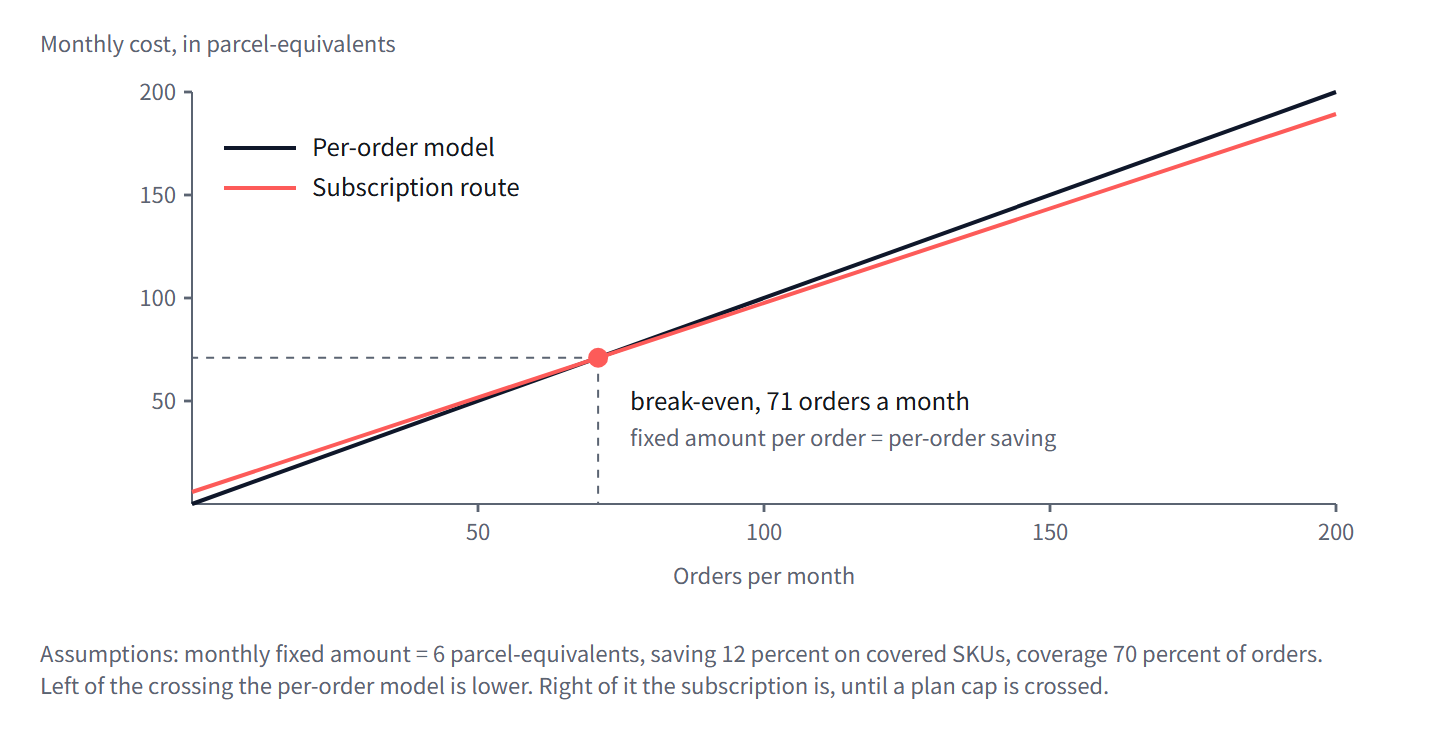
Let P be the monthly subscription expressed in parcel-equivalents. Let s be the fractional saving per order that the catalogue route gives you on the SKUs it covers. Let N be the orders you place in a month. The monthly cost of the per-order model is N. The monthly cost of the subscription route is P plus (1 minus s) times N. The two are equal when N equals P divided by s.
Four assumptions, each of which you replace with your own figure.
Assume P = 6 parcel-equivalents a month. That is, the monthly subscription costs what six typical orders cost to fulfil. Read it off the vendor's current pricing page and divide by your own typical fulfilment cost.
Assume s = 0.12. The catalogue route saves 12 percent of the per-order fulfilment cost on the SKUs it covers, through a better source price or cheaper freight.
Assume coverage = 0.70. Seven out of ten of your orders are for SKUs the catalogue can supply; the rest have to be sourced outside it.
The effective saving per order is 0.12 multiplied by 0.70, which is 0.084. The break-even order count is 6 divided by 0.084, which is 71.4, so call it 71 orders a month.
| Orders in the month | Per-order model: Lovegodrop | Subscription route: Zendrop | Which is lower | Fixed amount per order |
|---|---|---|---|---|
| 20 | 20.0 | 6 plus 18.3, or 24.3 | Per-order, by 4.3 | 0.30 |
| 40 | 40.0 | 6 plus 36.6, or 42.6 | Per-order, by 2.6 | 0.15 |
| 71 | 71.0 | 6 plus 65.0, or 71.0 | Equal | 0.084 |
| 120 | 120.0 | 6 plus 110.0, or 116.0 | Subscription, by 4.0 | 0.05 |
| 300 | 300.0 | 6 plus 274.8, or 280.8 | Subscription, by 19.2 | 0.02 |
The last column is the one to look at. The fixed amount, spread over the month's orders, falls as volume rises, and the row where it equals the per-order saving is the break-even row.
Now add the cap. Assume the plan covers up to 100 orders a month at P = 6, and that the next tier costs P = 12 with the same saving. At 120 orders, the subscription route now costs 12 plus 110, or 122, against 120 for the per-order model, and the verdict reverses. Crossing a tier is not a smooth event, and a merchant who grows past a cap without recomputing will find the subscription has become the expensive option again.
One more correction, for anyone whose sales are seasonal. Because both sides are linear in the number of orders, the break-even depends on the total across the year and not on how the orders are spread. A merchant with 600 orders concentrated into eight selling months and a merchant with 600 spread across twelve are at the same point in the model. What the spread does change is the visibility: in a month with no orders, the subscription carries six parcel-equivalents and the per-order model carries nothing, and four of those months a year is a real line in the accounts whether or not the annual arithmetic still favours it.
Product-first, and what the catalogue subscription is really buying
The entry point argument from the other comparison pages applies here, and it is what the subscription is priced against.
A subscription catalogue is product-first. The merchant opens the catalogue, filters by category and margin, and pushes the chosen products into the store. The catalogue does the discovery work, and the monthly amount is the price of that discovery being available on demand. For a merchant whose problem is what to sell next, this is a genuine service and it is worth paying for.
Per-order sourcing is order-first. It needs something to source: a sold line item, a product page, a photo, a keyword. A merchant with no products and no orders gets nothing from it, and that is a real limitation rather than a talking point.
The important consequence sits between the two. A product-first catalogue can only supply what it lists. When a merchant wants a product that the catalogue does not carry, three things can happen: the merchant substitutes a similar product from the catalogue, the merchant abandons the idea, or the catalogue offers a sourcing path outside it. Verify which of the three applies and what the outside path costs, because that row of the model decides the coverage figure in the break-even above.
Coverage is the variable that merchants overestimate. It is easy to believe that a catalogue covers most of your business when you are browsing it, and much harder to sustain that belief after you have gone through your top thirty SKUs line by line. The audit procedure on the DSers page takes twenty minutes and it is the same audit.
There is one thing the catalogue model does that a sourcing relationship structurally cannot: it makes the product decision fast. Choosing from a shortlist is quicker than evaluating candidates, and for a merchant who wants to add twenty products this quarter, that speed has a value the arithmetic above does not capture.
When a subscription is the rational choice
Three conditions make the fixed monthly amount a good buy, and a fourth that has nothing to do with the arithmetic.
The first is predictable volume. A subscription converts an uncertain per-order cost into a known monthly one, and the value of that is highest when you can forecast your order count. If you know you will place around three hundred orders a month for the next quarter, the fixed amount spread across them is small and the planning benefit is real.
The second is heavy use of one catalogue. If the catalogue covers most of your orders, then the saving s applies to nearly all of them, and the coverage correction in the break-even barely moves the answer. The subscription is priced for that merchant, and that merchant should buy it.
The third is the surrounding tooling. Branded invoicing, a support function, a returns flow and a single place to manage it all reduce the number of systems a merchant operates. If those are the things you would otherwise build or buy separately, the subscription bundles them, and the bundle is worth more than the catalogue alone.
The fourth is a preference: some merchants would rather pay a known amount and stop thinking about it. That is a legitimate reason and it does not need to be justified by arithmetic. A fixed cost you have stopped noticing is a fixed cost that no longer costs you attention, and attention is the scarce input in a small operation.
If three of those four describe you, a catalogue subscription is the rational buy and Zendrop's model is the one to buy. If none of them do, and your volume is uneven, the per-order structure fits the shape of the business better, and forcing a subscription onto it does not.
Decide in four steps
- Write down your average orders per month over the last twelve months, not the last one. Artefact: one number, and it should be the average, because a single good month distorts the answer.
- Compute the coverage figure: the share of those orders that the catalogue you are considering can actually supply today. Do this by hand, on your top thirty SKUs, and not by browsing.
- Read the monthly fixed amount off the vendor's page and divide it by your own typical fulfilment cost for one order. That gives you P in parcel-equivalents, and it is the only conversion you need.
- Compare your average monthly orders against P divided by the effective saving. Above it, the subscription is the lower-cost structure; below it, and by a margin that matters at low volume, the per-order model is.
| Your situation | The structure that costs less | Why |
|---|---|---|
| Fewer than 50 orders a month, spread across a wide catalogue | Per-order sourcing | The fixed amount is spread over too few orders to fall below the saving |
| 50 to 150 orders a month, catalogue coverage above two thirds | Recompute with the break-even formula | This is the band where the answer flips, and it flips on coverage |
| Over 200 orders a month, coverage high, volume stable | The subscription | The fixed amount per order is small and the tooling is included |
| Seasonal, with whole months at zero orders | Per-order sourcing | The empty months carry the fixed amount and produce nothing to spread it over |
| Wide catalogue sourced outside any single catalogue | Per-order sourcing | Coverage is low, so the effective saving collapses |
The second row is where most merchants actually sit, and it is the reason the formula is worth doing rather than a rule of thumb.
What to verify in a trial of either
A month-long trial only tells you something if you measure the same things on both sides.
- Place the same ten orders through each route, using SKUs you actually sell, and record the goods figure and the freight figure separately. Artefact: a two-column sheet with one row per order.
- Record when the freight figure was produced on each side: at selection, or after the parcel was weighed and measured.
- Ask each side what happens to the difference if the prepaid freight exceeds the measured freight. Refunded automatically, refunded on request, or retained.
- Test one product that the catalogue does not carry, and record how many days the outside path takes and what it costs as a share of the order.
- Test one month with no orders, or read the plan terms closely enough to know what that month would have cost.
- Time the handling. Count the minutes you spend per order on each route, including the sourcing conversation, and multiply by your monthly order count.
The third step is the one that separates the structures, because it tells you who carries the risk of a wrong estimate. The sixth is the one merchants never do and always regret skipping, because the handling time is where a per-order model either wins or loses.
よくある質問
Is a subscription always worse at low volume?
Not always, only on the arithmetic. At low volume the fixed amount per order is high, but if the catalogue saves you more than that per order, or if the tooling is work you would otherwise pay for separately, the subscription can still be the better buy. Compute P divided by the effective saving before deciding.
What is the single number I should get first?
Your average orders per month over a year. Everything else in the calculation is a ratio against it, and a single busy month will otherwise tell you the wrong story.
Does per-order sourcing have any fixed cost at all?
No subscription, no minimum quantity and no sourcing fee. Storage is included for 90 days.
What happens in a month when I sell nothing?
Under a subscription, the fixed amount is still carried. Under per-order sourcing, nothing is carried, because no purchase is made and no freight is quoted.
How do I compare two vendors, one of which does not publish a fixed amount?
Convert everything into parcel-equivalents. Express the monthly amount as a count of your own typical orders, and express the saving as a fraction of the fulfilment cost. Both sides then sit on one scale without any currency.
今週やること
- Pull your order counts for the last twelve months and write the monthly average at the top of a sheet.
- Take your top thirty SKUs by order count and mark which ones a catalogue you are considering can supply today.
- Convert the monthly fixed amount into parcel-equivalents by dividing it by your typical fulfilment cost per order.
- Compute the break-even order count and write it beside your average. The two numbers answer the question.
- Place one identical order through each route and record when the freight figure was produced on each.
Lovegodropのソーシングチームが執筆・管理しています。このページの作成と検証方法.
まずは販売済みの注文から始める
ShopifyまたはWooCommerceストアを接続し、支払い済みの注文を1件選ぶと、コミットする前にその注文の調達・配送見積もりを確認できます。