
Lovegodrop vs AutoDS:自動化プラットフォーム vs 調達オペレーション
片方は既に発送先のある注文を自動化。もう片方はその発送先を見つける。両方重要で、導入順序が結果を決める。
要点
- An automation platform optimises a purchase it can already address; a sourcing operation finds the address.
- Honest third column: we do not monitor supplier listings, and we do not reprice. Those are the platform's functions, not ours.
- Automation multiplies your supply quality in both directions: it scales a good supplier and it propagates a bad one.
- The platform is the better fit with many SKUs, thin margins per SKU, and a catalogue that lives entirely in the suppliers it can reach.
- Three checks tell you whether a supplier connection is real or a redirect: push an unlisted SKU, ask for post-packing freight, and ask who holds the goods.
One watches listings, the other owns the warehouse
Your repricing rules are working. Your listings are being monitored four times a day, and the orders are being pushed without you touching them. The problem is that two of the suppliers behind the monitored listings have stopped shipping, and the automation has no opinion about that.
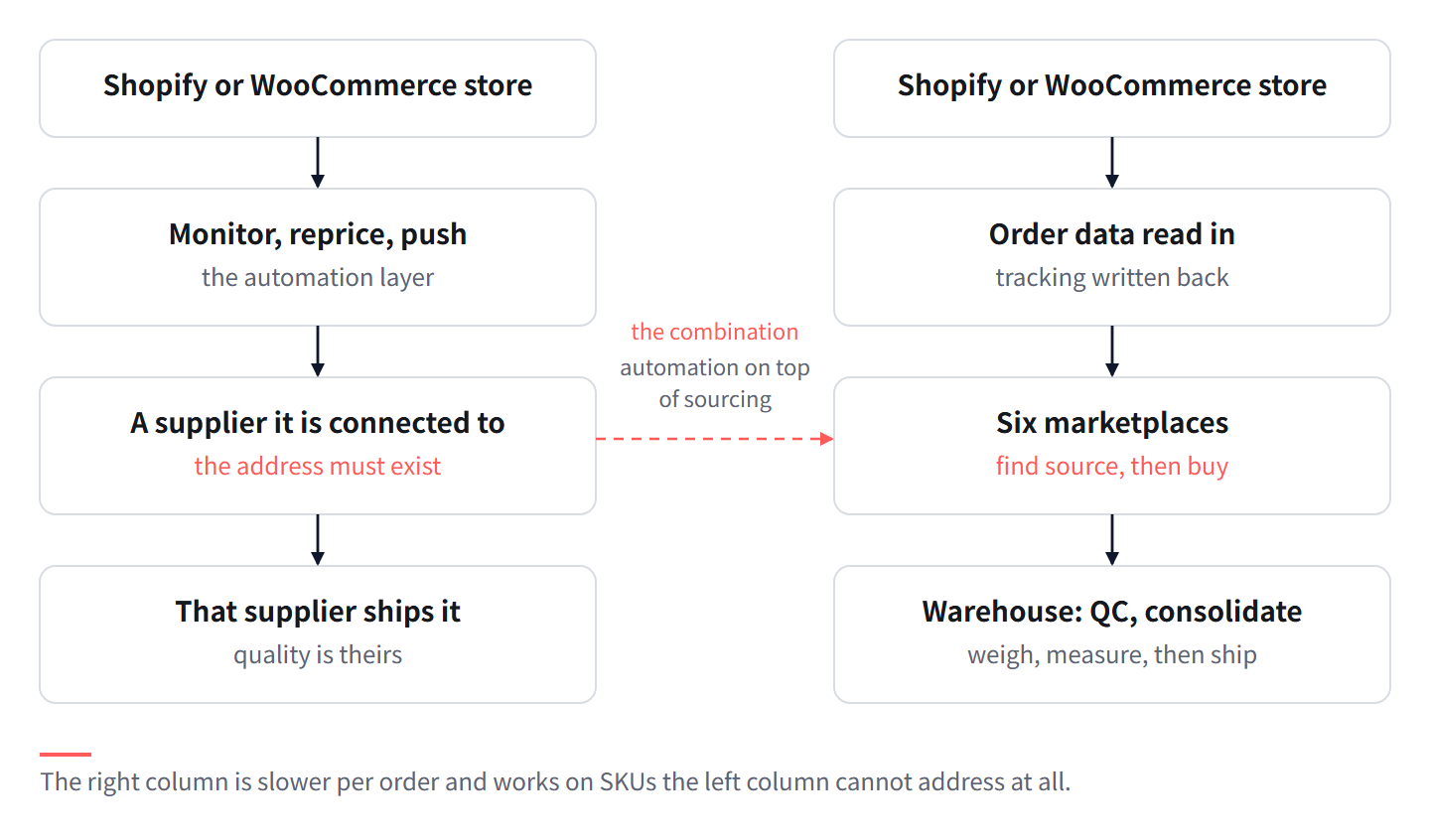
AutoDS is an automation layer. It watches the listings in your store, adjusts their prices against rules you set, and pushes the resulting orders to the suppliers it is connected to. Lovegodrop is a sourcing operation: we find the item on 1688, Taobao, Weidian, Yupoo, Xianyu or Dewu, buy it, hold it, inspect it, consolidate it, and ship it.
These are not the same kind of thing, and the comparison that matters is not which one wins. It is what each one needs in order to function.
The automation layer needs an address. It needs a supplier listing that exists, that it can reach, and whose price and stock it can read. When those three things hold, it is the most efficient instrument in this category, and nothing else comes close on handling time.
The sourcing operation is what produces the address when one does not exist. It takes a photo, a keyword or another store's product page and returns candidates from six marketplaces. Once the goods are bought, they sit in a warehouse where they can be inspected, measured, repacked and consolidated before anything is dispatched.
The failure mode of the first is silence. The automation pushes an order to a supplier who cannot fulfil it, and the first you hear of it is the customer. The failure mode of the second is slowness: a human has to find the goods and another human has to measure the parcel before a freight figure exists. Neither failure mode is an argument against the thing that produces it.
The automation functions, and an honest third column
The table below has a third column that says "not offered" in places. That is deliberate, and a comparison page that hides it is not worth reading.
| Function | AutoDS | Lovegodrop |
|---|---|---|
| Monitor a supplier listing for price and stock | Yes, continuously and at scale | Not offered |
| Reprice your store when the source moves | Yes, by rules you set | Not offered |
| Import a product from a URL | Yes, from the sources it can reach | Route A pushes a marketplace product into your store as a draft or live product |
| Push the order to the supplier | Yes, automated | The purchase is placed at the marketplace, then fulfilled |
| Find a source where none exists | Not the function; it pushes to suppliers it is connected to | Find Source B2, from a photo, a keyword or another site's product page |
| Address 1688, Weidian, Yupoo, Xianyu, Dewu | Verify which marketplaces the platform can reach in your account | All six, natively |
| Quote freight | From the connected supplier | Human sourcing line, after the warehouse weighs and measures |
| QC photos before dispatch | Verify what the connected supplier provides | 3 per item, included |
| Consolidate several orders into one parcel | Depends on the connected supplier | Included |
| Store goods | Depends on the connected supplier | 90 days included |
| Return window on the purchase | Follows the supplier's terms | 7 days on the purchase, before dispatch |
| Write tracking back to the store | Yes | Yes, written to the order |
| Change your store's theme, checkout or apps | Installs as an app in the store | No. Order data is read and tracking is written back; the store is otherwise untouched |
| Relabel and repack | Verify | Included |
Three rows carry the whole comparison.
Published figures, checked 2026-11. AutoDS's published plans (as listed in third-party reviews, checked 2026-11): Import $26.90, Starter $39.90, Advanced $66.90–$69.90 per month, billed per sales channel with Amazon-channel plans priced higher, and a $1 trial. On this side: no subscription and no sourcing fee, 90 days of included storage, three free QC photos per item before freight is approved, and goods at the marketplace's live price. One further row no other comparison on this site lists: individual buyers, not only merchants, can also buy through the platform, with or without a store.
The first row is the platform's core competence, and we do not do it. If your business depends on knowing that a supplier's price moved at three in the morning, you need that function, and we are not the place to get it.
The fifth row is ours. When the goods are not addressable, a push has nowhere to go, and the work is to find them.
The seventh row is where the two models meet and it is the row that decides the freight number. A freight figure produced from a supplier listing inherits the listing's claims about weight and dimensions. A freight figure produced after the warehouse has measured the parcel is a measurement, and on our side any amount prepaid above it is returned to you.
Automation multiplies what you already have, in both directions
This is the mechanism, and it can be worked out from your own numbers.
Every input below is an assumption that you replace with figures from your own store. Assume 300 SKUs under monitoring, swept every 6 hours, which is 4 sweeps a day and 1,200 supplier checks a day, or 36,000 a month.
Assume that across your last 100 orders, 4 arrived at a supplier who could not ship them. That is a failure rate of 0.04.
Assume 500 orders a month, that pushing an order by hand takes you 3 minutes, and that the automated push takes 20 seconds.
The time arithmetic: 500 orders by hand is 1,500 minutes, or 25 hours. Automated, it is 167 minutes, or 2.8 hours. The automation saves 22.2 hours a month.
The failure arithmetic: at a rate of 0.04, 500 orders produce 20 failures a month. At 2,000 orders a month the same rate produces 80. Assume each failure takes 15 minutes of support and refund handling: that is 5 hours a month at the lower volume and 20 hours at the higher one.
Net the two: at 500 orders, the automation saves 22.2 hours and costs 5 hours in failure handling, so it is worth 17.2 hours. At 2,000 orders it saves 88.8 hours and costs 20 hours in failure handling, so it is worth 68.8 hours.
Now change one input. Assume the sourcing operation halves the failure rate to 0.02 by moving the twenty worst SKUs onto verified supply. The failure handling at 500 orders falls from 5 hours to 2.5, and at 2,000 orders from 20 hours to 10. The time saved by the automation is unchanged, because it does not depend on the supply.
The conclusion is the shape of the formula rather than the numbers. The automation contributes a saving proportional to your order count. The supply contributes a cost, also proportional to your order count, multiplied by the failure rate. The automation cannot change the failure rate, and the supply cannot change the handling time.
That is what "automation multiplies what you have" means in practice. Scaling a 0.04 failure rate to ten times the volume produces ten times the failures. Scaling a 0.02 rate produces half as many, at the same volume, for the same automation spend.
There is a second multiplier that catches merchants out, and it is the repricing rule. A rule that follows the source price will follow it in both directions, including into a contribution you did not intend. Set the floor as a ratio of the selling price rather than as a number: if your floor is 0.30 of the selling price as contribution after goods and freight, the rule must stop there rather than at a figure you picked once.
Where the automation platform is the better fit
AutoDS is the better answer in four situations, and the first three are about scale.
The first is a large SKU count. Monitoring 300 listings by hand is not a task anyone does. The value of the function grows with the number of things being watched, and below a few dozen SKUs most of that value is unrealised.
The second is thin margin per SKU. When the contribution on an order is thin, a source price move matters, and repricing against a rule is faster and more consistent than repricing by memory. If your margins are thin enough that a supplier's price change decides whether an SKU is worth selling, you need the rule.
The third is a catalogue that lives entirely in the suppliers the platform can reach. If every SKU you sell has an addressable listing, the sourcing problem does not arise, and the automation's advantages come without its limitation.
The fourth is the merchant who wants the lowest possible intervention. Some merchants want to look at their store once a week and not think about fulfilment in between. Automation is the only way to that, and it is a legitimate goal.
None of these are arguments we can win, and we do not try. The right answer for a store with a stable, addressable, wide catalogue is the automation platform, and a merchant in that position should not move.
The combination pattern, and the data each side needs
The combination is real and it works: the automation layer on top, the sourcing operation underneath. What makes it work is a clean interface, and the interface is a set of specific data items.
| What the automation layer needs from the sourcing side | What the sourcing side needs from the automation layer |
|---|---|
| One stable source identity per variant, so a push has exactly one destination | The store variant ID and the SKU mapping, so the right goods are bought for the right variant |
| A goods price signal, even a coarse one, to feed the repricing rule | The destination country and the quantity, before the purchase is placed |
| A stock signal, or an honest statement that no signal is available | The packing instruction, so the parcel is measured against what you asked for |
| A freight basis, however rough, so the repricing floor can be set as a ratio | One named contact for exceptions, so a failed source reaches a human |
| A rule for what happens when a source fails twice | The rule for which orders are consolidated and which travel alone |
Setting it up takes an afternoon, and it is worth doing in this order.
- Freeze the variant list and assign exactly one source identity to each. A variant with two destinations will be pushed twice, and that is the most common way this arrangement fails.
- Draw the line between automated and human: pushing the purchase is automated, quoting the freight is human, because freight depends on packed dimensions and route. Artefact: one written rule stating which steps are which.
- Set the repricing floor as a ratio of the selling price, and write the ratio down where you will see it.
- Write the exception rule: the conditions under which a SKU is pulled from automation and handed to a human. Twice-failed is the usual threshold.
- Run twenty orders through the combined setup and reconcile them one by one, checking that each was sent once and that tracking came back the same way on both sides.
- Review monthly, and move a SKU between the automated and the human line based on what the review shows.
The table's most important cell is the third row on the left. An automation layer that receives no stock signal will happily push an order for goods that do not exist. An honest "no signal available" is more useful than an optimistic one, because the rule can be written to compensate for a known gap and cannot be written to compensate for an unknown one.
Three checks that reveal whether a supplier connection is real or a redirect
A platform may present a supplier it is connected to, or a supplier it redirects to. The difference determines who is accountable when something goes wrong, and three questions separate them.
- Push an order for a SKU that is not in any of the platform's connected catalogues, and watch what happens. A real connection has a mechanism for the unlisted case, even if the mechanism is a sourcing request. A redirect will ask you to go and find the supplier yourself.
- Ask for the freight component to be computed after the parcel is packed, and ask what happens to the difference if the prepaid amount exceeds the measured one. A real connection can answer both parts. A redirect refers you to the supplier's listing.
- Ask who physically holds the goods, where the inspection photos come from, and whether two orders from two suppliers can be consolidated into one parcel. Consolidation across suppliers requires a warehouse someone operates, and it is the question that cannot be answered by a description.
There is a fourth worth adding, because it is the one that matters on a bad day: when the connected supplier goes out of stock, what happens to the open orders in the next hour. Ask for the mechanism, not the reassurance, and ask it before you need it.
The three checks also apply in reverse, and you should run them on us. Ask where the goods are held, ask who measures the parcel, and ask what happens when a candidate we return is rejected. The answers you get in writing are the answers you can plan against.
Decide in four steps
- Count the SKUs whose supplier receives a price or stock signal today. That is the population the automation can act on, and it is usually smaller than the SKU count.
- Compute the failure rate from your own last 100 orders: the number that reached a supplier who could not ship. Artefact: one rate, from your data rather than from anyone's marketing.
- Multiply the rate by your monthly order count to get the failures the automation would propagate, and compare that against the hours it would save you.
- Fix the worst SKUs first if the failure rate is above 0.03, then automate. Automating before that scales the problem rather than the business.
| Your situation | What to add first | What to add second |
|---|---|---|
| Wide catalogue, addressable suppliers, failures under 2 per 100 orders | The automation platform | A sourcing line for the SKUs that fall out |
| Wide catalogue, addressable suppliers, failures above 4 per 100 orders | A sourcing line for the worst SKUs | The automation platform, over the improved supply |
| Catalogue built from Weidian, Yupoo or Xianyu suppliers | The sourcing operation | Automation for monitoring and repricing only, if at all |
| Fewer than 30 SKUs, stable prices, low volume | Neither, yet | Reconsider when the SKU count or the volume justifies it |
| Bulky goods where freight is the deciding cost | The sourcing operation, for measured freight | Automation, once the freight basis is stable |
よくある質問
Can AutoDS and Lovegodrop be used on the same store?
Yes. The automation layer can monitor and reprice across a catalogue while the sourcing operation handles the SKUs with no addressable supplier. The condition is one destination per variant, so no order is pushed twice.
Do you reprice my listings?
No. We do not monitor supplier listings and we do not reprice your store. Those are functions of an automation platform, and if you need them, an automation platform is where to get them.
Why is a freight quote not automated on your side?
Because freight depends on packed dimensions and on the route, and neither is known until the goods exist in a warehouse and have been measured. Marketplace listings routinely understate weight and dimensions, so a figure produced before packing is an estimate with the listing's error in it.
Does automation make a failing supplier visible?
It makes the failure faster and more visible in aggregate, which is useful, but it does not prevent it. A monitored listing that shows in stock when it is not will produce an order the automation pushes confidently and the supplier cannot fill.
What is the first thing to move if my failure rate is high?
The SKUs producing it. Compute the rate per SKU rather than across the store, because a store-wide rate of 0.04 is often two or three SKUs at 0.20 and the rest at zero. Move those first and the average follows.
今週やること
- Take your last 100 orders and count the ones that reached a supplier who could not ship them.
- Compute the rate per SKU, not across the store, and list the three SKUs producing the most failures.
- Push an order for a SKU that is not in any connected catalogue, through whichever platform you use, and record exactly what happens.
- Ask where the goods are held and who measures the parcel, in writing, of any supplier connection you depend on.
- Set the repricing floor as a ratio of the selling price, if you have not already.
Lovegodropのソーシングチームが執筆・管理しています。このページの作成と検証方法.
まずは販売済みの注文から始める
ShopifyまたはWooCommerceストアを接続し、支払い済みの注文を1件選ぶと、コミットする前にその注文の調達・配送見積もりを確認できます。