
Lovegodrop مقابل Syncee: تغذيات موزعين أم توريد من المتاجر
A feed can only route what some supplier published. التوريد من المتاجر الإلكترونية can attempt what merely exists. Which one matters depends on your orders.
أبرز النقاط
- A distributor feed routes what suppliers published; marketplace sourcing attempts what exists on six Chinese marketplaces, including sellers who publish no feed at all.
- The useful split is availability versus listing. Most of 1688 and nearly all of Yupoo and Weidian are available but unlisted.
- Lovegodrop binds a source to a variant you already sell, so the delisted SKU keeps its page, reviews and sales history.
- A feed is genuinely better at large-catalogue price and stock sync, at brand-supplied assets, and at authorised-reseller relationships.
- Run the order-weighted coverage test on your last 90 days before deciding; SKU counts hide the problem and order lines expose it.
What a feed is, and what it quietly decides for you
A supplier moved prices on Friday afternoon. Your store sold eleven units of that SKU at the old price over the weekend, and those eleven orders need goods by the middle of the week or they need refunds. At that moment the useful question is not which service has the better interface. It is whether anything in your stack can still buy that item.
Syncee runs distributor feeds: suppliers publish product data into it, you import rows from that data into your store, and price and stock updates flow afterwards. Lovegodrop sources from six Chinese marketplaces, 1688, Taobao, Weidian, Yupoo, Xianyu and Dewu, and buys what you point us at or what we find for you.
The difference is what has to exist before anything can happen. With a feed, a product must be published into the file before it can be routed, so what you can sell is the subset some supplier chose to publish and to keep publishing. With marketplace sourcing, no third party has to publish anything, so what you can sell is closer to what actually exists.
Availability and listing are not the same thing, and once you separate them most of this page falls into place. A product can be available and unlisted, which covers most of 1688 and effectively all of Yupoo and Weidian, because those sellers run shop pages and photo albums rather than feed files. A product can also be listed and unavailable, when a row claims stock while the supplier behind it has gone dry and has not pushed an update.
If you are building a catalogue from nothing, availability and listing nearly coincide and the distinction costs you nothing. If you are holding eleven paid orders for something that has no row anywhere, the distinction is the entire problem.
Three consequences follow, and they are the ones merchants discover late.
The first is what you must do to rescue a SKU that is already selling. If fulfilment depends on a row, the repair is to find another row. If fulfilment depends on a purchase, the repair is to find the goods, and the store page never moves.
The second is whose commercial relationship you are inside. With a published row, the supplier sold to you through their channel and their terms govern the purchase. With marketplace sourcing, we purchase at the marketplace on your behalf, you approve the goods payment to start it, and you approve the shipping payment separately after the warehouse has weighed the parcel.
The third is whose data discipline you inherit. A feed row is whatever the supplier exported. A marketplace purchase is a fresh transaction each time, with its own QC photos.
Feed coverage, outside-the-feed sourcing, variants, who buys
Read the middle column as what to verify on the Syncee side, because supplier participation and integration depth change. Read the right column as how our service is documented today.
| The question to settle | Distributor feed | Lovegodrop as documented |
|---|---|---|
| What determines catalogue coverage | Which suppliers published a feed and what their integration exports | Six marketplaces: 1688, Taobao, Weidian, Yupoo, Xianyu, Dewu |
| Can a product outside the feed be sourced | No route unless a supplier adds that row; you import a different row instead | Yes. Route B2 takes a photo, a keyword or another site's product page, returns candidates, you pick one |
| Can a variant you already sell be bound to a source | The variant and its row arrive together on import. Ask whether a variant created another way can later be pointed at one | Yes. Route B1 binds the supply link to the existing store variant; the product page is not rebuilt |
| Variant handling | Axes are whatever the supplier exported; combinations outside those axes do not exist as rows | Variants are handled per store variant, including combinations the original seller does not list as a single option |
| Who owns the purchase | The supplier sells to you through their channel; the account and the warranty are between you and them | We buy at the marketplace on your behalf. Goods payment first, then shipping payment after measurement |
| What happens when the row disappears | The store product loses its route; the repair is finding a replacement row | The order still carries the variant; the repair is binding a new source to the same variant |
| What you must maintain | The import mapping, and the assets you overwrote on top of it | Nothing downstream of the store. Each fulfilment is a fresh purchase |
Two rows decide most outcomes. Row two decides the worst day of your month: if a supplier goes quiet on a SKU carrying your volume, the question is whether your fulfilment method has any path to goods nobody published. Row three decides whether a rescue keeps its history. Importing a replacement creates a new page; binding a source to the variant you have keeps the reviews, the sales history and whatever search position that page earned.
Published figures, checked 2026-11. Syncee offers a free tier; their current plan prices are on their pricing page and are not reproduced here (checked 2026-11). On this side: no subscription and no sourcing fee, 90 days of included storage, three free QC photos per item before freight is approved, and goods at the marketplace's live price. One further row no other comparison on this site lists: individual buyers, not only merchants, can also buy through the platform, with or without a store.
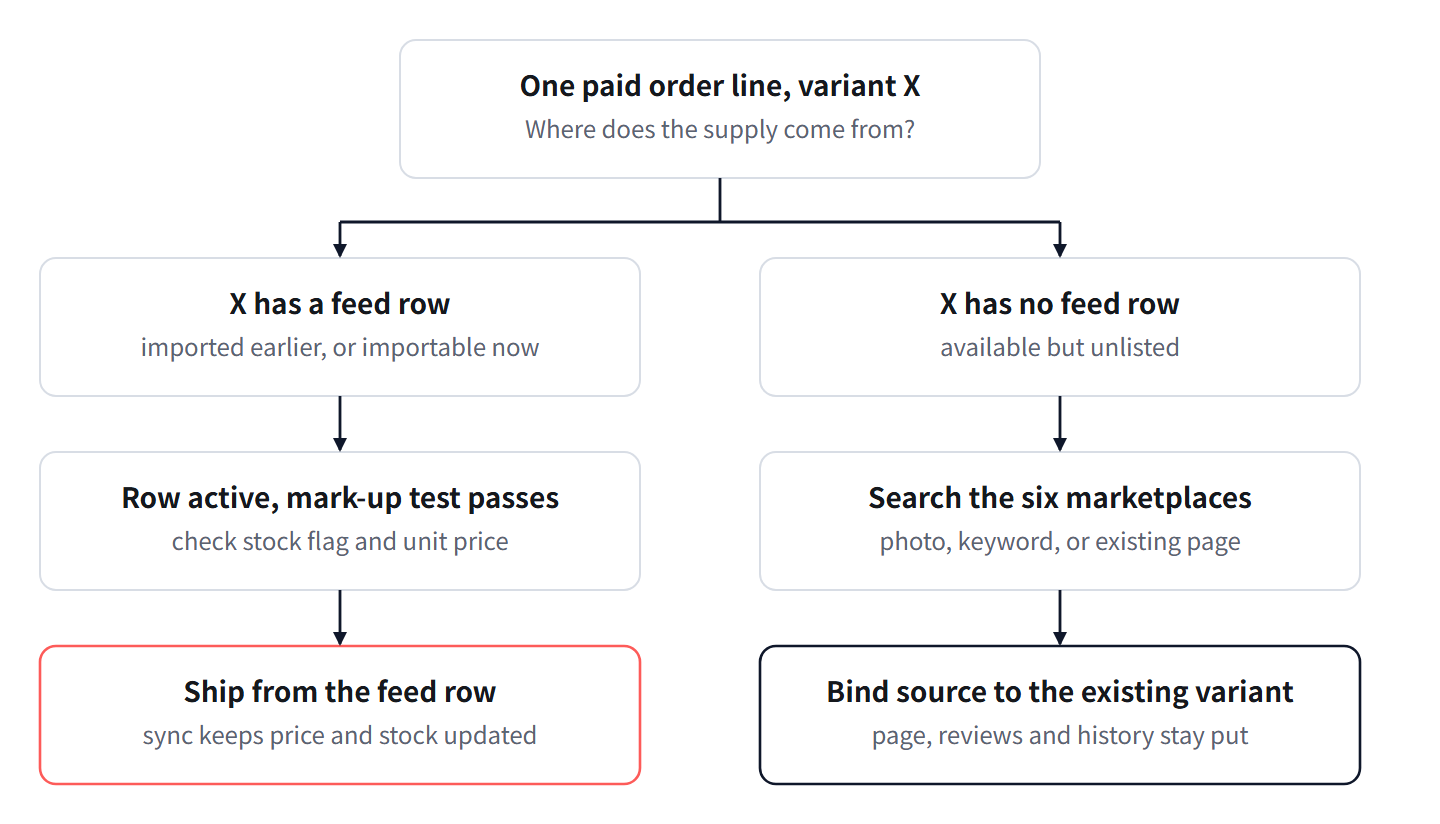
Note the asymmetry in that diagram. The right-hand path does not require you to abandon the left-hand one. Most mature stores run both at once, with a rule attached, and the rule is coverage.
What a feed does to your data, and to your own merchandising work
Every row you import carries the exporting habits of whoever wrote it. Titles come in whatever pattern that supplier uses, some with the size or colour embedded and some without. Descriptions range from a full specification with materials and care instructions to two sentences translated once and never revised. Image sets range from a studio shoot to four phone pictures on a grey floor. Units are inconsistent between suppliers: some rows are priced and described per piece, some per set, and the difference quietly changes every margin calculation downstream.
The practical consequence is that the weakest exporter in your mix sets your cleanup workload. Strong suppliers need nothing. Weak ones need the title rewritten, the description rewritten, the images replaced, the variants rebuilt and the units corrected, and they need it again whenever the supplier pushes an update that overwrites your edits.
The second consequence is internal competition. The same physical product tends to appear under several suppliers in one feed system, with different titles and different images. Import two of them and you have two product pages in one store, splitting reviews, splitting whatever organic ranking each would have earned, and confusing customers who find both.
Against that, there is one advantage you should not argue with. Published rows often come with assets you could not produce yourself: supplier photography shot properly, size charts, material specifications, and certification documents for categories where a certificate has to exist before you can advertise honestly. Getting those from the feed is legitimate, fast and far better than photographing the item in your kitchen.
So the merchandising cost is not uniform, and pretending it is leads to the wrong conclusion. Split your catalogue into two slices.
| Slice | What you do | Why |
|---|---|---|
| Top by order volume, typically the 20 percent of SKUs carrying most lines | Rewrite every inherited field: title, description, variant names, units, images where you can do better | These pages earn the traffic and the reviews. Supplier copy here costs you ranking you would otherwise own |
| The long tail | Accept supplier copy as published, fix only title and unit mismatches | Rewriting all of it costs more than the tail returns |
| Anything you are testing | Accept copy during the test, rewrite only if it survives | Most tests fail, and rewriting failures is pure loss |
The last thing a feed changes is how often you touch price and stock. With a working sync, hundreds of rows update themselves, and that is real work you are not doing manually. It is also worth stating plainly in this comparison: that capability is the strongest argument for staying on a feed, and nothing about marketplace sourcing replaces it. If your operation is hundreds of active rows that all still import cleanly, the arithmetic below barely moves your decision.
Where the feed model wins outright, and when to stay there
Say this for the feed model: if your catalogue is large, mostly covered, and built from rows that suppliers maintain, the outstanding weekly work is pricing and merchandising, and it does this better than we do.
Four situations are honest wins.
Large catalogue, hundreds of active rows. Price and stock updates propagate without anyone touching them. Sourcing per purchase cannot match that, because there is no row to update and no publisher to push changes. If your weekly problem is keeping 600 prices current rather than finding goods, stay where you are.
Brand-supplied assets. Where a supplier publishes photography, sizing data and documentation for resellers, taking it through the feed beats reconstructing it yourself. For anything with a compliance document attached, using the official file is not laziness, it is the correct procedure.
Authorised relationships. Where a supplier needs to know who resells their products, where pricing terms are contractual, where warranty registration runs through serial numbers, the relationship has to be with you. Sourcing from a marketplace does not create that relationship and should not be substituted for it.
Domestic fulfilment. Some publishing suppliers hold stock in the country you sell into, and for stores whose customers expect domestic returns and short delivery windows, that structure answers the question on its own. Nothing about sourcing from Chinese marketplaces competes with inventory already sitting near your customers.
The merchant who should not move is easy to describe: several hundred rows, all still importable, no deliveries outstanding, and a weekly routine of repricing rather than rescuing. Moving that store would trade a solved problem for an unsolved one.
Where a feed stops: four walls
Every model has a boundary, and this one is reached in four repeatable ways. The useful part is knowing which wall you are standing at, because the rescue differs.
| The wall | What it looks like | What it costs you | The test that confirms it |
|---|---|---|---|
| Available but unlisted | The product is on 1688, or in a Weidian shop or a Yupoo album, and no supplier ever published a row | No route at all. The store page takes money for something nothing can fulfil | Send the product page or a photo to a sourcing line. Candidates coming back means you hit this wall |
| Listed but dry | The row exists and shows stock, and the supplier's own channel cannot supply it | Orders route to a purchase that never happens, and you find out when nothing ships | Order it once through the row and once from the marketplace, and compare which one ships |
| Variant outside the exported axes | The colour or size combination you sell is not one of the supplier's rows | Either you drop the combination or you sell something the row does not describe | Compare your variant list against the row's variant list; note every line that does not match |
| Price moved under you | The row updates and the economics of a live product change overnight | Margin on every future unit, silently | Record the row price weekly for your top ten SKUs and note every change with a date |
The first wall is structural and nothing about a feed will ever fix it, because it requires a seller to publish who has no reason to. The second is a data-freshness problem, and it is the one most merchants misdiagnose, since a row showing stock looks identical whether or not the stock exists. The third is where bundles, kits and made-to-order combinations live, and it is common in apparel and in anything configurable. The fourth is unavoidable anywhere someone else sets the price.
For all four, the question is the same as it was in the opening: can anything in your stack still buy that item, from anyone, this week.
Decide from your last 90 days of orders
Opinions about which model is better are cheap. The order-weighted coverage number is not, and it takes twenty minutes to produce.
| If this is true of your store | Use | Because |
|---|---|---|
| Nearly all recent order lines map to active rows you still have | The feed model | The work ahead is pricing and merchandising, which is what that model automates |
| Some SKUs carry orders and were never in any feed | Sourcing | There is no row to repair. The goods have to be found, not imported |
| Your top SKU was pulled this week and still has paid orders | Sourcing, immediately | Binding a source to the existing variant keeps the page and its history intact |
| You sell combinations no supplier exports | Sourcing | Combinations that are not rows do not exist for a feed |
| You need contractual reseller status or certificates from the brand | The feed model | That relationship has to be between you and the supplier |
| Your catalogue is hundreds of rows and your weekly work is repricing | The feed model | Automated sync beats manual handling at that scale |
| Uncovered lines are under a tenth of your volume | Keep the feed, route exceptions to sourcing | Running both is normal, provided each variant has exactly one source |
That last row is the normal end state, and worth stating carefully. Running two routes at once is safe as long as no variant can route twice. Give every variant one owner and write the rule down, because the failure mode of a mixed setup is not confusion, it is one order shipping twice from two suppliers.
Here is the coverage procedure, which produces the number behind all of that.
- Export every order line from the last 90 days, grouped by SKU, with a line count per SKU. Artefact: the base file, dated.
- Sort by line count descending and keep the top 30. Below the top 30 the line counts are too thin to change a decision.
- For each of the 30, attempt three things in order: find an active row for exactly that variant, find an active row for something acceptable, or fail to find one. Record one of three outcomes, plus a one-line reason.
- Sum the line counts of the failures, and divide by the total line count of the 30. Artefact: the order-weighted uncovered share, as a percentage.
- Compute the same figure on SKU counts rather than line counts, and keep both. The gap between the two numbers is the size of the mistake you would have made by counting SKUs.
- Apply the threshold: under five percent, the feed covers you and exceptions can be handled by hand. Between five and twenty percent, keep the feed and give the exception path real capacity. Above twenty percent, exceptions are now your main operation and should be the basis of the choice.
- Write the number and the date in your operating notes. It drifts, and it does not drift back on its own.
The test that separates a purchase price from a resale price
A number sitting in a feed row can be one of three very different things: the supplier's selling price to you, that price plus handling and a resale margin, or the top tier of somebody's pricing schedule. They look identical in the import screen and behave completely differently in your margin. This test separates them, and it takes one SKU to run.
- Record the feed row's unit price for one specific variant, with today's date. Feed prices move, and an undated number is useless three weeks later.
- Find the same product and the same variant on one of the six marketplaces. Record the single-unit listing price, and record the price at the seller's first published quantity break.
- Express the marketplace figures as a percentage above or below the feed figure. Do this rather than keeping raw numbers, because it lets you compare across SKUs with completely different magnitudes.
- Add freight. On the marketplace route you will not have a freight figure until the warehouse weighs the parcel, so for the first pass use the relationship you have measured on comparable parcels and label it as an assumption.
- Ask whoever publishes the row to state in writing what the number represents: their selling price to you, or a price that already includes their margin and handling. Request the tier structure as well. Artefact: a written answer, or a documented refusal.
- Repeat across five SKUs, ideally across three different suppliers. Artefact: a ratio table with one row per SKU, and a supplier column.
Read the ratios like this.
| Ratio of the feed unit price to the marketplace single-unit price | What it most likely is | What to do |
|---|---|---|
| At or below 1.10 | Close to the published supplier price, plus handling | Keep it. The sync and the assets are worth more than the remaining difference |
| 1.10 to 1.35 | Either a resale margin or the single-unit tier of a lower schedule | Ask which, in writing, then compare landed totals rather than goods-only |
| 1.35 to 1.60 | Probably a reseller sitting above the maker | Source the same item once yourself and measure the landed difference before accepting it |
| Above 1.60 | A chain with more than one participant | Replace the row or renegotiate. Nothing else will close that gap |
Notice what the test does not tell you. A high ratio is not evidence of anything improper; margin for handling, storage, returns and support is legitimate work and deserves paying for. The test tells you what you are buying, so you can decide whether that particular bundle of work is worth the difference for that particular SKU.
One feed line, read out in full
Assumptions, stated before any arithmetic. Take one variant of a hard-goods product that you import from a row and that you have also located on 1688. Express everything as a share of the feed row's unit price, which we call one hundred units only so that no currency enters the calculation. Assume the marketplace single-unit listing price sits eighteen percent below the feed figure, and assume that seller publishes a quantity break at twenty pieces priced a further eight percent below their single-unit price. Assume freight on the marketplace route, measured after packing rather than estimated, comes to eleven percent of the reference figure per unit when units ship singly. Assume nothing about delivery speed.
Feed unit price, as reference: 100.
Marketplace single-unit price: 100 x (1 - 0.18) = 82. The ratio of feed to marketplace is 100 / 82 = 1.22, which puts this row in the second band of the table above.
Marketplace unit price at the quantity break: 82 x (1 - 0.08) = 75.44. The ratio of feed to that tier is 100 / 75.44 = 1.33, still inside the second band but near its top edge.
Landed comparison at one unit, assuming the feed figure excludes outbound delivery and the marketplace side carries it: marketplace total is 82 + 11 = 93, against 100 for the row. The marketplace route is seven percent below the row on a landed basis, and the row was twenty-two percent above it on a goods-only basis. That gap narrowing is the entire reason for doing this in landed terms.
Now take twenty units. Assume consolidation changes the freight picture, because one parcel carrying twenty units has a lower per-unit freight than twenty parcels carrying one each, and assume that brings the per-unit freight down to seven percent of the reference. Marketplace landed per unit becomes 75.44 + 7 = 82.44, against 100. The difference widens to roughly eighteen percent.
Apply the decision rule from the previous section: a difference under about ten percent is smaller than the value of automated price and stock sync, and above it, sourcing the item yourself is worth doing for that SKU. At one unit this row passes. At twenty units it fails. The honest conclusion is not "the feed is expensive" or "the feed is fine"; it is that this row is right for your test volume and wrong for your reorder volume, which is exactly the sort of thing you cannot see without doing the arithmetic once.
Run the same six steps on a SKU where the ratio comes out below 1.10 and you will reach the opposite conclusion just as quickly. That is the point of the procedure: it produces a decision per SKU rather than a preference for the month.
الأسئلة الشائعة
Does an out-of-stock row mean the product cannot be bought?
No. It means that channel is dry. Availability and publication are separate things, and the way to tell them apart is to attempt the item once from the marketplaces using the row's own product page as the reference. If candidates come back, you have learned that your catalogue was smaller than the market for that SKU.
Can both arrangements run against the same store at the same time?
Yes, and this is the common end state. Both read orders and both write tracking back, and neither modifies your theme, checkout or apps. The one hard rule is that each variant has exactly one source, because two sources means one order shipping twice.
Should I import replacements for delisted SKUs or re-source the ones I have?
Re-source them, almost always. Importing creates a new product page and abandons the reviews, the sales history and the search position attached to the page you already have. Binding a source to the existing variant keeps all three and costs you one conversation instead of a rebuild.
Why does freight get quoted after the warehouse weighs things?
Because marketplace listings routinely understate weight and dimensions. A figure produced at product selection inherits whatever the listing claimed. Ours is produced after the parcel is weighed and measured, and any amount prepaid above the measured figure is returned to you.
How many of my SKUs need to be covered before I leave a feed?
Count order lines rather than SKUs. Below five percent of recent order lines uncovered, a feed is doing its job and exceptions can be handled one at a time. Above twenty percent, exception handling is your operation, and the model you choose should be built around it.
ما يجب فعله هذا الأسبوع
- Export your last 90 days of order lines grouped by SKU, keep the top 30, and compute the order-weighted uncovered share. It takes twenty minutes and it is the only number that decides anything here.
- Take your three highest-volume rows and run the mark-up test on each, recording every ratio with today's date.
- Pick your worst delisted SKU and send its product page or a photo to a sourcing line, then compare what comes back against the row you were using.
- Rewrite the merchandising fields on your top five SKUs by order volume, and leave the tail alone.
- Write down which variant routes through which method, so no order can ever ship twice.
كتبه ويحافظ عليه فريق التوريد في Lovegodrop. كيف تُكتب هذه الصفحات وتُدقَّق.
ابدأ بطلبية سبق أن بِعتها
اربط متجر Shopify أو WooCommerce، واختر طلبية مدفوعة، وشاهد عرض الشراء والشحن لتلك الطلبية تحديدًا قبل أي التزام.