
Lovegodrop مقابل Spocket: موردون غربيون أم متاجر صينية
جغرافيتان للتوريد. اختيارك يحدد تشكيلة منتجاتك ووعد التسليم وسقف ما سيدفعه المشتري.
أبرز النقاط
- A domestic network and a marketplace source are not two suppliers of the same catalogue. They are two different product ranges.
- The domestic lane supports a short delivery promise and a higher retail ceiling. The marketplace lane supports a longer promise and a lower landed share.
- The ceiling ratio is the whole calculation: what a buyer pays for the same item falls as the promise lengthens.
- The domestic route is the better answer when short delivery is the product, when you do not want sourcing work, and in categories where a domestic wholesale supply exists.
- Some products only exist in the Chinese marketplaces. For those, there is no decision to make.
Two sourcing geographies, two kinds of store
Your product page promises delivery inside a week. The customer is in the same country as your supplier, so the parcel would arrive in two days if the goods came from there, and yours will be on a plane. Which of those two stores you are running decides this comparison before a single feature does.
Spocket sources from suppliers based in or near the buyer's market, in the United States and Europe for the most part; verify the current network for the region you actually sell into. Lovegodrop sources from six Chinese marketplaces: 1688, Taobao, Weidian, Yupoo, Xianyu and Dewu.
That is not a difference in supplier quality. It is a difference in range, and it produces three consequences at once.
The first is what you can sell. A domestic wholesale network carries what that network's suppliers stock, which is a real, useful, finite list. The Chinese domestic market sells things that have no Western wholesale equivalent, and it sells them at prices that reflect a different cost base.
The second is what you can promise. A domestic leg is shorter than an international one, and the promise on your shipping page has to be one you can keep with the geography you chose.
The third is the ceiling on the price. A buyer pays more for the same item when it arrives sooner, and that difference is a ratio you can put a number on. It is the calculation this page spends the most time on, because it is the one merchants get wrong in both directions.
The consequence merchants misjudge is the second. A short promise is a product feature, and it is worth more than most of the margin arithmetic suggests, because it changes conversion as well as price.
What each can and cannot source
| A domestic supplier network: Spocket | Six Chinese marketplaces: Lovegodrop | |
|---|---|---|
| Where the supplier sits | In or near the buyer's market; verify the network for your region | In China, with goods held in a warehouse there |
| Typical categories | Home, beauty, apparel, pet and general merchandise with a domestic wholesale supply behind it | Everything the Chinese domestic market sells, including categories with no Western wholesale equivalent |
| Can a product outside the network be sourced? | The network is the catalogue. Verify whether an outside request is available and what it costs | Yes. A photo, a keyword or another site's product page is the standard input |
| What happens with a branded item | A genuine branded product needs a reseller authorization before you list it, and the suppliers in the network generally require one | The same authorization question applies to any genuine branded product. A product built to the same specification as a branded item is available in the marketplaces, and the decision to list it, and the listing risk, sit with you |
| What a Yupoo album gets you | Nothing to import | A Find Source request |
| Who holds the goods | The individual supplier | We do, in the warehouse |
| The freight leg | A domestic one, from the supplier to the buyer | An international one, across 24 routes in postal, commercial express and dedicated line |
| Consolidation across sellers | Usually not, because the sellers are separate businesses | Included |
| Storage | Not part of the arrangement | 90 days included |
| Freight measured when | Varies by supplier; verify | After the warehouse weighs and measures the parcel |
| Inspection before dispatch | Verify what the supplier provides | 3 QC photos per item, included |
The third row is the one that decides most of it. A network is a closed catalogue by construction, and that is what makes it fast to shop. A set of marketplaces is open, and that is what makes it slow to shop and able to produce anything.
Published figures, checked 2026-11. Spocket's plans (third-party reviews, 2026) run from roughly $24 to $99 per month on top of a free tier, priced for EU/US supplier access. On this side: no subscription and no sourcing fee, 90 days of included storage, three free QC photos per item before freight is approved, and goods at the marketplace's live price. One further row no other comparison on this site lists: individual buyers, not only merchants, can also buy through the platform, with or without a store.
The fourth row is the one merchants should read before they list anything. The authorization question is identical in both lanes, because it is a legal question about someone else's trademark and not a question about where the goods came from. Where the two lanes differ is on a product built to the same specification as a branded item: the domestic network will not carry it, and the marketplaces will. What a merchant does with that availability is their decision, and the listing risk is theirs.
The seventh row is the one that sets the store's promise. It is a mechanism, not a guarantee, and the promise on your shipping page should be derived from it rather than from what you would like to be true.
The margin structure, in ratios
Here is the calculation that the geography actually turns on. Every input is an assumption, and the one that matters most is the one you have to estimate yourself.
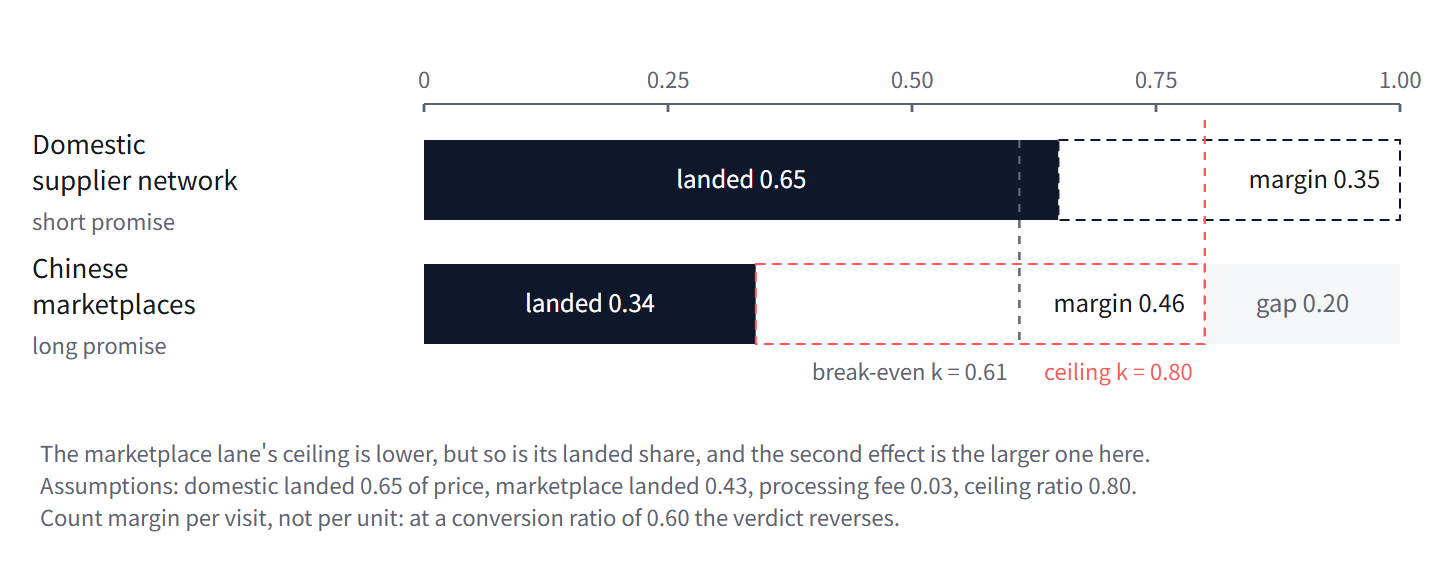
Assume the same product, sold in both lanes. Assume a buyer will pay 1.00 for it under a short delivery promise and 0.80 under a long one. Call that ratio k. It is the single input the result turns on, and it is yours to estimate, not ours to publish.
Domestic lane. Assume the goods share is 0.55 of the selling price and the freight share is 0.10. Landed is 0.65, and the margin at the short-promise ceiling of 1.00 is 0.35.
Marketplace lane. Assume the goods share is 0.18 of the selling price, the freight share is 0.22, and the processing fee is 0.03. Landed is 0.43 of the selling price. At the long-promise ceiling of 0.80, landed is 0.43 multiplied by 0.80, which is 0.344, and the margin is 0.456.
Compare: 0.456 against 0.35. The marketplace lane leaves 30 percent more margin per unit, at least on this arithmetic.
Now find the break-even. The marketplace margin is (1 minus 0.43) multiplied by k, which is 0.57k. Setting that equal to the domestic margin of 0.35 gives k = 0.61. Above 0.61, the marketplace lane wins on margin per unit; below it, the domestic lane does.
Then apply the correction that merchants skip. A long promise converts differently from a short one, and margin per unit is not margin per visit.
| Willingness to pay at the long promise (k) | Conversion rate at the long promise, relative to short | Marketplace margin per unit | Marketplace margin per visit | Domestic margin per visit | Which lane wins |
|---|---|---|---|---|---|
| 0.90 | 0.90 | 0.513 | 0.462 | 0.350 | Marketplace |
| 0.80 | 0.80 | 0.456 | 0.365 | 0.350 | Marketplace, narrowly |
| 0.80 | 0.60 | 0.456 | 0.274 | 0.350 | Domestic |
| 0.70 | 0.70 | 0.399 | 0.279 | 0.350 | Domestic |
| 0.61 | 0.80 | 0.350 | 0.280 | 0.350 | Domestic, because of conversion |
The last two columns are the ones to read. The marketplace lane wins on margin per unit across most of the table and loses on margin per visit across much of it, and the conversion ratio is what flips it.
The honest conclusion is that the two effects are close to cancelling in a realistic range. A merchant who counts only the margin per unit and switches will be surprised by the traffic conversion, and a merchant who counts only the conversion and stays will be surprised by how much the landed share differs. Both numbers have to be in the same sheet.
Where the domestic route is the better answer
Spocket is the better answer in three situations, and the first is the one that decides the others.
The first is when short delivery is the product. Some stores sell the promise more than the item: a gift that has to arrive by a date, a replacement part a machine is waiting for, a category where the buyer is comparing your delivery estimate against a shop down the road. In that store, a domestic source is the point, and a cheaper international one is a downgrade of the thing being sold.
The second is when you do not want to do sourcing work. A network presents a catalogue with prices and a freight basis attached, and the merchant's job is to choose. A marketplace route asks the merchant to find, evaluate and sometimes reject candidates. Both are real work, and the network asks for less of it.
The third is brand-safe categories. In categories where a genuine branded product is the inventory and a reseller authorization is the normal arrangement, a domestic supplier network operates inside that frame and a marketplace route requires the merchant to police it. If you are selling branded goods through a proper authorization, the domestic lane fits the way that business is structured.
There is a fourth worth stating plainly: a merchant whose customers are in a single country and whose expectations were set by that country's retailers. Meeting an expectation you did not create is expensive to decline, and a domestic supply is the simplest way to meet it.
Where the Chinese-marketplace route is the only option
There are products for which this is not a choice, and they are more common than the comparison framing suggests.
The first is a product that exists only in the Chinese domestic market. Categories with no Western wholesale equivalent, products built for a domestic buyer, and anything sold through a Weidian shop or a Yupoo album fall in here. There is no domestic network listing to compare against, because no domestic supplier stocks it.
The second is a product you found on someone else's store and want to sell. The route from a competitor's product page to a source runs through the marketplaces, and it does not run through a Western supplier network.
The third is price-sensitive volume goods where the landed share decides whether the SKU is viable at all. The arithmetic in the third section shows why: a goods share of 0.18 against 0.55 is a difference in kind, not in degree, and on a SKU where the retail ceiling is fixed by the market, it is the difference between a viable listing and no listing.
The fourth is consolidation. If you sell across many sellers and you want one parcel to arrive, the goods have to be in one warehouse first. A network of independent domestic suppliers does not offer that, and a warehouse operation does.
The fifth is holding stock. If your model depends on buying ahead, holding units, and shipping from inventory, the 90 days of included storage on our side is the mechanism, and a per-supplier arrangement is not.
None of this makes the marketplace route better in general. It makes it the only route for a specific set of products, and recognising which of your SKUs sit in that set is the useful work.
Decide by the delivery promise your store makes
The decision keys on the promise, because the promise is what the buyer is paying for and everything else adjusts to it.
- Write down the delivery promise your store makes today, as it appears on the page, not as you intend to rewrite it. Artefact: one sentence, in your own words.
- Classify it as short, medium or long against what the two geographies can actually support.
- For each of your top ten SKUs, write whether the product exists in a domestic network at all.
- Compute the ceiling ratio for one representative SKU, using the arithmetic above, and count the conversion correction.
- Match the promise to the geography. If they conflict, change the promise before you change the supplier, because a promise you cannot keep costs more than a margin point.
| What your store promises | Where to source | Why |
|---|---|---|
| Short, measured in a handful of days | A domestic supplier network | An international leg cannot be compressed into that, and a promise you miss becomes refunds and disputes |
| Short, for a category that only exists in the marketplaces | Neither, as stated. Change the promise or the product | This is the row merchants get stuck on, and it is a genuine conflict rather than a trade-off |
| Medium, measured in weeks | Either; decide with the ceiling arithmetic | Both lanes can keep a promise of this length |
| Long, or deliberately undefined | Six Chinese marketplaces | The domestic premium buys speed you are not selling |
| Nothing stated at all | Fix the promise first | Every calculation downstream depends on it, including this one |
The second row is where the most time gets wasted. A merchant who wants a short promise and a marketplace-only product is asking for two things that cannot both be true, and the resolution is a business decision about what the store is, not a sourcing decision.
The fifth row is more common than it sounds. Stores that never state a delivery window are deferring the decision to the customer, and a stated window, even a long one, converts better than an absent one.
What to test in the first month with either
The first month should produce evidence, not impressions.
- Buy your own product twice, once in each lane if you are testing both, and record the date of the order and the date of arrival. Artefact: two rows in a sheet with the interval between them.
- Record the freight basis for each: what was quoted, when it was measured, and whether it changed after packing.
- Ask who holds the goods and where, in writing, of whichever supplier you are testing. The answer tells you what consolidation and inspection are possible.
- Test one product that is not in the network or the catalogue you are evaluating, and record what the outside path costs as a share of the selling price.
- Measure the interval in step 1 against the promise on your own page, and write down the difference. If the promise is shorter than the evidence, change the promise.
- Record how long a support question takes to get a substantive answer on each side, in hours rather than in impressions.
Steps 1 and 5 belong together, and they are the two that change how the store reads. A promise you have evidence for is a marketing asset; a promise you have not tested is a liability you have written yourself.
الأسئلة الشائعة
Are the two mutually exclusive?
No. Many stores run both: domestic suppliers for the SKUs where speed is the product, and marketplace sourcing for the ones with no domestic equivalent. The split is per SKU, and the promise on each product page has to match the lane that SKU uses.
Is the marketplace lane always cheaper on goods?
It is usually lower on the goods share, which is different. The goods share in the worked example is 0.18 against 0.55, but the marketplace lane adds an international freight leg and a second payment. Compare the landed share, not the goods price.
Can I source a branded product through either route?
The authorization question is the same in both and it comes first. A genuine branded product needs the right to sell it, wherever it is bought. A product built to the same specification as a branded item is a different matter, and it is available in the marketplaces and not in a domestic network.
What is the one number I should estimate before deciding?
The ceiling ratio k: what a buyer will pay for the same item under the longer promise, as a fraction of the short-promise price. Every other input in the arithmetic is measurable; that one is a judgement, and it moves the answer.
Does a domestic source remove the freight problem?
It changes it. A domestic leg is a different mechanism from an international one, and it still has a chargeable weight and a route. Ask when the freight is measured in whichever lane you use.
ما يجب فعله هذا الأسبوع
- Copy the delivery promise off your own shipping page into a document, word for word.
- Take your top ten SKUs and mark which ones have a domestic supplier at all.
- Buy one of your own products and record the order date and the arrival date.
- Compute the landed share for that SKU in the marketplace lane and compare it against your current arrangement.
- Change the promise on the page if the evidence from step 3 does not support it.
كتبه ويحافظ عليه فريق التوريد في Lovegodrop. كيف تُكتب هذه الصفحات وتُدقَّق.
ابدأ بطلبية سبق أن بِعتها
اربط متجر Shopify أو WooCommerce، واختر طلبية مدفوعة، وشاهد عرض الشراء والشحن لتلك الطلبية تحديدًا قبل أي التزام.