
运费估算为什么错了、该怎么办
你定价之后仍会有六件事改变运费估算。哪些可控,以及报价偏高时的处理流程。
要点
- Six drivers: actual weight, packed dimensions, route substitution, remote-area classification, seasonal capacity surcharges, consolidation assumptions.
- Ranked by frequency and by movement, dimensions and weight are the frequent ones and route substitution moves the rate itself.
- An estimate is for deciding whether to sell the product. A quote is for deciding whether to approve the shipment.
- When the measured amount is below the prepayment, the difference is returned. Replace your planning figure with the measured one.
- Price freight into the retail price at the planning figure plus a margin, and revise the figure every time a parcel is measured.
You quoted a customer on a number nobody had measured
A customer buys, you approve the goods payment, and the shipping quote comes back materially above the figure you had in your head when you set the retail price. The margin on that order is gone. Worse, you may have already told the customer what shipping would be.
The quote is not wrong. The number you had in your head was produced before anyone had touched the parcel, from a marketplace listing that understates weight and dimensions as a matter of course. This article separates the two kinds of number, lists the six things that move between them, and gives you a procedure for the day the quote lands high.
The six drivers of the gap
| Driver | What moves | Why it moves |
|---|---|---|
| Actual weight | The mass figure | The listing weight is often the bare product, and packing materials add mass that nobody declared |
| Packed dimensions | The volumetric figure, which is the one that usually binds | The listing gives the product envelope. The carrier is billed on the bounding box of the packed parcel |
| Route substitution | The rate and the divisor together | The route you assumed may not be the route available when the parcel is ready, and every route carries its own rate and constant |
| Remote-area classification | A surcharge on the destination | Some destination postcodes sit outside the carrier's standard network and attract a surcharge |
| Seasonal capacity surcharges | A per-kilogram surcharge for a period | Carriers add surcharges when capacity is tight, and they lift them when it is not |
| Consolidation assumptions | The number of parcels, and therefore the fixed components and the minima | You assumed one parcel; the packer made two, or combined two and produced a larger bounding box than either |
Five of the six push the number up. The sixth can push it either way, which is the one merchants forget to check because they assume consolidation always helps.
They also combine multiplicatively rather than additively, and that is why a quote can land far above the worst single driver. A parcel packed into a carton 1.8 times larger than planned, shipped on a route priced 1.3 times higher, in a week carrying a 1.2 surcharge, is 1.8 × 1.3 × 1.2 = 2.8 times the planned freight on the part of the charge that scales with weight. The per-parcel fixed component does not scale, so the total will come in below that product. Decompose on the scalable part and keep the fixed part separate, or you will over-attribute the gap to whichever driver you noticed first.
Which is the practical argument for asking for the quote in parts: measured weight, measured dimensions, divisor, named route, and any surcharge shown on its own line. A quote that arrives as one figure has already combined the drivers, and you cannot decompose a number you were never given the inputs to.
Ranked by frequency and by how far they move the outcome
Treat the two middle columns as planning assumptions derived from the mechanism, not as measured rates. Replace them with your own log after twenty parcels.
| Driver | How often | Typical movement, as a ratio | Visible in the quote? |
|---|---|---|---|
| Packed dimensions | Frequent, on most soft goods | 1.2 to 2.2 on chargeable weight | Yes, as the measured dimensions |
| Actual weight | Frequent | 1.1 to 1.5 on actual weight | Yes, as the measured weight |
| Route substitution | Occasional | 1.1 to 1.6 on the rate, plus any divisor change | Yes, as the named route |
| Seasonal capacity surcharge | Seasonal | 1.05 to 1.3 on the freight line | Usually as a separate line; ask if it is not |
| Consolidation assumption | Occasional | 0.7 to 1.7 on the total, either direction | Yes, as the parcel count |
| Remote-area classification | Rare | 1.05 to 1.4 on the freight line | Sometimes bundled into the rate; ask |
The ranking by frequency and the ranking by movement are not the same list, and that matters. Remote-area classification moves a lot and happens rarely, so it is worth one question at the address stage rather than a place in your planning margin. Packed dimensions happen constantly and move moderately, so they deserve a standing instruction rather than a question.
An estimate before purchase is not a quote after measurement
| Estimate before purchase | Quote after measurement | |
|---|---|---|
| When it is produced | Before anyone has touched the parcel | After it has reached the warehouse and been weighed and measured |
| Inputs | Listing weight and dimensions, an assumed route | Actual weight, packed bounding box, the route actually available |
| Whose figures | The marketplace seller's, which run low in one direction | The party issuing the quote, measured on the parcel |
| What it is for | Deciding whether to sell the product at all | Deciding whether to approve this shipment |
| What it is not | A commitment | An estimate |
| Failure mode | Quoted to a customer as if it were fixed | Arrives after the customer's expectation has been set |
| Behaviour when it overshoots | The merchant absorbs the difference | You approve it, or you do not |
| Behaviour when it undershoots | Nothing, the guess stands | If the prepaid amount exceeds the measured amount, the difference is returned |
The mistake merchants make is not trusting the estimate. It is treating the estimate as a promise made by someone, when no one has made one. An estimate is a planning figure you derived. A quote is a number someone is prepared to stand behind, because it was produced from the object itself.
That distinction is also the reason the freight quote runs through a human sourcing line rather than an automated one. Freight depends on packed dimensions and route, and neither exists as a fact until the parcel does. Keyword, link and image search can return candidates and goods pricing automatically, because those are facts on a page. Freight is not.
The customer-facing consequence is worth stating plainly, because it is where the estimate does real damage. If you have told a customer a shipping figure before the goods were bought, you have made a promise on the strength of a marketplace listing, and the listing is the least reliable input in the whole chain. Either quote shipping as a range, or say that shipping is confirmed after the parcel is measured, or build it into the price and stop mentioning it. All three are honest. A single confident number is not, and it is the one that generates the message you least want to answer.
When the measured amount is lower than what you prepaid
This happens more often than merchants expect, because the same listing error that causes overshoot on soft goods causes undershoot on dense ones. The handling of it is simple, and the useful part is what you do with the figure afterwards.
- Open the quote and confirm the measured inputs: actual weight, packed dimensions, divisor, chargeable weight, route, and any surcharge shown separately.
- Note the difference between the prepaid amount and the measured amount. The difference is returned to you, so the overshoot costs you nothing except the time it sits.
- Replace the planning figure for that SKU with the measured one, in the same sheet you keep the landed ratios in.
- Recompute the retail price if you built freight into it. A SKU priced on a 0.82 kg plan that measures 0.60 kg is priced about 27% too high on its freight component, and that shows up as conversion you never attributed to shipping.
- Record the pair, planned against measured. The ratio between them, across twenty SKUs, is your own error distribution, and it is the only figure that tells you how wide your planning margin needs to be.
The artefact is an updated planning figure. Do step 4 even when it is inconvenient, because the cost of an overpriced listing is invisible in a way that an underpriced one is not.
Pricing shipping into the retail price when the number is not final
| Approach | What it protects | What it exposes you to | Use it when |
|---|---|---|---|
| Build the planning figure plus a margin into the retail price, and absorb the variance | Conversion, and the customer's expectation | You eat every overshoot; you need a margin wide enough to cover your own error distribution | The SKU has a stable shape and you have measured it at least once |
| Charge shipping separately at checkout, quoted from the planning figure | The margin on every order | Cart abandonment at the shipping step, and complaints when the charged figure differs from the quote | Freight is a large share of the price and the variance is wide |
| Free shipping above a basket threshold, with freight spread across the basket | The conversion of multi-unit baskets | Small baskets, where one parcel's freight can exceed the contribution on the order | Average basket is comfortably above one unit and the category is light |
Whichever you choose, the rule that matters is the same: the planning figure is a plan, and it gets revised every time a parcel is measured. An approach that treats the first planning figure as permanent will drift, because components of freight move independently of each other.
A note on the margin width. Do not pick a round number out of politeness. Take the ratio of measured to planned across the SKUs you have actually shipped, take the upper end of it, and use that. If you have no measurements yet, plan at divisor 5000 with a 10% margin and revise after the first parcel.
The procedure when the quote comes back materially higher
Assumptions for the arithmetic below: selling price S, rate r = 9% of S per chargeable kilogram on the dedicated line, per-parcel component h = 2% of S, divisor 5000.
You planned on a 28 × 20 × 6 mailer, giving volumetric 3,360 ÷ 5000 = 0.672 kg against an actual 0.90 kg, so a planned chargeable weight of 0.90 kg and a planned freight of 8.1% + 2% = 10.1% of S.
The quote comes back on a carton, 30 × 22 × 14 cm:
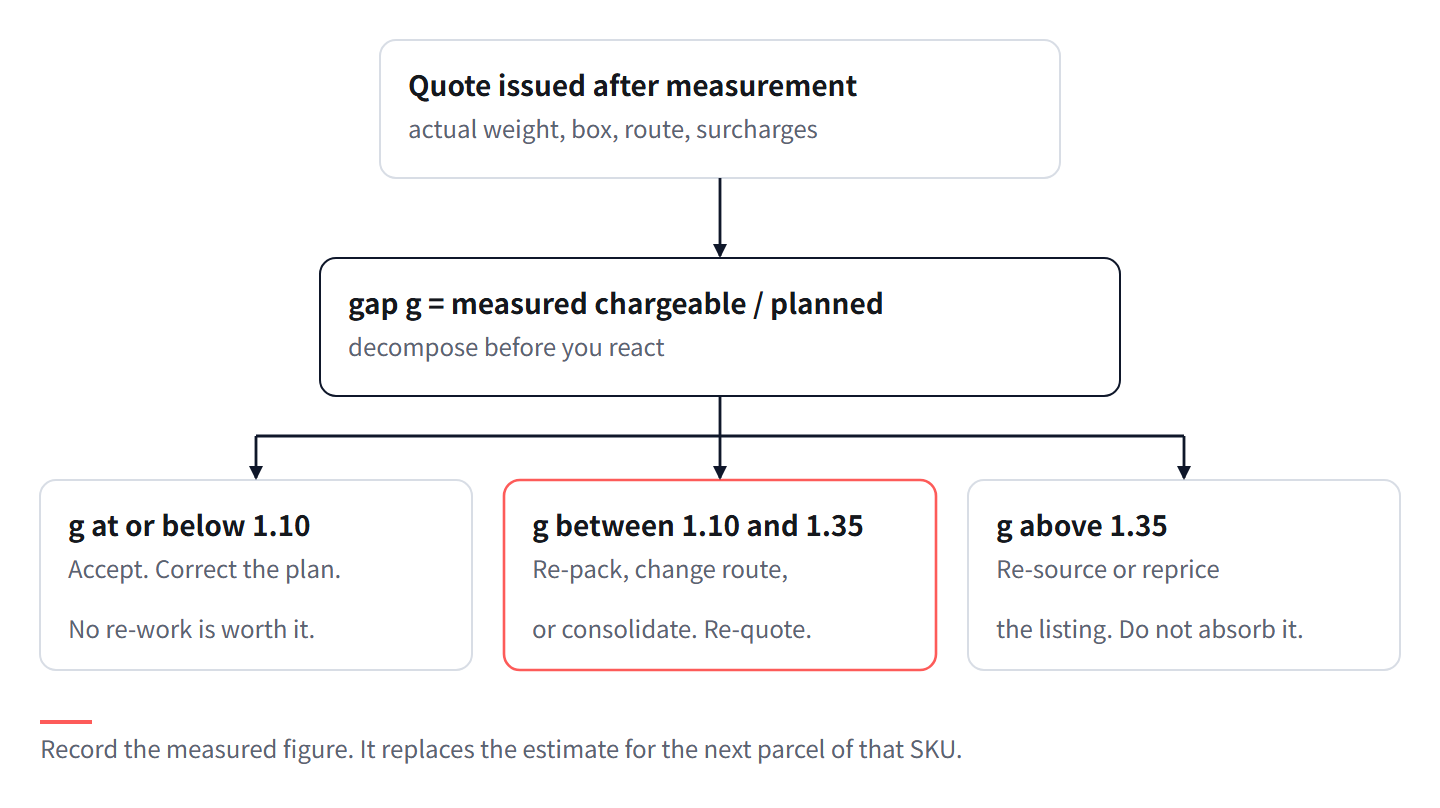
- Compute the gap ratio. Volumetric 9,240 ÷ 5000 = 1.848 kg, actual 0.90 kg, chargeable 1.85 kg. g = 1.85 ÷ 0.90 = 2.06.
- Decompose it. Ask for the measured dimensions, the actual weight, the divisor and the named route. Here the whole gap is one driver: the packing. Effect 2.06 on chargeable weight.
- Suppose the route was also substituted to commercial express at 1.35r. Freight becomes 1.85 × 1.35 × 9% + 2% = 22.5% + 2% = 24.5% of S, against a planned 10.1%. Total ratio 2.43, not 2.06 × 1.35 = 2.78, because the fixed component does not scale with weight. Decomposition only works if you do it on the weight-and-rate part and keep the fixed part separate.
- If dimensions dominate, issue a packing instruction and ask for a re-measure before you approve. A mailer at 28 × 20 × 7 gives volumetric 0.784 kg, actual wins at 0.90 kg, and the freight returns to 10.1%. That is a 14.4 point swing on the selling price from one instruction.
- If route substitution dominates, ask for the originally assumed route and compare divisors, not just rates. A cheaper rate on a smaller divisor can lose to a dearer rate on a larger one.
- If a surcharge dominates, ask whether it is seasonal and when it lifts. If it lifts inside the included storage window, holding the parcel can be cheaper than shipping into the surcharge, and you can decide that with arithmetic rather than hope.
- If consolidation dominates, ask for the number both ways, including the per-parcel components, and take the lower.
- Record the decision in the order: approve, re-work, hold, or re-source, with one sentence naming the driver that caused it.
The artefact is a decision record with a named driver. After twenty of them you will know which driver actually costs you money, which is rarely the one you assumed.
Which of the six you can actually control
| Driver | Who controls it | What you can actually do |
|---|---|---|
| Actual weight | Nobody, after the product is chosen | Choose a lighter variant, or accept it. It is a property of the product |
| Packed dimensions | The warehouse, on your instruction | Fully controllable. Send the instruction with the goods approval, not after the quote |
| Route substitution | Partly the route's availability, partly your choice | Name a first and second choice route in advance, so a substitution is not a surprise |
| Remote-area classification | The destination | Ask before the customer commits, if the address is unusual. Otherwise accept it |
| Seasonal capacity surcharges | The carrier's capacity | Time your shipments, and use the included storage window to wait out a surcharge you can see coming |
| Consolidation assumptions | You, before packing | State how many parcels you want and why. Consolidation of multiple orders into one parcel is included, so the constraint is arithmetic, not a fee |
Two of the six are fully yours, and they are also the two that move most: the packing instruction and the parcel count. They cost one message, sent at the moment you approve the goods payment. Everything else is either a property of the product or a property of the week you happen to be shipping in.
常见问题
Is the quote I was given at purchase a commitment?
No. A figure produced before the parcel exists is derived from listing data, and listing data understates weight and dimensions in one direction. The commitment is the quote issued after weighing and measuring, which is the one you approve.
Why can freight not be quoted automatically the way goods pricing can?
Because freight depends on packed dimensions and route, and neither is a fact until the parcel is at the warehouse. Automated search returns candidates and goods pricing; a freight quote runs through the human sourcing line for that reason.
What if the measured amount is lower than what I prepaid?
The difference is returned to you. Update the planning figure for the SKU and revise the retail price if freight was built into it, because an overpriced listing costs you conversion silently.
Should I hold a parcel to wait out a seasonal surcharge?
Do the arithmetic rather than guessing. Storage is included for 90 days, so the cost of holding is your customer's patience and the capital in the units, against a surcharge that lifts on a date you can ask for.
Can I prevent remote-area surcharges?
Not by negotiating. You can check the destination classification before the customer commits, and you can decide whether the order is worth accepting on that address.
本周行动清单
- Open your last ten orders and write the planned chargeable weight next to the measured one, wherever both exist.
- Compute the gap ratio on each pair and find your own upper end. Use it as your planning margin.
- Send a standing packing instruction with your next goods approval, so dimensions stop being the default driver.
- Name a first and second choice route in advance for your highest-volume SKU, and write both divisors down.
- Add one column to your sheet: the driver named in the decision record. Count them after twenty orders.
由 Lovegodrop 采购团队撰写并维护。这些页面如何撰写与核查.