
已有订单时如何选择中国采购代理
订单已在等货时,单价和目录规模是最错误的比较维度。要比可逆性、可见性与责任归属。
要点
- Wrong criteria for this job: cheapest handling, fastest reply, biggest catalogue. Right criteria: reversibility, visibility, liability.
- Nine weighted criteria, scoring 0 to 5 each, produce a score out of 100 that you fill in yourself from test orders rather than from marketing pages.
- Every archetype has something it structurally cannot do. Identify which limitation intersects your own order mix before you compare anyone.
- Place three deliberate evaluation orders: one easy, one ambiguous, one hard. The hard one decides the relationship.
- Insist on four written clauses covering measured weight, segregated payments, inspection and wrong items, and cancellation plus storage.
Why the usual buying criteria fail once you already have orders
Three customers have written this morning about orders that were due to leave last week, and your supplier has not answered since Thursday. You are not choosing a product today. You are choosing who will be holding your money, your stock and your customer relationships during the next failure, and that decision is made before any of it goes wrong.
Every list of criteria for choosing a sourcing agent describes a different merchant, one who is still deciding what to sell. Those lists compare three things: how cheap the unit is, how fast the agent replies, and how many products sit in the catalogue. All three are sensible when your problem is finding something to sell. None of them survive contact with a live order book.
Cheapness is measured per unit shipped, and it silently excludes the units that never shipped. Fast replies are measured at enquiry, which is the easiest moment to be fast, not during an exception, which is when slowness costs you. Catalogue size is measured in rows, and rows are not availability. The merchant with paid orders is exposed to a different set of failures, and the three criteria that actually govern those failures are reversibility, visibility and liability.
Reversibility. After you learn something new about an order, can you still change course? Every stage you cannot back out of is a commitment made before you had the information. With live orders, information arrives late, because it arrives from a warehouse rather than from a listing page.
Visibility. Given one order number, can you reconstruct what was bought, from whom, what it weighed, and why it cost what it cost? This is not trust, and it is not an accusation. It is a document question with an answerable form.
Liability. When the wrong item ships, or the wrong quantity, or the wrong customer receives it, who absorbs the loss and how quickly is that decided? Vague answers here are common and expensive, because this is the criterion that only becomes visible after it has already cost you something.
Notice what the three have in common. Each describes a state after something has gone wrong, whereas the usual criteria each describe a state while everything goes right. Choosing on the wrong three optimises the part of the relationship that does not need optimising.
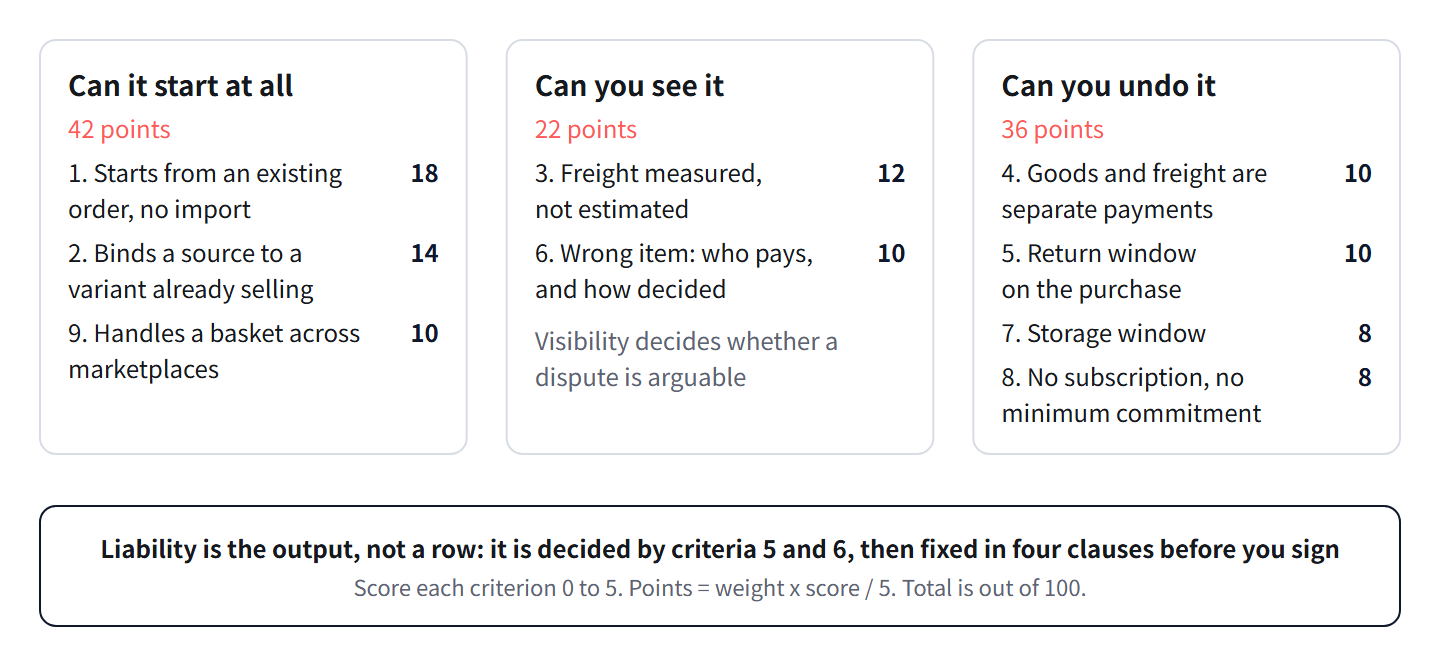
Nine criteria with weights
Weights below sum to one hundred. Change them if your order mix says otherwise, then write down that you did, because the arithmetic is only useful if you own it.
| Number | Criterion | Weight | Why it matters when orders are already paid for | How to test it in one week |
|---|---|---|---|---|
| 1 | Can it start from an existing order, with no catalogue import | 18 | Everything else is downstream of this. If the agent needs you to import something first, the SKU with no catalogue has no route at all | Hand them three sold order lines for products that are not in any catalogue and see what comes back |
| 2 | Can it bind a source to a variant that is already selling | 14 | This is what preserves a product page. Rebuilding the page throws away reviews, sales history and whatever ranking it earned | Ask for a change of source on a live variant, and check whether the store product is recreated or stays put |
| 3 | Is freight measured or estimated | 12 | Marketplace listings routinely understate weight and dimensions, so an estimate inherits whatever the seller typed | Compare the listing's claimed weight against what the warehouse records on five parcels |
| 4 | Are goods and freight separate payments | 10 | Two payments means two approval points, each taken after new information arrives. One payment means one decision made before any of it exists | Ask what you approve, in order, and what each approval commits you to |
| 5 | Return window on the purchase | 10 | The wrong-item case is routine rather than exotic. Without a stated window it becomes a negotiation each time | Ask how many days, who pays return transport, and get it in writing |
| 6 | What happens when the wrong item ships | 10 | This is the liability question in its plainest form. Vagueness here is a real cost | Ask them to describe the last three occurrences and what each cost the merchant |
| 7 | Storage window | 8 | Holding stock deliberately only works if the included window is long enough to be useful and its start point is defined | Ask the number of days, what starts the clock, and what happens at expiry |
| 8 | Subscription or minimum commitment | 8 | Commitments reduce your ability to walk, and the ability to walk is what keeps any vendor honest | Ask directly, and ask what a free tier does not include |
| 9 | Can it handle a multi-marketplace basket | 10 | Customer orders increasingly contain items that naturally come from different sellers, and consolidating those is a judgement call, not a lookup | Send one order containing three items from three different sellers |
The sum is one hundred by construction: 18 + 14 + 12 + 10 + 10 + 10 + 8 + 8 + 10 = 100. Criterion one carries the most weight because a service that cannot begin cannot be rescued by anything it does later.
The scorecard you fill in yourself
Nothing is scored for you here. Any table that arrives pre-scored is someone else's priorities wearing your clothes, and vendor comparisons in this category are almost always pre-scored by whoever benefits.
Score each candidate zero to five against each criterion. Reserve five for a documented answer you could quote in a dispute, three for something that works in practice but is not written down anywhere, and zero for an answer that arrived as marketing rather than as a term. Ask each vendor the identical questions on the same day, since comparability is most of the value.
| Criterion | A five looks like | A zero looks like | Vendor A score | Vendor B score |
|---|---|---|---|---|
| 1 Start from an existing order | Takes order data directly and returns candidates for products you do not have links for | Requires you to import a catalogue product before it can do anything | ||
| 2 Bind to an existing variant | Points a new source at the variant you already sell; the store page is untouched | Requires deleting and recreating the product to change its source | ||
| 3 Freight measured, not estimated | Quote arrives after the warehouse weighs and measures, with the divisor shown | Quote generated at selection time from listing data | ||
| 4 Separate payments | Two approvals, two itemised documents, each showing components | One bundled figure at checkout | ||
| 5 Return window | Stated number of days in writing, with who pays return transport | We will look after you, and nothing else | ||
| 6 Wrong item remedy | Described outcome: who pays, how decided, how many days to raise | Handled case by case | ||
| 7 Storage window | Stated days, stated start point, stated outcome at expiry | No clear statement, or silence about expiry | ||
| 8 No subscription or minimum | Confirmed in writing, including what a free tier excludes | Requires a plan, a commitment period, or a volume floor | ||
| 9 Multi-marketplace basket | One parcel from several sellers, decision explained | Requires separate shipments per seller | ||
| Points row | Compute as weight x score / 5 for each cell, then sum the column | Please do not skip this row; the weighted sum is the entire point |
To convert a column into something you can compare: multiply each score by its weight and divide by five, then add the nine results. The result is a number out of one hundred, and it is only yours if the inputs are your own measurements.
Five archetypes, and what each is structurally unable to do
Vendor names change and features converge. Archetypes persist, because they follow from what the business had to build first. Identify the archetype from signals rather than labels, then read the limitation column before anything else.
| Archetype | What it is genuinely good at | What it is structurally unable to do | How to recognise it |
|---|---|---|---|
| Catalogue platform | Discovery, bulk import, and keeping hundreds of prices and stock levels current without you touching them | Source anything nobody published. Available but unlisted is invisible to it, which covers much of 1688 and most of Yupoo and Weidian | It shows you a catalogue to browse before it shows you anything else, and the flow starts with choosing a product |
| AliExpress-facing tool | Mapping existing AliExpress listings onto your variants, syncing order data, automating repeat purchase on well-behaved listings | Source goods that only exist on other marketplaces, or from sellers who never listed on AliExpress at all | Every instruction assumes an AliExpress URL; the mapping flow is the core screen |
| Community buying agent | Finding awkward items, negotiating on price, dealing with sellers who do not export anything machine-readable | Integrate with your order flow. Everything is a conversation, usually in a chat thread, with no tracking write-back and no per-variant binding at scale | You are given a contact and a form rather than a dashboard, and quotes arrive as messages |
| Order-first sourcing service | Starting from a sold line item, finding the goods from a photo or another site, binding the result to the variant you already sell | Run a standing inventory programme with forecasting and automatic replenishment triggers. That requires the merchant to say how much to buy | The flow starts with your order data or with an image, not with a catalogue or a product picker |
| Logistics-first provider | Storage, consolidation, packing quality, route selection and cost-per-parcel optimisation | Begin before a source exists. It needs supply links you bring with you, and searches become support conversations | Its documentation is about warehouses, routes and chargeable weight rather than marketplaces |
The limitation column is the useful one, and it should be read against your own order mix rather than in the abstract. Write down the share of your last ninety days of order lines that fall outside whichever archetype you are evaluating. If that share is above twenty percent, you are looking at the wrong archetype regardless of how impressive anything else about it is.
Where we sit, stated without hedging: Lovegodrop is the order-first archetype. Routes are A import from one of six marketplaces, B1 bind a source to a variant you already sell, and B2 find a source from a photo, a keyword or another site's page. Sources are 1688, Taobao, Weidian, Yupoo, Xianyu and Dewu. Two payments, the second after measurement. Ninety days of storage, three inspection photos per item, relabelling, repacking, consolidation and a seven-day return window on purchases, no subscription, no minimum quantity, no sourcing fee.
Three evaluation orders to place on purpose
Do not test a vendor with something easy. Testing with something easy measures everyone's best behaviour and tells you nothing that a marketing page would not.
- Choose the three orders before you contact anyone: one clean, one ambiguous, one deliberately hard, all three for products you actually sold last month. Artefact: three briefs written down, one per order, same wording for every vendor.
- Send all three briefs to every candidate on the same day, in the same format, with a stated response deadline. Artefact: a timestamped request thread per vendor.
- Order one, the easy one, is a product with a working marketplace link and a standard variant. Record only three things: whether the correct item arrived, how long between approval and dispatch, and whether the measured weight matched the listing. Artefact: your baseline for that vendor.
- Order two, the ambiguous one, uses only a photo of a common product with many plausible sellers. Record whether you were offered choices, whether you were asked which one you wanted, or whether one was chosen for you. Artefact: the consultation behaviour, which is the whole purpose of this order.
- Order three, the hard one, is a genuine difficulty: a bundle spanning two marketplaces, a heavy item in an awkward shape, or a category with route restrictions. Record whether the vendor engaged, declined, or silently substituted. Artefact: the exception profile, which decides most working relationships.
- Ask one follow-up question on all three: if the measured weight had differed from the listing by thirty percent, what would have happened, and what would you have been asked to approve. Artefact: the answer, compared side by side.
- Score the results against the nine criteria within forty-eight hours, while the details are still fresh. Artefact: a filled scorecard, dated, with the three orders referenced by number.
The easy order will be handled well by nearly everyone, and that is fine; it exists to establish baseline competence. The ambiguous order distinguishes vendors who consult from vendors who decide for you, which matters far more than it sounds because substitution is where unhappy customers are manufactured. The hard order is the one that predicts your next bad week.
From criteria to signed terms, in twelve steps
- Set your weights. Start with the nine above, adjust for your own mix, and record the date. Artefact: a weighted criteria sheet you will reuse for every future vendor comparison.
- Pull your last ninety days of order lines, sorted by frequency, and note which ones have no confirmed source today. Artefact: the uncovered share, expressed as a percentage of order lines rather than of SKUs.
- Map your shortlist onto the five archetypes and strike any archetype whose structural limitation intersects that uncovered share. Artefact: a shortlist of three or fewer, each with a reason written beside it.
- Send identical written questions to every remaining candidate, fourteen questions maximum, numbered, with a response deadline. Artefact: comparable answers, plus a note on which questions went unanswered.
- Request the three documents in advance, for a shipped order if you have one: purchase record, inspection record, freight invoice with components. Artefact: whoever sends them has answered the visibility question without arguing about it.
- Place the three evaluation orders from the previous section. Artefact: three dated outcomes per vendor, plus a consultation note on the ambiguous one.
- Fill in the scorecard for each vendor, using only what you observed. Artefact: a score out of one hundred per vendor, with the evidence referenced.
- Compare landed rather than quoted. Ask every vendor to state what their freight figure is based on, then recompute your own from measured dimensions on the same three parcels. Artefact: landed figures built on one set of measurements.
- Convert each vendor's score and landed figure into coverage-adjusted terms, using the arithmetic in the worked example below. Artefact: one effective figure per attempted order line, per vendor.
- Negotiate the four clauses in the next section before agreeing anything else, since those are the terms you will actually rely on. Artefact: four clause texts, each accepted or refused in writing.
- Agree a pilot period with a defined volume and a defined review date, not an open-ended trial. Artefact: start date, volume, review date, and the named criteria to be re-scored at review.
- Write down the escalation path: who to contact, by what channel, within how many hours, for a stalled purchase, a wrong item and a dispute. Artefact: one page you can hand to whoever works with you next.
Steps nine and eleven are the ones merchants skip. Skipping nine compares headline figures rather than real ones, and skipping eleven turns every trial into an indefinite arrangement with no point at which anyone has to justify continuing.
The four clauses to insist on in writing
Ask for each of these as text, not as reassurance. Saying no to any of them is itself an answer, and it is a cheaper answer to receive before you sign than after.
| Clause | Aim for wording like this | Why it exists | What a refusal signals |
|---|---|---|---|
| Measured weight | Freight is quoted after the goods are weighed and measured. Any amount paid above the measured figure is refunded. The route, actual weight, volumetric weight and divisor appear on the invoice | This converts freight from a promise into a computation you can check | Without it, variances get absorbed silently, and your records will not match your costs |
| Segregated payments | Goods and freight are invoiced separately and approved separately. No charge is applied without a documented approval | Two decision points mean the second is taken after you have seen something real | Without it, one approval commits you to everything, decided before the parcel existed |
| Inspection and wrong items | Inspection images are produced before the shipping payment is requested. Where the wrong item, wrong quantity or damaged condition originates with the seller, the vendor replaces or refunds the goods, and the window for raising it is stated in days | This is the liability criterion written down. Days and party are what make it usable | Without it, every wrong item becomes a negotiation conducted while your customer is waiting |
| Cancellation and storage | The stage at which an order becomes non-cancellable is stated, along with any cost up to that point. Storage is included for a stated number of days from a stated start point, with a stated outcome and notice requirement at expiry | These are the two terms merchants discover only when they are already paying | Without it, expiry is decided unilaterally, and cancellation is whatever they say it is at the time |
Everything else in a vendor agreement is detail beside these four. Terms about support hours and account management read nicely and rarely decide an outcome. These four decide what happens on exactly the days that matter.
Two vendors scored: how the cheaper quote loses
All inputs below are illustrative assumptions, stated so the arithmetic can be checked and then replaced with numbers from your own three evaluation orders.
Assume you are comparing two candidates after completing the procedure above. Assume both buy from the same marketplace seller, so the goods price is identical, and both ship on the same route, so measured freight is identical. Assume freight comes to 34 percent of the goods price after measurement. Set the goods price at 100 percent by definition, so no currency enters the calculation. Assume vendor A adds no service line on these ten units while vendor B adds 3, giving A a landed figure of 134 and B a landed figure of 137 per shipped unit. Assume you trialled ten SKUs and that vendor A could start only six of them without a catalogue record, so its coverage is 0.60, while vendor B sourced all ten, so its coverage is 1.00.
Assume the following scores came out of your three evaluation orders, on the zero-to-five scale:
| Start from order | Bind variant | Measured freight | Separate payments | Return window | Wrong item | Storage | No subscription | Basket | |
|---|---|---|---|---|---|---|---|---|---|
| Vendor A | 4 | 3 | 4 | 3 | 4 | 5 | 5 | 5 | 5 |
| Vendor B | 5 | 5 | 5 | 5 | 5 | 4 | 4 | 5 | 4 |
Vendor A: (18 x 4 / 5) + (14 x 3 / 5) + (12 x 4 / 5) + (10 x 3 / 5) + (10 x 4 / 5) + (10 x 5 / 5) + (8 x 5 / 5) + (8 x 5 / 5) + (10 x 5 / 5) = 14.4 + 8.4 + 9.6 + 6.0 + 8.0 + 10.0 + 8.0 + 8.0 + 10.0 = 82.4.
Vendor B: (18 x 5 / 5) + (14 x 5 / 5) + (12 x 5 / 5) + (10 x 5 / 5) + (10 x 5 / 5) + (10 x 4 / 5) + (8 x 4 / 5) + (8 x 5 / 5) + (10 x 4 / 5) = 18.0 + 14.0 + 12.0 + 10.0 + 10.0 + 8.0 + 6.4 + 8.0 + 8.0 = 94.4.
Read that result properly before acting on it. Vendor A is not a bad vendor. It scored full marks on four criteria, including the two whose absence would cost you the most cash: wrong-item handling and storage. Its problem is directional. The twenty points sitting on criteria one, two and four are exactly the reversibility block, and those are the points that govern what you can do after learning something new.
Now convert the score into something with units in it. Vendor A quoted the lower landed figure per shipped unit, 134 against 137, a lead of three, which is 2.2 percent.
Effective cost per attempted order line, dividing by coverage rather than assuming every line ships:
Vendor A: 134 / 0.60 = 223.3.
Vendor B: 137 / 1.00 = 137.0.
The cheaper vendor now costs 63 percent more per attempted line, because four out of ten lines did not ship at all.
The break-even makes the decision rule explicit. Solve 134 / c = 137 for c, and c = 134 / 137 = 0.978. Vendor A only comes out ahead once it can start from at least 97.8 percent of the lines you send it. Everything below that threshold belongs to the dearer quote, and the threshold is just your two landed figures divided by each other.
Sensitivity, because numbers like this should be pushed. If your own measurement puts vendor A's coverage at 0.95 rather than 0.60, then A's effective figure is 134 / 0.95 = 141.1 against B's 137.0, a gap of 3.0 percent, and the choice becomes genuinely close. If vendor B's service line were 12 rather than 3, its landed figure would be 146 and the break-even coverage would fall to 134 / 146 = 0.918, meaning A would only need 91.8 percent coverage to win. The larger a vendor's price advantage, the more coverage shortfall it takes to erase it, and you can compute your own threshold from your own two numbers in one line of arithmetic.
The reason for doing this rather than comparing quotes is that the quoted figure and the realised figure diverge by exactly the coverage term, and coverage is something no vendor's quote can tell you. You have to measure it yourself, using three orders, one of them deliberately hard.
常见问题
What is the single most predictive test for a sourcing agent?
Ask them to source something you have only a photograph of, then watch whether you are asked to choose between candidates. That behaviour, more than any feature, predicts what happens the first time a seller cannot supply what you asked for.
How long should a trial last before committing?
Agree a defined volume and a review date instead of a duration. Ten trial units across three difficulty levels tells you more than three weeks of easy orders, and a fixed review date gives both sides a point at which continuing has to be justified.
Should I always take the cheapest landed quote?
Only above roughly ninety-eight percent coverage, with the two vendors assumed above. Below that, compute the effective figure per attempted line by dividing landed cost by your measured coverage, then compare. The arithmetic is one division and it changes the answer often.
What do I do when a vendor will not put a term in writing?
Treat the refusal as the answer and record it. A term that exists only verbally is unavailable precisely when you need it, which is during a disagreement about what was agreed.
How often should I re-score?
Every time your mix changes materially, and at least annually, because coverage drifts. Suppliers get pulled, listings disappear, and the uncovered share tends to rise rather than fall on its own.
本周行动清单
- Pull your last ninety days of order lines, count the ones with no confirmed source, and write the uncovered share down with today's date.
- Set your weights, starting from the nine above, and record any change you make so the arithmetic stays yours.
- Send identical written questions to your shortlist, requesting the three documents and the four clauses in the same message.
- Place three evaluation orders, one clean, one photo-only, one genuinely hard, and note whether you were consulted or simply told.
- Compute the effective figure per attempted order line for each vendor by dividing landed cost by measured coverage, and compare that rather than the quotes.
由 Lovegodrop 采购团队撰写并维护。这些页面如何撰写与核查.