
Vad tre QC-foton kan — och inte kan — bevisa
Tre foton per artikel ingår. Vad de tre kan bevisa, de åtta defektklasserna de missar, och instruktionen som får dem att svara dig.
Sammanfattning
- Spend the three photographs on three different questions: is it the item, is it complete, is the surface good.
- A photograph cannot catch size, odour or electrical function, and it catches colour only if your own reference is in the frame.
- What must be measured: weight, packed dimensions, two size points, quantity, and function. Each produces a number for the SKU record.
- Write the instruction in four parts and end it with your failure mode, in your own words.
- Query when the doubt is about the evidence. Reject when the doubt is about the item.
Three photos: the number, the scope and the reason for both
Three QC photographs per item are included. Three is not a rounded-up number and it is not a courtesy. It is the smallest set that can answer three different questions at the same time, and any two of them collapse two questions into one.
The three questions a photograph set has to answer are these.
- Is this the item that was purchased. Identity: the silhouette, the colour, the print, the shape of the thing.
- Is it complete. The accessory set, the parts, the quantity against the purchase.
- Is the surface the customer will see first in the condition the customer expects.
One photograph answers one thing well. A shot of a box tells you a box arrived. A shot of the item front-on tells you the shape and the print. A close shot of a seam tells you the build. Spend the three on three different questions, and do not spend two of them on the same one.
What the three do not do is equally specific, and most of this page is about the second list.
| The three can establish | The three cannot establish |
|---|---|
| That the item is the one you bought | What it weighs |
| That the accessory set is there | How big it is |
| That the surface has no visible flaw | That it works |
| That the print is where it should be | What it smells of |
| That the fittings match | What is inside a lining |
The second column is not a defect in the service. It is what a photograph is.
Which defects a photo can catch and which it cannot
Eight classes, and for each one the condition under which a photograph catches it at all.
| Defect class | Can a photo catch it? | The condition | What to do instead |
|---|---|---|---|
| Colour deviation | Partly | Only if a reference of your own sits in the same frame. A camera's white balance hides a shift | Compare against your own product page, on a screen you know, and publish a tolerance |
| Missing accessory | Yes | The whole set laid out flat in one frame | Ask for the lay-flat shot as one of the three |
| Wrong size | Only with a scale in frame | A tape or a ruler in the shot, across the two points your size chart names | Measure at the warehouse and compare the number |
| Stitching or seam failure | Partly | Surface seams only. A seam under a lining is invisible at any angle | Name the angle, and treat seams as a downstream risk on any SKU where they fail |
| Hardware mismatch | Yes | A close shot of each fitting, with the finish visible | Name the fittings in the instruction |
| Print placement | Yes | A straight-on shot of the print area | Put the print area in the three |
| Odour | No | Nothing. A photograph has no smell | Ask for a note in the inspection instruction |
| Electrical function | No | A photograph of a lit unit proves a light existed once | Ask for a powered test and record the outcome as text |
The classes in the bottom two rows are the ones that end in a dispute, because the warehouse photographs look clean and the customer is still right.
What must be measured rather than photographed
Six things. Each one produces a number, and each number goes on the SKU record.
- Weight. On the scale at the warehouse, before the shipping quote is issued. This is the figure the freight charge is computed from.
- Packed dimensions. Three axes, after packing, which is what the volumetric weight is derived from.
- Size and fit dimensions. A tape on the actual item, at the two points your size chart states.
- Quantity. A count against the purchase, not a photograph of a pile.
- Function. A powered test with the outcome recorded in text, not a photograph of a switch.
- What the customer feels rather than sees: fabric weight, stiffness, the travel of a zip. These are noted, not photographed.
The first two are the ones that move money. The other four are the ones that move your return rate.
Writing the inspection instruction
The default is that the warehouse takes the three views it always takes. Those views are chosen to be fast across every SKU, which means they are chosen for none in particular, and they will be three views of the silhouette.
An instruction has four parts.
- The three angles, named, with the thing that has to be in the frame.
- The one thing that goes in as a scale or a reference.
- The measurement to state as a number.
- The condition to look for, in the words of your own return reasons.
Written out, it looks like this.
Photograph one: the front, straight on, with the printed area facing the camera and a tape across the two measurements on my size chart.
Photograph two: the accessory set that ships with it, laid out flat in one frame.
Photograph three: the fittings, close, with the zip pull and the buckle both visible.
State the measured weight in grams and the packed dimensions in centimetres.
I am looking for: the correct print, both fittings present, and the accessory set complete.
The last line is the one that changes the outcome. Name your failure mode, and the three photographs are taken to answer you. Leave it out, and they are taken to answer nobody.
Approve, query or reject: the rule and what each costs
| Decision | The condition | What it costs you |
|---|---|---|
| Approve | All three photographs answer their question, the measured figures are inside your tolerance, and nothing on your failure-mode list appears | One approval, and the parcel moves on the next dispatch |
| Query | A photograph is missing, is at the wrong angle, or the measured figure differs from the SKU record by more than the tolerance | A re-shot and one handling cycle. The order waits inside the included storage |
| Reject | The identity is wrong, an accessory is missing, or a failure mode on your list is visible | The seven-day window, the purchase returning, and a new source for that SKU |
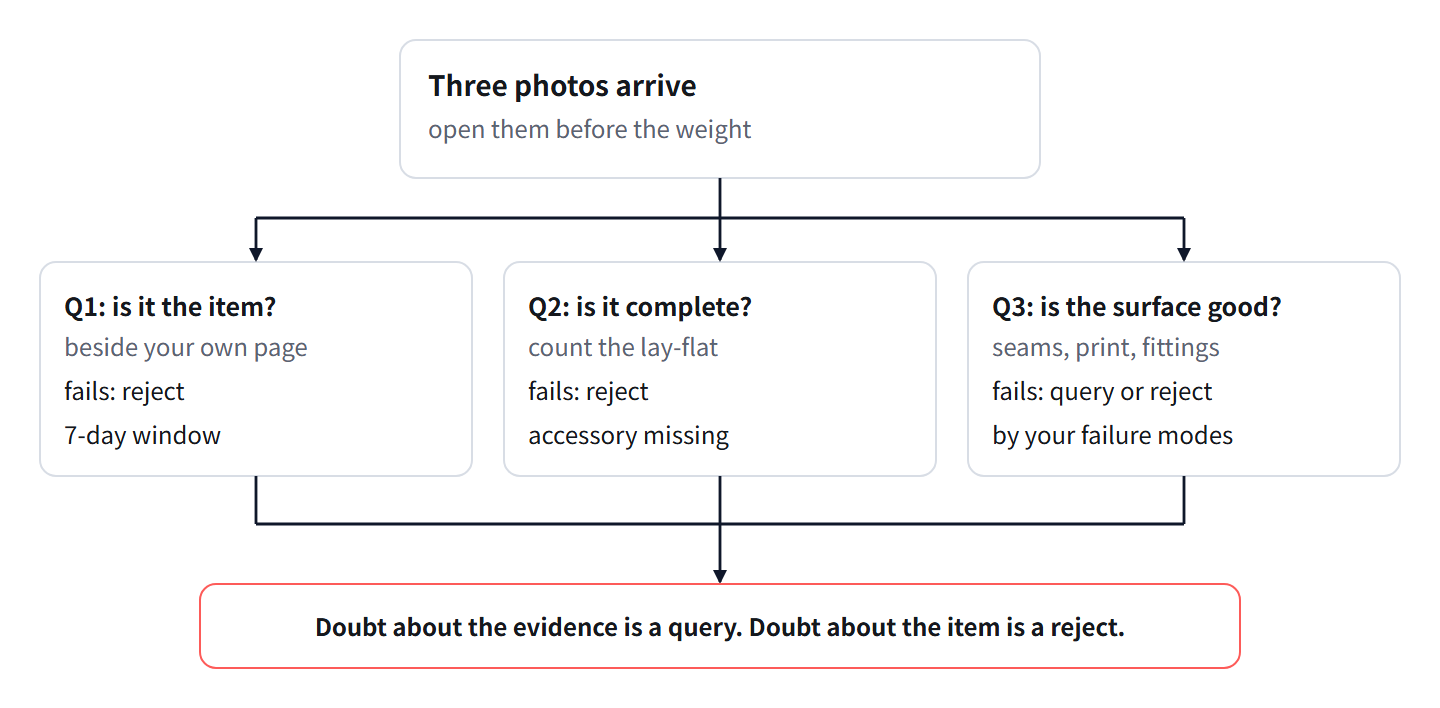
The rule that separates the last two is one sentence. Query when the doubt is about the evidence. Reject when the doubt is about the item.
A missing photograph is a query, because the item may be fine and you simply cannot see it. A missing accessory is a reject, because the item is not complete and no re-shot will make it complete. A photograph taken from the wrong angle is a query. A print in the wrong place is a reject.
The costs are different in kind. A query spends time, and storage for 90 days is included, so a query inside the window costs you your customer's patience and nothing else. A reject spends the purchase and the sourcing work, and it is the only one of the three that can lose the order outright.
The five minutes after the photographs arrive
- Open the three photographs before you open anything else. Do not read the weight first, because the number will bias what you think you see.
- Answer question one: is this the item. Put the photograph beside your own product page and compare the print, the colour and the shape in that order.
- Answer question two: is it complete. Count the accessories in the lay-flat frame against what the listing promised.
- Answer question three: is the surface the customer sees first in the condition you would accept on your own order.
- Read the measured weight and the packed dimensions, and compare them against the SKU record. A figure above 1.25 times the record is a signal, not a rounding.
- Decide approve, query or reject by the rule, and write the decision down with the time it was made. Artefact: a decision line on the order.
Worked example: what three photographs catch
Every input stated. Take a SKU with an observed defect incidence of 6.0 per 100 units, distributed across the eight classes as follows: colour deviation 1.0, missing accessory 0.8, wrong size 0.7, stitching or seam failure 1.2, hardware mismatch 0.5, print placement 0.6, odour 0.6, electrical function 0.6.
The default set is three views of the silhouette: front, back, one close shot.
| Class | Incidence per 100 | Caught by the default three | Escapes |
|---|---|---|---|
| Colour deviation | 1.0 | 0.5 | 0.5 |
| Missing accessory | 0.8 | 0.3 | 0.5 |
| Wrong size | 0.7 | 0.0 | 0.7 |
| Stitching or seam failure | 1.2 | 0.4 | 0.8 |
| Hardware mismatch | 0.5 | 0.2 | 0.3 |
| Print placement | 0.6 | 0.6 | 0.0 |
| Odour | 0.6 | 0.0 | 0.6 |
| Electrical function | 0.6 | 0.0 | 0.6 |
| Total | 6.0 | 2.0 | 4.0 |
Coverage with the default three: 2.0 / 6.0 = 33 percent.
The specified set spends the three differently: the item with a tape across the two size-chart measurements, the accessory set laid flat, and the print area with the fittings in one close frame.
| Class | Incidence per 100 | Caught by the specified three |
|---|---|---|
| Colour deviation | 1.0 | 0.5 |
| Missing accessory | 0.8 | 0.8 |
| Wrong size | 0.7 | 0.7 |
| Stitching or seam failure | 1.2 | 0.4 |
| Hardware mismatch | 0.5 | 0.5 |
| Print placement | 0.6 | 0.6 |
| Odour | 0.6 | 0.0 |
| Electrical function | 0.6 | 0.0 |
| Total caught | 3.5 |
Coverage with the specified three: 3.5 / 6.0 = 58 percent. The escapes fall to 2.5 per 100, and 1.2 of those 2.5 are odour and function, which no photograph catches at any angle.
The ceiling is (6.0 - 1.2) / 6.0 = 80 percent. That is the most three photographs can ever do on this SKU, and the remaining 20 percent has to be handled downstream rather than at the warehouse.
The same six per hundred, the same three photographs, and 25 percentage points of coverage are decided by where you point them.
When the photographs were clean and the customer disagrees
It happens, and the useful question is not who is right. It is which of the eight classes the complaint belongs to.
- Ask the customer for a photograph before you answer anything. Their photograph is evidence; their words are a claim.
- Put the customer's photograph beside the three warehouse photographs and compare them in the same order: identity, completeness, surface.
- If the complaint is in a class a photograph cannot catch, which means odour, function or the interior, the warehouse did nothing wrong and the response is the downstream one.
- If the complaint is in a class a photograph could have caught and the warehouse photograph shows nothing, the failure is in the instruction or the angle, and the fix is to change the three for that SKU.
- Record the outcome under the return reason you used to write the instruction, so the instrument improves on the next order.
Step 4 is the one that produces a better set of three. A SKU whose failure mode is seams needs a seam in the frame, and you only find that out by recording that a seam complaint arrived.
Building a standing instruction per SKU
Do this once per SKU and send it with every order on that SKU.
- Pull the top three return reasons on the SKU from the last ninety days.
- Write one failure mode per return reason, in your words, not the customer's.
- Spend the three photographs on those three failure modes, one each.
- Add the two measurements to state as numbers: the measured weight and the packed dimensions.
- Store the instruction against the variant, and send it at the same time as you approve the goods payment.
Vanliga frågor
Why three and not five?
Three is what is included, and three is the smallest set that answers the three questions separately. A fourth photograph would be better, but the gain from spending three well is larger than the gain from a fourth spent badly.
Can a photograph prove the size?
Only with a scale in the frame. Otherwise it proves the shape, which is a different thing and not the one customers complain about.
What do I do about a smell complaint?
Nothing at the warehouse, because there is nothing to photograph. Ask for a note in the inspection instruction and treat it as a downstream case, the same as a functional fault.
How long do I have to act on the photographs?
Seven days from receipt at the warehouse, and the clock starts at receipt, not at the moment you open the message.
Is a query worth the delay?
When the doubt is about the evidence, yes. A re-shot costs one handling cycle inside storage that is already included, and it is cheaper than shipping an item you could not see.
Att göra den här veckan
- Take your highest-return SKU and write down its top three return reasons from the last ninety days.
- Turn those three into one failure mode each, in your own words.
- Spend the three photographs on them and write the instruction in the four parts.
- Send it with the next order on that SKU and time how long the three answers take you.
- After the order ships, record the measured weight and dimensions in the SKU record.
Skriven och underhållen av Lovegodrops sourcing-team. Hur dessa sidor skrivs och granskas.
Börja med en order du redan sålt
Koppla en Shopify- eller WooCommerce-butik, välj en betald order och se offerten för inköp och frakt för just den ordern innan du binder dig.