
Xianyu e Dewu: quando plataformas de segunda mão e autenticadas são a fonte certa
O Xianyu vende um item por anúncio. O Dewu coloca uma etapa de autenticação no meio. Quais tipos de pedido cada um atende, e os quatro controles.
Pontos principais
- Xianyu is peer-to-peer and one-item-per-listing. Dewu is an authentication-based marketplace for branded goods.
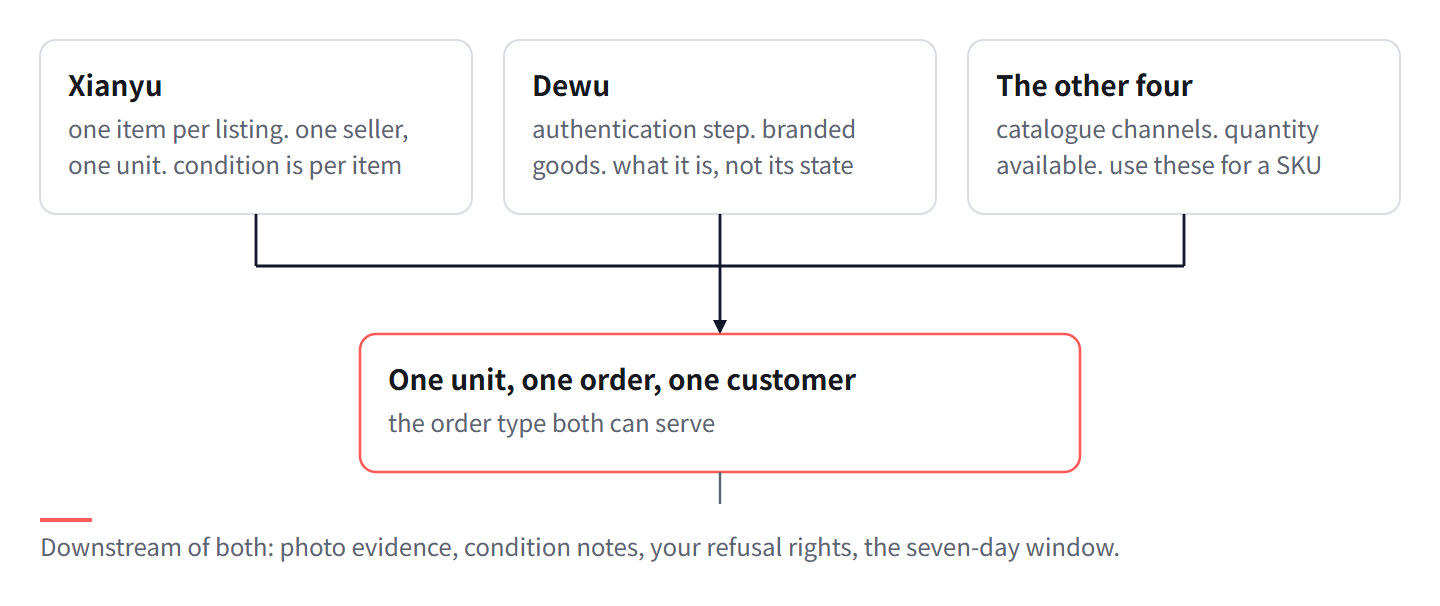
- Neither is a catalogue channel. Both are the right answer for a single unit, and the wrong one for a SKU you sell weekly.
- On Xianyu a three-unit order becomes three purchases, three sellers and three inbound parcels, consolidated into one outbound.
- Get the condition grade in writing from the seller before the goods payment, on a four-point scale, with the wear named.
- Authentication on Dewu covers what the item is. It does not cover condition, accessories, or what the customer expected.
Two platforms that are not the same kind of marketplace
A customer has paid for one unit of a branded item you do not hold, and the listing you normally buy from is out of stock. Two of the six marketplaces we source from are built for exactly that situation, and they are built on opposite mechanics.
Xianyu is a peer-to-peer second-hand marketplace. Every listing is one physical item owned by one person. There is no stock count because there is no stock: the listing and the item are the same object, and when it sells the listing ends.
Dewu is an authentication-based marketplace for branded goods. A listing can be new or used, but the defining mechanism is that goods pass through an authentication step before they get to the buyer.
Everything practical falls out of that one difference. On Xianyu the unit of trade is a single item and the counterparty is a person. On Dewu the unit of trade is a listing with a condition and an authentication outcome, and the counterparty is a seller with a verification step sitting in the middle of the transaction.
Which order types each one can serve
| Order type | Xianyu | Dewu | Reason |
|---|---|---|---|
| One unit, used condition acceptable | Yes, with the condition in writing | Yes, with the authentication step | This is the case both exist for |
| Several units of the same SKU | No | Only where the listing carries quantity | One physical item per Xianyu listing |
| A SKU you sell every week | No | Only for a listing with standing availability | A source you cannot bind to a variant is not a source |
| A one-off the customer has already paid for | Yes | Yes | One unit, one order, one customer |
| A stand-in for a supplier who went out of stock mid-order | Yes, for a single unit | Yes, for a branded item | Speed beats continuity here |
| A catalogue build or a pre-order | No | No | Neither is a stock channel |
| Bulk for holding | No | No | Neither is a wholesale channel |
Read the table by column and the two platforms stop looking like substitutes. They overlap on one row and diverge on every other.
The one-unit constraint and what it does to a multi-unit order
On a normal marketplace a three-unit order is one purchase, one inbound parcel and one outbound parcel. On Xianyu it is three separate listings, three different sellers, three purchase records and three inbound parcels, because no single listing can supply three units of one physical item.
Three things follow, and only one of them is good news.
- The goods side becomes three transactions, each approved on its own. The goods payment is what starts the purchase at the marketplace, so three units means three approvals.
- The inbound side becomes three parcels, and consolidation is what makes this survivable. Consolidating multiple orders into one parcel is included, so the three arrive separately and leave together.
- The QC side becomes three sets of three photographs, and the condition is not shared across them.
Now the arithmetic, with the inputs stated. Assume a customer order for three units of the same SKU, that all three listings are found in one pass, and that the three purchases are placed on the same day. Assume the sellers dispatch at 1 day, 3 days and 6 days.
| Step | Figure |
|---|---|
| Mean of the three dispatch intervals | (1 + 3 + 6) ÷ 3 = 3.33 days |
| The interval that actually binds | 6 days |
| The ratio of the binding interval to the mean | 6 ÷ 3.33 = 1.80 |
| Inbound parcels before consolidation | 3 |
| Outbound parcels after consolidation | 1 |
| Parcels the warehouse handles | 4 |
The inbound phase is bounded by the slowest seller, not by the average, and the slowest seller is 1.8 times the mean. Any plan built on the average will be wrong by that factor.
Now the condition side. Assume the three units arrive graded A, B and B on the four-point scale below. The grades are not shared across the three sellers, and the order does not have one condition: it has three.
| What you can promise | What you cannot promise |
|---|---|
| Three units of the item | Three units in the same condition |
| One outbound parcel | One inbound parcel |
| One measured freight charge at the end | One goods line across the three |
The rule that comes out of it: for a multi-unit order, either split the order into three single-unit shipments, or find a source that carries quantity.
Condition grading, and getting it in writing
| Grade | Meaning | What you may promise the customer |
|---|---|---|
| A | As new, no visible wear, every accessory present | The item as your listing describes it |
| B | Light wear on close inspection, accessories present | The item, with the wear named to the customer first |
| C | Visible wear, or an accessory missing, or a marked flaw | Only after the customer has agreed to it in writing |
| D | Heavy wear or a functional fault | Not for a customer order |
A grade you invent after the photographs arrive is a note to yourself. A grade the seller stated in the thread is something you can act on, because it is the thing the seven-day window attaches to.
- Ask the seller four questions in one message: are there marks, are all accessories present, how old is it, and has it been used or opened. Save the answer text.
- Ask for two extra photographs beyond whatever the listing shows: the exact area of wear, and the accessory set laid out flat.
- Record the grade with the date, and record it in the seller's words as well as your letter. Artefact: the grade line on the SKU record.
- Do not accept "good condition" as a grade. It is an adjective, and an adjective cannot be returned to.
What the authentication step protects and what it does not
The authentication step on Dewu is a third party examining the item against a standard before it moves on, with the outcome recorded. That is worth having, and there is a version of it that merchants oversell to themselves.
| What it covers | What it does not cover |
|---|---|
| Whether the item is what it claims to be | Whether the item is new |
| That a third party examined it before it moved on | Accessories, packaging or the completeness of the set, unless those are in scope of the check |
| A recorded outcome you can refer to | What the customer expected when they opened it |
| A decision made before the goods move on | The seven-day window, which you still have to use yourself |
The second column is where an order goes wrong. A buyer who hears "authenticated" and reads "as new" has made an inference the platform did not offer, and the inference arrives at the customer through your product page.
The four risk controls
| Control | What it is | When you use it | What it produces |
|---|---|---|---|
| Photo evidence | Three QC photographs per item at the warehouse, at the angles you name, plus the seller's own pre-sale photographs | Before you approve the shipping payment | A dated set you can compare the customer's photograph against |
| Condition notes | The seller's written grade on the four-point scale, and your own note on the same record | Before the goods payment | The thing the seven-day window attaches to |
| Refusal rights | The goods payment and the shipping payment are separate, and nothing leaves the warehouse before your second approval | On every order | A decision that is yours, not theirs |
| The seven-day window | Seven days from receipt at the warehouse | When the photographs and the stated grade disagree | A return before the money is spent on freight |
The third control is the one that makes the other three usable. Because the two payments are separate, the photographs and the measured figures arrive inside a gap you control, and the gap is where the four controls get applied.
Buying a one-off for a customer order
The point of this procedure is that the customer never sees the machinery. They see one parcel and one tracking number.
- Before you source anything, confirm with the customer that one unit is what they want and that the condition you can actually get is the condition they will accept. Artefact: their agreement in the order notes.
- Get the four condition answers in writing from the seller and record the letter. Do not skip to the photographs; the seller's words are what you can act on later.
- Make the goods payment. Artefact: a purchase record with the stated grade beside it.
- When the parcel is at the warehouse, read the three QC photographs against the seller's stated grade, in that order.
- Where the photographs and the grade disagree, use the seven-day window before you approve the shipping payment, not after. The window covers damage and discrepancy, and it runs from receipt at the warehouse.
- Approve the shipping payment only on the measured figures, which are weighed and measured at the warehouse rather than taken from the listing.
- File the photograph set, the grade and the measured weight against the SKU, so the second unit of the same item does not start from zero.
When neither platform is the right source
| Situation | Right source | Why |
|---|---|---|
| One unit, the customer has paid, your usual listing is out | Xianyu or Dewu | Speed, and nothing else needed |
| Three units of the same SKU | A marketplace with quantity | The one-unit constraint makes this four parcels |
| A SKU in your catalogue you intend to keep selling | A catalogue marketplace | There is nothing to bind on a listing that dies with the item |
| A non-branded item with no authentication path | The other four | The authentication step has nothing to examine |
| A SKU where the customer will expect new | A catalogue marketplace | Authentication does not mean new |
Perguntas frequentes
Can I use Xianyu for a SKU I sell every week?
No. The listing and the item are the same object, so when it sells the listing ends, and there is nothing to bind to the variant. A SKU you sell weekly needs a source that exists next week.
What does the authentication step actually give me?
A third party examined the item before it moved on and recorded the outcome. It tells you what the item is. It says nothing about condition, accessories or the customer's expectation on arrival.
How do I handle a three-unit order when the customer needs them together?
Consolidation. Three inbound parcels, one outbound. The inbound phase is bounded by the slowest of the three sellers, so count on the slowest rather than the average.
Is a seller's "good condition" enough?
No. It is an adjective, not a grade, and an adjective cannot be returned to. Ask the four questions and make them name the wear.
What happens if the photographs and the seller's stated grade disagree?
Use the seven-day window before you approve the shipping payment. That is the whole reason the window sits where it does, and after dispatch it has closed on the transaction that mattered.
O que fazer esta semana
- List the SKUs where you have taken a one-off order in the last ninety days and mark which ones you sourced from a catalogue marketplace.
- Write the four condition questions into one message and save it as a template.
- Take one out-of-stock SKU and ask its seller for the four answers, purely to see whether you get them.
- Add the measured weight and the stated grade to the SKU record for the last one-off you fulfilled.
- Decide, for each one-off SKU, whether it is a one-off by nature or a SKU you should move to a source with quantity.
Escrito e mantido pela equipe de sourcing da Lovegodrop. Como estas páginas são escritas e verificadas.
Comece com um pedido que você já vendeu
Conecte uma loja Shopify ou WooCommerce, escolha um pedido já pago e veja a cotação de sourcing e frete para esse pedido específico antes de se comprometer.