
Kiedy trzymać zapas — a kiedy jest to martwy kapitał
Magazyn rozwiązuje trzy problemy i tworzy jeden. Rachunek pierwszego zakupu, SKU, które nigdy nie powinny leżeć, i warunek wyjścia do zapisania w pierwszej kolejności.
Najważniejsze w skrócie
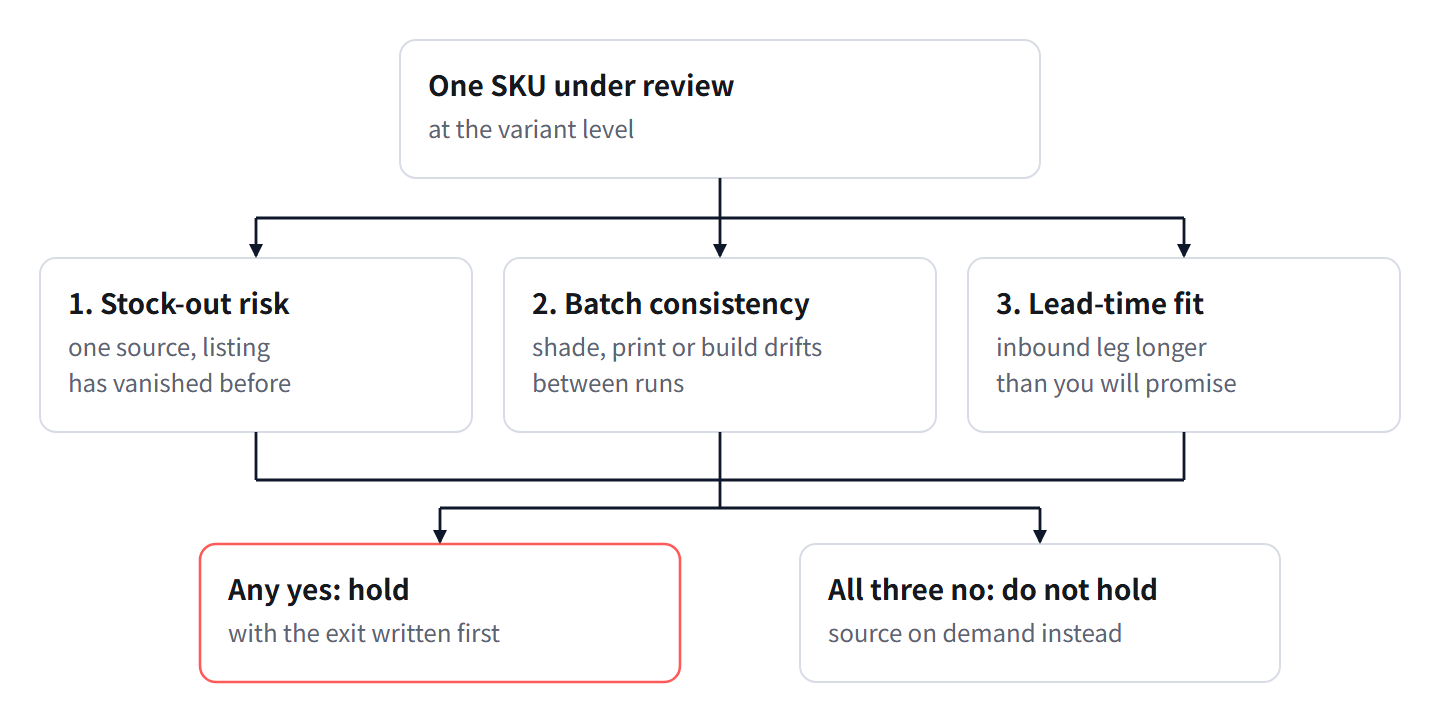
- Three reasons to hold: the source disappears, the batch drifts between runs, or the inbound leg is longer than you can promise.
- Hold single-source, stable-demand, narrow-variant SKUs. Do not hold multi-source commodities, trend goods, or wide variant spreads.
- Ninety days of included storage removes a fee. The remaining costs are capital, obsolescence, and buying more than the arithmetic supports.
- Compute the reorder point from your own demand: exposure window demand plus z times the standard deviation over that window.
- Write the exit condition before the purchase. A hold without an exit is a purchase, not a decision.
The stock you are holding is either insurance or a mistake
A supplier listing vanishes the week your best SKU starts moving, and you spend the next ten days either refunding orders or re-sourcing at a worse price. That is the experience that makes merchants want to hold stock. It is also the experience that makes them hold the wrong stock, in the wrong quantity, for the wrong reason.
Storage is not a strategy. It is insurance against three specific failures, and like any insurance it has a premium you should be able to state before you buy the policy. If you cannot name the failure you are insuring against, you are not holding stock, you are buying inventory and hoping.
The three problems storage actually solves
| Problem it solves | What it costs you without storage | What holding costs you instead | When the problem is real |
|---|---|---|---|
| Supplier stock-out | Lost or refunded sales, and a listing that may have to be paused while you find a replacement | Capital in units, and the risk that they never sell | When the source is one seller whose listings disappear for weeks at a time |
| Batch consistency | Returns, and a review profile damaged by units that do not match the ones the customer saw | Units from one batch, all alike, and the holding cost of that batch | When shade, finish, print or build drifts between production runs |
| Lead-time compression | The customer waits the whole chain: purchase, inbound, inspection, packing, freight | The inbound leg is already done, so only the outbound leg remains | When the inbound leg is longer than you are willing to put in front of a customer |
The third one is the reason most merchants give, and it is the weakest of the three on its own. Compressing a lead time does not create demand. If a SKU sells steadily, a shorter wait may convert better; if it sells in bursts, the wait was never the constraint.
The first two are the ones worth paying for. A concentrated source is a real risk, because a marketplace listing is not a contract and a seller can take it down without telling you. Batch drift is a real risk, because a customer who received a different shade from the one in the photograph will return it, and the return costs you more than the freight you were trying to save.
Which SKUs to hold and which should never sit still
| Archetype | Hold or not | The rule behind it |
|---|---|---|
| Single source, stable demand, narrow variant range | Hold | The stock-out risk is concentrated and predictable, and the arithmetic below has data to work from |
| Multi-source commodity, many equivalent listings | Do not hold | If three sellers carry it, a stock-out is a short re-source, not a lost sale |
| Variant spread wider than six, demand spread across all of them | Do not hold | Per-variant demand is too thin to carry a safety stock. See the arithmetic below |
| Seasonal, with a defined window | Hold into the window only | The exit condition is the end of the window, written before the purchase |
| Trend-driven with a short cycle | Do not hold | Obsolescence risk exceeds stock-out risk, and the cycle ends before the stock does |
| Bulky, high volume ratio | Do not hold | Freight is already a large share of the price, and holding does not change the divisor |
| Long production lead, made to order | Hold | The lead time itself is the reason, and it will not shorten |
| New SKU, under thirty days of data | Do not hold | You do not yet have the demand distribution the reorder point needs |
Read the rule column rather than the verdict. The verdict is a default for a SKU you have not analysed; the rule is what to apply when your SKU sits between two rows.
What a ninety-day storage window changes, and what it does not
Storage is included for 90 days with us, alongside three QC photos per item, relabelling, repacking and consolidation. That removes one line from the calculation, and it is worth being precise about which line it is.
What it removes: the periodic storage charge. A hold that would have carried a fee for months now carries none for the first 90 days, so the decision collapses onto its real costs.
What it does not remove, and these are the costs that decide the question:
- Capital. The units are bought and paid for before they are sold. The cost is what that money is not doing elsewhere, plus the concentration risk of having it in one SKU.
- Obsolescence. The value of the units declines with the season, with a trend, and with any change you make to the listing. A unit that was right in one quarter may be unsellable in the next.
- The temptation to over-buy. This is the one to watch. A storage fee is a cost signal, and removing it removes the signal. A merchant who would order 50 units when storage is charged will order 200 when it is not, and those extra 150 units are the real cost of the free window.
The discipline that replaces the fee is the arithmetic below plus a written exit. Without one of them, free storage turns a good decision into a large one.
The reorder-point arithmetic for a first hold
Assumptions, stated because every figure depends on them:
- Average daily demand d = 3 units per day, from your own order history
- Standard deviation of daily demand σd = 1.5 units per day
- Lead time L = 12 days: the observed interval from goods approval to the parcel being ready at the warehouse, including inbound, inspection and packing
- Review interval R = 7 days: how often you look at stock and place a reorder
- Service level 95%, so z = 1.65
- Order cycle 30 days
The steps:
- Exposure window = L + R = 19 days. Demand over it = 3 × 19 = 57 units.
- Standard deviation over the exposure window = σd × √(L + R) = 1.5 × √19 = 1.5 × 4.36 = 6.5 units.
- Safety stock = z × 6.5 = 1.65 × 6.5 = 10.8, round up to 11 units.
- Reorder point = 57 + 11 = 68 units. When on-hand reaches 68, you place the reorder.
- Order-up-to level = reorder point + demand over one order cycle = 68 + 3 × 30 = 158 units. Peak on-hand is around 158.
- Check the hold against the storage window: 158 units at 3 per day is 53 days of cover, which sits inside the 90-day window.
- Note what the safety stock is: 11 of the 158 units, about 7%, exist purely because demand is uncertain. The other 149 are pipeline stock, and no amount of forecasting removes them.
Two sensitivities worth running before you commit. At a 90% service level, z = 1.28 and safety stock falls to 8.3, cutting the hold by roughly 3 units, about 2% of the total. If lead time doubles to 24 days, exposure becomes 31 days, demand over it rises to 93 units, the window standard deviation becomes 1.5 × √31 = 8.4, safety stock 13.8, and the reorder point rises to 107. Lead time moves the hold far more than service level does, which is why a measured L matters more than a chosen z.
The artefact is a reorder card for the SKU: d, σd, L, R, z, reorder point, order-up-to level, review date. One card, one SKU, revisited at R.
Why variant spread makes a healthy unit count a bad hold
Take the same SKU and spread it across 18 variants, three colours by six sizes, with demand spread evenly.
- Per-variant daily demand = 3 ÷ 18 = 0.167 units per day
- Per-variant standard deviation, assuming the variants move independently = 1.5 ÷ √18 = 0.354 units per day
- Per-variant safety stock = 1.65 × 0.354 × √19 = 1.65 × 1.543 = 2.55, round to 3 units
- Per-variant reorder point = 0.167 × 19 + 3 = 3.17 + 3 = 6.2, round to 7 units
- Order-up-to per variant = 7 + 0.167 × 30 = 7 + 5 = 12 units
- Total across 18 variants = 216 units, against 158 held as one pooled item. The spread costs 1.37 times the stock for the same service level
Now the part that surprises people. At 95% service per variant, the chance that at least one of 18 variants is out of stock at a given moment is 1 − 0.95 to the power of 18. That is 1 − 0.397, so about 60%. Holding 216 units, you will still be missing some variant roughly six times in ten.
And the unit count still looks healthy. 216 units looks like a well-stocked SKU on a dashboard, but 12 units of a variant selling 0.167 per day is 72 days of cover for that variant, while the variants that actually carry the demand sit at two or three. The distribution is wrong, not the total.
The remedy is not a bigger hold, it is a narrower one. Rank variants by demand, take the ones that carry most of the volume, and run the per-variant arithmetic only on those. Leave the long tail to source-on-demand, because for a variant selling one unit a fortnight, the stock-out cost is one order and the holding cost is permanent.
The first-hold procedure, with the exit written before the purchase
- Choose one SKU with at least 60 days of sales data at the variant level. Not the SKU you like, the one with data.
- Compute d and σd from your own order history at the variant level, not at the SKU level.
- Measure L yourself: days from goods approval to the parcel being ready. Use an observation, not an expectation.
- Choose a service level you can finance, and write down its z. 95% is 1.65, 90% is 1.28.
- Compute the reorder point and the order-up-to level, and write them on the reorder card with the review date.
- Write the exit condition before you buy anything. A usable one names a measurement and a date: "If fewer than 90 units have sold by the review date 60 days out, the remainder is repriced and no reorder is placed." Write the number in before you know whether you will like it.
- Buy the first hold at the order-up-to level, set the review in the calendar, and do not look at it again until that date.
The artefact is two documents: the reorder card and the exit condition. The second is the one merchants skip, and it is the one that decides whether the hold was a decision or a purchase.
Signals that you should stop holding
| Signal | What it means | What to do |
|---|---|---|
| Sell-through below the reorder point for two consecutive review intervals | Demand moved, inventory did not | Stop reordering and run the exit condition |
| A second source appears with an equivalent listing and a stable price | The risk you insured against has gone | Let stock run down, do not reorder |
| The batch you hold drifts from what the supplier ships now | The consistency reason has inverted | Stop shipping from stock until the listing is corrected |
| Units still on hand at day 60 of the storage window | The hold exceeded demand | Apply the exit now, while there is window left |
| Returns citing a difference between the unit and the listing | Listing and batch have diverged | Pause the hold and fix the listing first |
| Variant spread has grown since the hold was placed | Per-variant cover fell without the total changing | Re-run the per-variant arithmetic before any reorder |
The second signal is the easiest to miss, because nothing bad happens when it appears. The hold keeps working, the stock keeps selling, and you keep reordering for a reason that stopped being true. Re-run the three tests from the top of this article at every review date, not only when something goes wrong.
Najczęstsze pytania
Is ninety days of included storage enough to make holding free?
No. It removes a fee line. The remaining costs are the capital tied up in the units, obsolescence, and the extra units you buy because nothing is charging you to hold them.
Should I hold a SKU that sells in bursts?
Usually not. Bursty demand has a high standard deviation relative to its mean, so the safety stock the arithmetic asks for is large and sits idle between bursts. Source on demand and accept the lead time.
What service level should I choose?
Pick the one you can finance, then check what it costs. Moving from 95% to 90% cut the hold by about 2% in the example, while doubling the lead time raised it by roughly a third. Measure L before you optimise z.
Can I hold stock across many variants if the total looks right?
The total is not the constraint. Eighteen variants at 95% each still leaves roughly a 60% chance that some variant is out of stock at a given moment. Hold the variants that carry the demand.
What if the supplier changes the batch while I am holding?
That is the signal to stop, and it is why the exit condition exists. Stop shipping from stock, correct the listing to match what is arriving, and decide whether the hold is still the right units.
Co zrobić w tym tygodniu
- Pick your highest-volume SKU and write d and σd at the variant level from the last 60 days of orders.
- Measure L on one real order: the days from goods approval to the parcel being ready.
- Run the seven-step arithmetic and write the reorder point and order-up-to level on one card.
- Write the exit condition now, with a number and a date, before you place any hold.
- Re-run the three tests on every SKU you are currently holding, and stop the ones that fail all three.
Napisane i aktualizowane przez zespół sourcingu Lovegodrop. Jak powstają i są weryfikowane te strony.
Zacznij od zamówienia, które już sprzedałeś
Połącz sklep Shopify lub WooCommerce, wybierz opłacone zamówienie i zobacz wycenę sourcingu oraz wysyłki dokładnie dla tego zamówienia, zanim się zobowiążesz.