
Lovegodrop vs BuckyDrop: due modelli ordine-prima, fianco a fianco
È l'accoppiata di modelli più vicina che entrambi i servizi abbiano. La tua decisione riguarda esecuzione, sequenza e aderenza, non quale concetto sia giusto.
Punti chiave
- This is the closest model match in the market: buy to order from Chinese marketplaces, warehouse in China, ship to your customer. Decide on execution, not concept.
- The sequence that matters most is quote, approval, payment. Ask any order-first service exactly what you commit to before the parcel is weighed.
- Ours uses two separate payments approved at two moments: goods to start the purchase, shipping after the warehouse measures the parcel.
- Every automated line in this category has a human boundary. The useful question is what triggers it and how long it takes, not whether it exists.
- Put the same fourteen questions to both vendors in writing and compare the answers side by side; vague answers are themselves a finding.
The closest match in the market, and what that means for your decision
Eleven orders came in overnight for a SKU whose supplier has stopped replying, and the only thing standing between you and a refund wave is whether anyone can find that item on a Chinese marketplace, buy it, and put it on a route before your handling promise expires. You are not evaluating a business model today. You are evaluating a sequence of operations.
BuckyDrop and Lovegodrop occupy the same narrow category, and both are closer to each other than either is to a catalogue platform. Both are China-based operations that purchase from Chinese marketplaces on a merchant's behalf, hold goods in a Chinese warehouse, inspect them, consolidate them and ship them against orders coming from a connected store. Neither requires you to import a product catalogue before it can work. Both can, in principle, start from an order you have already sold.
Say plainly what follows from that: this page is not going to tell you the other model is wrong, because it is not. What separates the two is execution, and specifically four things: what each step locks you into, what each step costs to reverse, where a person has to take over from the software, and which regions and categories each operation is built around.
That reframes your reading. Do not look for the better concept, since you have already chosen it by being here. Look for the answer to one operational question: when something goes wrong mid-order, which of these two sequences leaves you with more room to move.
There is also a cost to this being a close match, and it is worth naming. Confronti between near-identical services are easy to write with invented differentiators. Everything below is either something we can describe from our own documentation, or something written as a question for you to put to the other side. Where a row says "verify", it means we are not claiming to know their answer, and you should treat a vague answer as a finding in itself.
Seven rows where execution differs
Read the middle column as a set of questions to put to BuckyDrop in writing, because terms, features and coverage change and we are not going to assert them. Read the right column as how our service is documented today.
| Operational row | BuckyDrop: what to verify | Lovegodrop: as documented |
|---|---|---|
| Store order sync | Which store platforms are supported, whether orders arrive automatically or by manual push, and whether the integration touches your theme, checkout or installed apps | Order data is read from a connected Shopify or WooCommerce store; nothing else is modified. Tracking is written back to the order |
| Binding an existing variant to a source | Whether a variant already selling can be pointed at a supply link you supply, and whether the store product has to be rebuilt to do it | Yes. Route B1 binds the link to the existing variant; the page stays exactly as it is |
| Sourcing from a photo | Whether an image alone can start a search, what you get back, how many candidates, and whether a person is involved at that stage | Yes. Route B2 accepts a photo, a keyword or another site's product page and returns candidates for you to choose from |
| Freight timing | Whether the freight figure you see before purchase is an estimate from listing data or a measurement taken after packing | Measured. The parcel is weighed and measured at the warehouse before the shipping quote is issued |
| Payment structure | Whether goods and freight appear as one combined approval or as two itemised ones, and what happens if the real weight exceeds the estimate | Two separate payments approved at two moments. Any amount prepaid above the measured figure is returned |
| Storage window | The included number of days, what counts as the start of the window, and what happens to goods at the end of it | 90 days included |
| What is charged for | Enumerate every charge. Storage beyond the window, photography over the included quantity, special packing, consolidation, returns, and any platform or processing levy | Storage to 90 days, 3 QC photos per item, relabelling, repacking and consolidation are included. No subscription, no minimum order quantity, no sourcing fee |
The row that decides most of the daily experience is the freight row, and it deserves a sentence on its own. Every service in this category faces the same input problem: marketplace listings understate weight and dimensions, so any freight figure produced before packing is an inheritance from whatever the seller typed. The only honest answers to that problem are either to measure later and requote, or to estimate and absorb the variance. Ask which one you are getting.
Published figures, checked 2026-11. BuckyDrop's published pricing (buckydrop.com, checked 2026-11): a free plan with a 30-order fulfilment quota, Pro at ¥199 per month per store, fulfilment at ¥9.9 per parcel, and no sourcing fee on 1688/Taobao purchases; their Trustpilot rating is 4.8 from 82 reviews. On this side: no subscription and no sourcing fee, 90 days of included storage, three free QC photos per item before freight is approved, and goods at the marketplace's live price. One further row no other comparison on this site lists: individual buyers, not only merchants, can also buy through the platform, with or without a store.
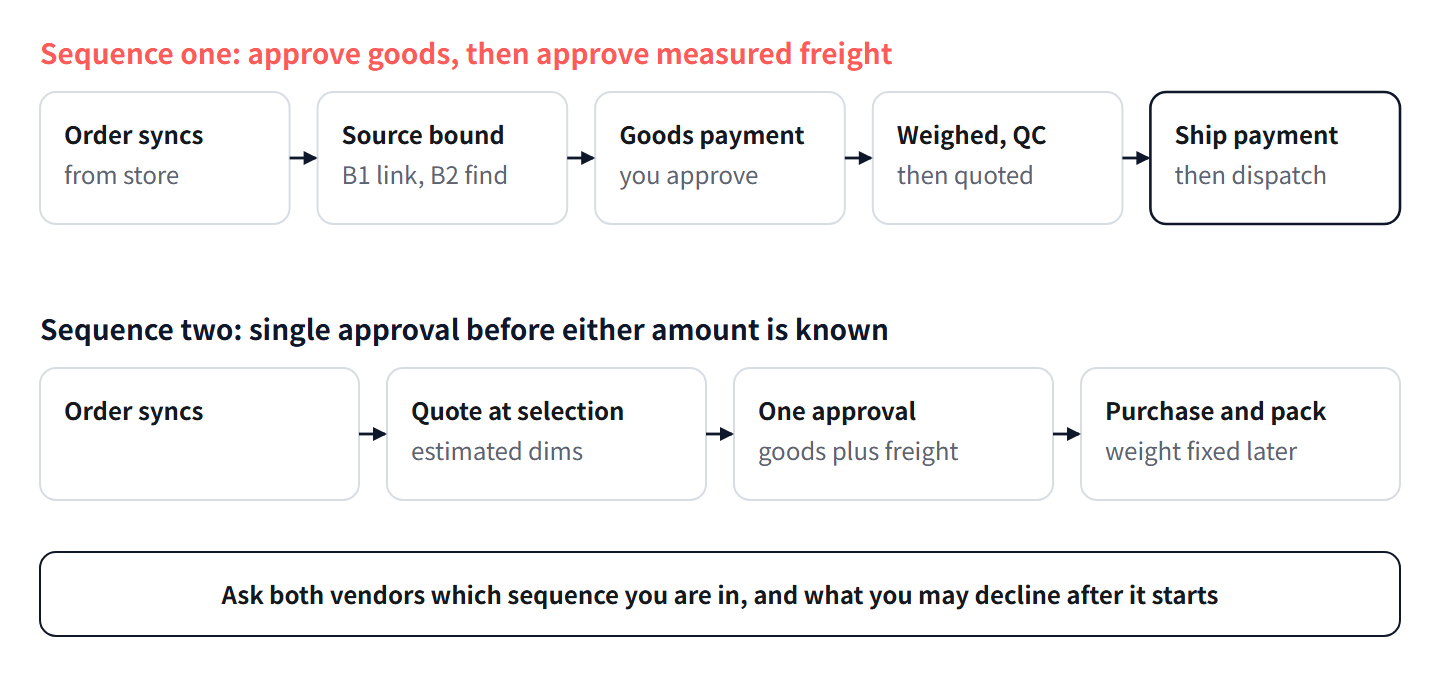
The sequence that matters most: quote, approval, payment
Everything else on this page is detail beside this one section. Reversibility is decided before anything ships, and it is decided almost entirely by order of operations.
Our sequence, step by step.
- The order syncs from your connected store. Read-only on your side; nothing else in the store is touched. Artefact: an order line with the variants it contains.
- The variant either already has a bound source, in which case the order routes immediately, or it does not, in which case you send a link, a keyword or a photo and candidates come back for you to pick one. Artefact: one confirmed source per variant.
- Goods pricing is produced for that source. You approve the goods payment, which starts the purchase at the marketplace. Artefact: the purchase begins, and nothing else is committed yet.
- The goods arrive at the warehouse. Three QC photos per item are taken, the parcel is weighed and measured, and only then is a shipping quote produced against the twenty-four routes available. Artefact: a freight quote based on measurement rather than on a listing.
- You approve the shipping payment. Consolidation, repacking and relabelling happen inside the same window if you asked for them. Artefact: a dispatched parcel and a tracking number written back to your store order.
The alternative shape, which you should document for whichever service you are evaluating.
- Establish which price is fixed before you commit. Request, in writing, a statement of what is locked at order creation and what can still change after packing.
- Establish whether there is a quote you can decline mid-process. Ask directly: after I approve, if the measured weight differs, can I cancel, and what does cancelling cost. Artefact: a written answer, or a documented absence of one.
- Establish the funding mechanism. Some operations work from a standing balance you top up; others take an approval per stage. Ask which, and ask what happens to an unused balance. Artefact: their description of the mechanism in their own words.
- Establish the requote threshold. If the measured weight exceeds the estimate, at what variance do they requote rather than silently adjust, and who has to approve that adjustment. Artefact: the threshold, or confirmation that there is none.
- Establish the inspection point. Ask whether QC photos exist before you are asked for the shipping payment or after. Artefact: the answer, which determines whether inspection is a gate or a report.
- Record all five answers in one document with today's date. You now have something comparable, which is the single most useful artefact this whole page can produce.
The difference between the shapes is not that one is right. A single approval is faster, needs fewer decisions from you, and suits a merchant who has a stable line and does not want to be consulted twice per parcel. Two approvals are slower and give you a gate: you can act on the QC photos and on the measured weight before you pay for shipping. Which one you want depends on how often your parcels surprise you.
The human touchpoint: when somebody has to take the order
Every automated line in this category has a boundary, and any comparison that pretends otherwise is not describing an operation. The interesting question is not whether a human gets involved, but where the line sits and what triggers it.
On our side the boundary is explicit and is in the documentation: keyword search, link search and image search run on the automated line and return candidates plus goods pricing. A freight quote requires the human sourcing line, because it depends on the packed dimensions and the route, neither of which can be known from a listing. We state that plainly. It is a constraint, and pretending it away would make every subsequent claim on this page less trustworthy.
Here is the complete list of triggers that pull an order onto a person rather than a machine, and you should ask the other side for the same list in the same form.
| Trigger | Why a machine cannot finish it | What to ask either vendor |
|---|---|---|
| Mixed marketplace basket | Different sellers, different dispatch times, one consolidation decision | Can one parcel hold goods from several marketplaces, and who decides when to pack it |
| Variant ambiguity | Two candidates match the photo and differ in specification | Who resolves the ambiguity, and do you get asked, or told |
| Suspected substitution by the seller | The marketplace seller sends something adjacent to what was ordered | At what point is this detected, and who bears the cost |
| Custom bundling or relabelling | Instructions are not machine-readable | What formats do you accept, and is there a limit per parcel |
| Freight quote against a route | Depends on packed dimensions and destination rules | Is the quote produced before or after measurement, and by whom |
| Damaged or short delivery | Requires a claim against the seller | How long do you have to raise it, and what evidence do they need from you |
| Restricted or awkward categories | Route eligibility varies by destination and product type | Which categories do you decline, in writing, before I send anything |
For each row, ask two things: how long a human takes to respond, and whether you can still cancel at that point. Those two answers, not the feature list, determine what an exception costs you.
Regional fit, and three cases where the other sequence wins
Two operations in the same country can still be built around different places and different things, and this is the axis most merchants forget to check until an order is already stuck.
Start with the source marketplaces. We source from six: 1688, Taobao, Weidian, Yupoo, Xianyu and Dewu. Each carries a different kind of seller. 1688 leans wholesale and factory-adjacent. Taobao carries the widest general range. Weidian holds a great deal of independent apparel. Yupoo is album-based and mostly used for catalogue browsing rather than checkout. Xianyu carries secondhand and surplus stock. Dewu is where a lot of branded footwear and streetwear inventory moves. Ask any other service for the same list, written down, because "Chinese marketplaces" is not an answer and covers everything from six sources to one.
Then destination coverage. We operate twenty-four routes across three service types: postal, commercial express and dedicated line. Ask the other side for their route list, matched to the destinations you actually ship to, rather than a total count. A route list that covers your top five destinations beats a longer list that covers none of them.
Worth stating plainly, because this comparison would be dishonest without it. If BuckyDrop turns out to run the second sequence described above, three situations make that sequence the better choice, and none of them is exotic.
Predictable parcels. When your items have a known size and weight and come from one supplier each, the mid-process gate mostly confirms what everybody already expected. Being asked twice per parcel then costs attention without returning information, and one approval at the start is genuinely better.
Dispatch-driven operations. If you are running paid traffic and measuring yourself on how fast orders leave, every hour spent waiting for your own approval is an hour the customer is waiting too. A sequence that moves immediately once the order exists wins that race, and no amount of control compensates for dispatch delay in that model.
High count, low value. If you ship many low-value orders a day, reviewing each one individually does not scale, and the cost of the occasional surprise is lower than the cost of reviewing everything. Choose flow over gates there, and use our fourteen questions to make sure you can still reconstruct an order afterwards.
Then category posture. Rather than claiming anything about which categories another service accepts, use this table as your own checklist and get answers in writing before you send anything.
| Category question | Ask it about both services | Record |
|---|---|---|
| Which categories are declined outright | Any accessories, electronics with cells, liquids, aerosols, anything with a compliance requirement | The written list |
| What evidence does each carrier route require | Battery declarations, material statements, age restrictions | Documents you must supply |
| Who decides the route | Do you choose from the list, or does the service assign one | Whether you can override |
| Where does consolidation stop being useful | At what point does a heavier combined parcel cost more than two light ones | The threshold, once you have measurements |
Decide by running this procedure
- Write down your three most recent problem orders, with what actually went wrong on each. Artefact: three concrete failures rather than a general feeling.
- For each failure, mark whether better sourcing, better information, or better logistics would have prevented it. Artefact: each failure assigned to one cause.
- Score the three causes. If most failures were about not having the goods, prioritise sourcing reach and variant binding. If they were about not knowing, prioritise inspection timing and quote transparency. If they were about transit, prioritise route coverage. Artefact: a primary requirement, named.
- Send the fourteen questions in the next section to both services, in writing, in one message each. Artefact: two sets of answers you can put side by side.
- Place three test orders through whichever service matches your primary requirement. One clean, one ambiguous, one deliberately difficult. Artefact: three dated outcomes.
- Compare the outcomes against your three failures. If the difficult order was handled better than your worst recent failure, you have your answer, and it is evidence rather than preference.
The thing to resist is deciding from the parts that are easy to compare. Feature lists, route counts and platform badges compare neatly and predict very little about what happens to a parcel that surprises everybody.
Fourteen questions to put to both vendors
Send these as one numbered message to each service. The point is comparability: identical wording, identical day, so that evasiveness shows up as a difference between two answers rather than as a feeling.
| Number | Ask both vendors exactly this | Why the answer is comparable |
|---|---|---|
| 1 | Can you start from an order I already sold, with no catalogue import | Yes or no, no room for nuance |
| 2 | Can a variant that is already selling be bound to a source I supply | Separates page-preserving workflows from rebuild ones |
| 3 | Is freight quoted before or after the parcel is weighed | Estimated versus measured is the whole freight question |
| 4 | Are goods and freight one payment or two | Determines what you can decline and when |
| 5 | What happens when the measured weight exceeds the estimate | Requote, silent adjustment, or absorbed variance |
| 6 | How many days of storage are included, and what starts the clock | Comparable as a number of days |
| 7 | List every charge that can appear on one order | An enumerated list either exists or it does not |
| 8 | Is there a subscription, a minimum quantity, or a sourcing fee | Yes or no per item |
| 9 | How many QC photos per item, included or charged | Number plus whether it is included |
| 10 | What is the return window on a purchase, and who pays return freight | Comparable as days and as a party |
| 11 | Which store platforms do you read orders from, and what do you write back | Integrations are binary |
| 12 | List the marketplaces you can source from, in writing | A list, not a phrase |
| 13 | Which categories do you decline | Scope stated before you send anything |
| 14 | What triggers a human to take over, and can I cancel once they have | Exception economics in one answer |
Two things to watch while the answers come back. First, whether either service answers the question asked rather than the one it prefers. Second, whether the numbers are given as published terms or as "typically", since "typically" is not a commitment and you will not be able to rely on it during a dispute.
One ambiguous order, and the arithmetic that decides it
Assumptions first, every one of them stated. Take an order containing one item weighing 380 grams as received, packed by the marketplace seller to 24 x 18 x 10 centimetres. Assume the route uses a volumetric divisor of 5000, meaning centimetres cubed divided by 5000 gives volumetric kilograms, and note that not every route uses the same divisor, so ask for it as part of question 3 above. Assume chargeable weight is the greater of actual and volumetric.
Actual weight: 0.38 kilograms.
Volumetric weight: (24 x 18 x 10) / 5000 = 4320 / 5000 = 0.864 kilograms.
Chargeable weight is therefore 0.864 kilograms, and the ratio of chargeable to actual is 0.864 / 0.38 = 2.27. The seller's carton is costing more than twice what the product weighs, and this is the normal case for anything packed with air.
Now assume the warehouse repacks it. Suppose removing the retail carton and an inner insert gets the same item into a mailer measuring 22 x 15 x 8 centimetres.
Volumetric after repacking: (22 x 15 x 8) / 5000 = 2640 / 5000 = 0.528 kilograms.
Chargeable becomes 0.528 kilograms, a reduction of 0.336 kilograms, which is 38.9 percent of the original chargeable figure. Repacking is included on our side, so the question is not what it costs but whether it happens by default, and that belongs in your fourteen answers.
Second scenario, same item, two units in one customer order.
Separately packed, at the original carton: 2 x 0.864 = 1.728 kilograms chargeable.
Consolidated into one mailer, assume 26 x 20 x 14 centimetres holds both: (26 x 20 x 14) / 5000 = 7280 / 5000 = 1.456 kilograms.
Consolidation saves 0.272 kilograms, or 15.7 percent of separate handling. Note that consolidation is not always a saving. Three small cartons sometimes weigh less than the padded box needed to hold all three safely, and the only way to know is to compare the measured figures, which is precisely why packing decisions belong after measurement rather than before.
Third scenario, the one that decides which vendor you use. Suppose the marketplace listing claimed 250 grams and 20 x 15 x 8 centimetres. The listing-based volumetric would be (20 x 15 x 8) / 5000 = 0.48 kilograms, and a freight figure built on that would be 44.4 percent below the measured 0.864 kilograms. Somebody absorbs that difference. If your vendor absorbs it silently, your quote history looks clean and your real costs drift. If your vendor requotes after measurement, your records are accurate and you get to decide whether to accept the parcel at that size, repack it, or decline.
That single mechanism is what question 3, question 4 and question 5 are testing, and it explains why this page keeps returning to sequence rather than to features.
Domande frequenti
Both services claim the same model. How do I choose without guessing?
Compare in writing rather than by reading marketing pages. Send fourteen identical questions to both, then place one clean order, one ambiguous order and one difficult order. The difficult order tells you more than every feature row combined.
Why can freight not be quoted for me automatically?
Because a real quote depends on packed dimensions and destination rules, neither of which exists anywhere until the goods are in a warehouse. Keyword, link and image search return candidates and goods pricing automatically on our side. The freight quote requires the human sourcing line, and that is a stated constraint rather than a shortcoming.
Can BuckyDrop and Lovegodrop run against one store at once?
Only with a strict rule attached: every variant has exactly one source. Two services both reading orders and both writing tracking will both try to fulfil a variant they each believe they own, and the customer receives two parcels.
What should I do when the measured weight comes back higher than I expected?
Treat it as information rather than bad news. Compare actual against volumetric, ask what repacking or consolidation would change, and then decide. Any amount prepaid above the measured figure is returned on our side, so the number you act on is the measured one.
Which categories are worth asking about before sending anything?
Anything with cells or batteries, liquids, aerosols, powders, magnets, and anything requiring a compliance document. Ask both services for their declined list in writing, because discovering it mid-order costs you the order.
Cosa fare questa settimana
- Email both services the fourteen questions in identical wording and file the answers side by side with today's date.
- Place one clean order, one ambiguous order and one deliberately difficult order, and record what happened to each.
- Compute actual versus volumetric weight on your three heaviest recent parcels, and note which ones repacking would have changed.
- Establish which categories either service declines, in writing, before you send another order.
- Write down which variants route where, so no order can be sent to two fulfilment paths at once.
Scritto e curato dal team di sourcing di Lovegodrop. Come vengono scritte e verificate queste pagine.
Inizia da un ordine già venduto
Collega un negozio Shopify o WooCommerce, scegli un ordine già pagato e consulta il preventivo di approvvigionamento e spedizione per quell'ordine prima di impegnarti.