
Rispondere a "dov'è il mio ordine" quando ancora non lo sai
La maggior parte dei ticket "dov'è il mio ordine" esiste perché anche il commerciante non vede lo stato dell'approvvigionamento. Cinque stati, una frase onesta ciascuno, e un triage dei blocchi.
Punti chiave
- Split the order into five states: purchased, in transit to warehouse, weighed and quoted, shipped, delivered.
- Write one truthful customer sentence per state, with no date in any of them.
- Never send a tracking number before the carrier has produced a first scan.
- Most real stalls sit in the weighed-and-quoted state and are blocked by your own shipping approval.
- A chargeback costs roughly 1.3 order-value units against about 0.01 for a proactive message.
WISMO is a supply-visibility problem wearing a support costume
A customer paid four days ago and nothing has moved. They write to ask where the order is, and the honest answer is that you do not know either, because the only thing your system can see is that the goods payment was approved and a purchase was placed at the marketplace seller.
That gap is where the ticket comes from. Not from impatience, not from rudeness. The customer is asking a question your supply chain has not answered yet, and the support desk is the only place the question can land.
Treating this as a support problem produces the standard fix: faster answers, better macros, another seat on the helpdesk. All of that moves the answer earlier by a few hours and leaves the cause untouched. The cause is that your order model has too few states. When "waiting for the seller" and "sitting at the warehouse unmeasured" are the same status in your system, the only truthful thing you can send is "soon", and "soon" is what generates the second ticket.
Three things follow from calling it a visibility problem instead. The fix belongs in the order model, not in the inbox. Ticket volume is a function of how many distinct states you can name, not of how quickly you type. And the most expensive tickets are the ones where the block is on your side and you did not know it was there.
The five states an order can actually be in
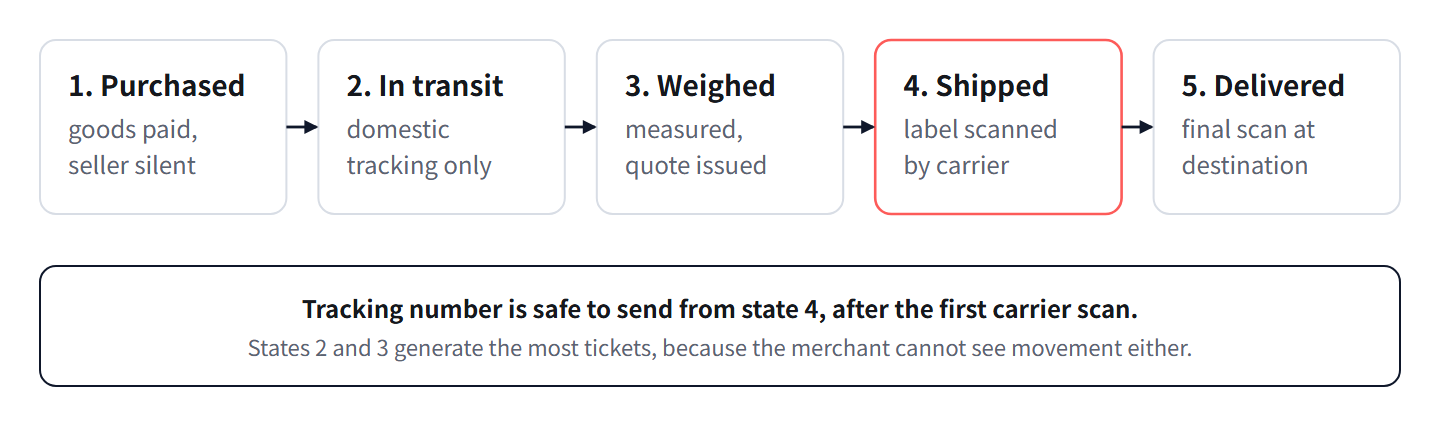
Five states is the smallest model that lets you answer truthfully. Three states ("processing", "shipped", "delivered") collapses exactly the two periods where the customer is most anxious and you are least informed.
| State | What is true | What your system can actually see |
|---|---|---|
| 1. Purchased | Goods payment approved, purchase placed at the marketplace, seller has not dispatched | Purchase record, seller name, marketplace order reference |
| 2. In transit to warehouse | Seller dispatched domestically; parcel moving to the consolidation warehouse; no international tracking exists yet | Domestic tracking number and its scans |
| 3. Weighed and quoted | Parcel received, weighed and measured, shipping quote issued, second payment awaiting your approval | Inbound receipt, weight, dimensions, quote, approval state |
| 4. Shipped | International label created and the carrier has physically scanned the parcel | Tracking number with at least one real scan |
| 5. Delivered | Final scan at the destination | Delivery scan and location |
State 3 is where most merchants lose the thread. It exists because goods and freight are two separate payments: the first starts the purchase at the marketplace, and the second is only quoted once the parcel has been weighed and measured at the warehouse. That design is deliberate, because marketplace listings routinely understate weight and dimensions, but it also means the order can sit still with the block sitting on your desk and nobody noticing.
What you can truthfully say in each state
One sentence per state. Each contains three parts: the state, the next event the customer should expect, and when you will write again. None contains a date.
| State | Say this | Do not say this |
|---|---|---|
| 1. Purchased | "Your order has been placed with our supplier and is waiting to leave their warehouse. I will write again as soon as it is on the move." | "Ships within 24 hours", "tracking will follow shortly", any calendar date |
| 2. In transit to warehouse | "Your order has left the supplier and is on its way to our warehouse. Once it is weighed and measured we will send you the shipping options and the tracking." | "Your order has shipped" (the customer hears international dispatch), the domestic tracking number presented as theirs |
| 3. Weighed and quoted | "Your parcel is at our warehouse, weighed and measured, and is waiting on the shipping confirmation. Nothing is lost; the next step is ours." | "Delayed", "warehouse backlog", silence |
| 4. Shipped | "Your parcel is with the carrier. Here is the tracking number, the first scan is visible, and the route is the one you chose." | A number that has no scan behind it |
| 5. Delivered | "Scanned delivered at the destination. If it is not with you, check with neighbours and the carrier's local depot first, then write to us." | Arguing with the scan, or "not our problem" |
The discipline is in the second column, not the first. Every one of those banned phrases is something a merchant writes when trying to be reassuring, and every one of them creates a belief the customer then acts on. "Ships within 24 hours" is a promise you did not get from the seller. "Your order has shipped" in state 2 is read as international dispatch, so three days later the customer is looking for a parcel that has not left the country.
A tracking number that exists is not a tracking number that moves
A label can be created before the carrier physically has the parcel. The moment the label is created, a number exists. Between that moment and the first physical scan there is a window in which the number resolves to "not found" or "no information yet", depending on the carrier and the route type.
Send the number inside that window and the customer opens it, sees nothing, and concludes the parcel does not exist. That is worse than silence, for one specific reason: silence leaves the customer in the state they were already in, whereas a dead tracking link creates a new belief, and the new belief is that you gave them a false number. A customer who believes that stops believing the next message you send, which is the point at which the conversation turns into a dispute filing.
| Tracking condition | What the customer sees | What you do |
|---|---|---|
| Label created, no scan | "Not found" or no events | Say nothing yet; send the state sentence for state 3 |
| First scan present | Origin or acceptance scan | Send the number |
| Scanned then stopped mid-route | Last known location, no new events | Send the state sentence plus the last scan location, and open a route trace |
| Delivered scan present | Delivery confirmation | Confirm and close, or start the non-delivery check |
Check the tracking yourself before you send it. One click, every time. The cost of that click is a few seconds; the cost of not doing it is the second ticket.
Triage for an order that has genuinely stalled
Every step below produces an artefact. The thresholds are internal triggers for you, not promises you pass to the customer.
- Write down the state and the timestamp of the last real event. Artefact: one line in your open-order log, with the state number from the five-state model.
- If the order has been in state 1 for more than 3 days, check whether the seller accepted the purchase rather than only receiving it. Artefact: a confirmation from the sourcing line. Escalation point A: no acceptance after 3 days, ask for a substitution candidate for the same variant.
- If the order is in state 2 and the domestic tracking shows no movement for 4 days, read the domestic scan history yourself. Escalation point B: no movement after 4 days, treat it as lost in domestic transit, reorder if the listing is still live, and tell the customer the order was re-purchased.
- If the order is in state 3, check whether the shipping payment is awaiting your approval. This is the most common self-inflicted stall and it costs you nothing to clear. Escalation point C: a quote older than 48 hours, ask for the packed dimensions to be re-confirmed before you approve.
- If the order is in state 4 with a label but no scan past the route's normal first-scan window, open a trace with the label number. Escalation point D: no first scan after 5 days, escalate to the route operator with the label and the dispatch date.
- Open one internal case per stalled order containing the order reference, the state, the last event timestamp, and everything you already checked. Artefact: a single case record, so the second person to touch the order does not repeat step 2.
- Write to the customer with the state sentence and the time of your next update, not with a delivery date. Artefact: one outgoing message, logged against the order.
- When the order passes your own stall threshold and you still cannot name the next event, offer the choice before the customer demands it: keep waiting, substitute the SKU, or refund the goods payment. Artefact: a recorded customer decision.
Step 8 is the one merchants skip, and it is the cheapest. A customer who has been given three options and picked one is not a customer who files a dispute.
The three data points that cut repeat tickets most
Put all three in the same place. A state with no timestamp reads as stale, and a timestamp with no named next event reads as a shrug.
| Data point | Where it goes | Which ticket it removes |
|---|---|---|
| Current state, in plain words, not status code | Order status page and the order confirmation email | "What is happening with my order?" |
| Timestamp of the last real event, plus the name of the next event | Same page, directly under the state | "Has anything happened since I asked?" |
| What is blocking, and whose side the block is on, when the block is yours | Same page, only when a block exists | "Why is nobody doing anything?" |
The third is the one almost nobody publishes, and it is the only one that converts a ticket into an action on your side. If the shipping payment is awaiting your approval, saying so on the order page is not a courtesy, it is the fastest way to get the approval noticed.
In practice the ranking is stable: state first, timestamp second, blocker third. Adding a fourth data point, such as the carrier name before the carrier has the parcel, adds volume without removing tickets, because it invites the customer to go and look at a tracking page that is still empty.
What one chargeback costs next to one proactive message
All figures below are ratios to one order-value unit. No currency appears, because the point is the shape of the cost, not the amount.
Stated assumptions:
- One order equals 1.00 unit of revenue.
- A chargeback returns the order value and adds a dispute fee plus internal handling. Assume the fee and handling together equal 0.30 units.
- Assume nothing is recovered from an in-transit parcel, so the recovery ratio is 0.
- One proactive message costs operator time only. Assume one operator minute costs 0.01 units, and one message takes one minute.
- Assume a month with 300 open orders, that 1 in 6 produces at least one WISMO ticket, and that 1 in 20 stalled orders becomes a chargeback when the customer is told nothing.
Chargeback cost: 1.00 plus 0.30, which is 1.30 units. Proactive message cost: 1 minute at 0.01, which is 0.01 units. Ratio: 1.30 to 0.01, or 130 to 1.
Now the month. Tickets are 300 divided by 6, which is 50. Unanswered stalls that become chargebacks are 50 divided by 20, which is 2.5.
Cost of silence: 2.5 chargebacks at 1.30 equals 3.25 units, plus nothing spent on messages, so 3.25 units. Cost of messaging all 50: 50 messages at 0.01 equals 0.50 units. Assume the messages remove 60 percent of the escalations, leaving 1.0 chargeback at 1.30. Total is 0.50 plus 1.30, which is 1.80 units.
Ratio: 3.25 to 1.80, which is about 1.81 to 1 in favour of messaging.
Now the sensitivity, because the 0.30 assumption is the one that moves: if the fee and handling equal 0.50 instead, a chargeback costs 1.50, silence costs 3.75, and messaging costs 0.50 plus 1.50 which is 2.00. The ratio becomes 1.88 to 1. The conclusion does not depend on the assumption, which is the whole point of doing it in ratios.
Domande frequenti
Should I send the tracking number the moment it is generated?
No. Send it after the first carrier scan. A number with no scan behind it reads as a dead link, and disputes get filed from that belief rather than from the delay itself.
What do I write when I genuinely do not know where the parcel is?
The state, the next event, and when you will write again. "It has left the supplier and is on its way to our warehouse; once it is weighed we will send the shipping options" is a complete answer even though it contains no location.
The tracking has not moved for days. What do I check first?
Whether the carrier has physically scanned it. A created label with no scan means the parcel is not yet in the carrier's network, which is a different problem from a parcel that scanned at origin and then stopped.
Should I refund early to keep the customer quiet?
Refund when the order is past your own stall threshold and you cannot name the next event. Refunding while the goods are still recoverable converts a slow order into a written-off one.
Will a tracking page on the store remove these tickets?
It removes the tickets caused by not knowing the state. It does not remove the ones caused by a state with no timestamp, or by a state with no named next event, because those are the questions the page leaves open.
Cosa fare questa settimana
- Take your open orders and assign each one of the five states. If more than a handful land in state 3, clear the shipping approvals first.
- Write the five customer sentences, one per state, and check that none of them contains a date.
- Change the tracking email so it fires on the first carrier scan instead of on label creation.
- Add the timestamp of the last real event to whatever status page your customers can see.
- Set one internal stall threshold per state and write it down where whoever answers the inbox can find it.
Scritto e curato dal team di sourcing di Lovegodrop. Come vengono scritte e verificate queste pagine.
Inizia da un ordine già venduto
Collega un negozio Shopify o WooCommerce, scegli un ordine già pagato e consulta il preventivo di approvvigionamento e spedizione per quell'ordine prima di impegnarti.