
Πώς να συγκρίνετε σωστά δύο προσφορές προμήθειας
Δύο προσφορές για το ίδιο SKU. Πέντε συνιστώσες αποφασίζουν ποια είναι φθηνότερη, και η γραμμή εμπορεύματος είναι μόνο μία από αυτές. Ο λόγος που τα κρίνει.
Βασικά σημεία
- Five components: goods, inbound, packing, freight, fees. Goods, inbound and freight are set by three parties who never see each other's numbers.
- Ranking on goods alone is right only when the other four are identical. They are not, and nothing in the process keeps them correlated.
- Normalise: divide the landed total by the selling price. One ratio per quote, comparable across every product in the catalogue.
- Fill six columns before you approve: goods basis, packing assumption, chargeable weight basis, route type, consolidation effect, payment structure.
- End with one accepted quote and one written sentence for each rejected one, naming the component that lost it and the condition that would reverse it.
You compared one number out of five
Two quotes land in your inbox for the same SKU. One is lower on the goods line by a margin you can see, and you approve it. Three weeks later the second payment arrives and the cheap one has cost you more. Nothing was misrepresented. You compared one number out of five, and the other four settled it.
This is not a failure of attention. The goods line is the only number a supplier volunteers, and it is the only one they control. Freight is quoted later, after the parcel has reached the warehouse and been weighed and measured, on a basis the supplier cannot observe. So the comparison available on the day you ask is systematically the comparison that leaves out the largest variable part.
The fix is not to ask for more quotes. It is to put every quote through the same five components, express the result as a ratio, and record why the losers lost.
The five components, and which of them move alone
| # | Component | Set by | Moves independently? | Where you can intervene |
|---|---|---|---|---|
| 1 | Goods price | The marketplace seller, at the variant level | Yes. It tracks seller stock, order quantity and the variant, with no relationship to anything downstream | Compare sellers; bind a second source; accept a different variant |
| 2 | Inbound to the warehouse | The seller's location and how they dispatch | Yes, and it is usually the smallest of the five | Ask whether the seller dispatches direct to the warehouse. Rarely worth optimising |
| 3 | Packing | The warehouse, as an assumption until the parcel is measured | No. It is downstream of the goods, and it is a decision, not a fact | State the packing before the purchase: de-box, mailer not carton, no void fill |
| 4 | Freight | Route type multiplied by chargeable weight | Yes, and it is the largest variable component | Choose the route; change the packed dimensions; consolidate |
| 5 | Fees and payment structure | The platform's payment structure | No. It is fixed in structure, but it attaches per payment | Decide how many payments an order splits into, because a fee rides on each |
The "moves independently" column is the one that matters. Components 1, 2 and 4 are produced by three different parties who never see each other's figures. There is no mechanism that keeps them proportional, and no reason for a seller with a good price to be a seller with a compact parcel.
Components 3 and 5 are different in kind. They are not facts you discover, they are decisions you make or fail to make. That makes them the two you can still change after the quote arrives, and the two a supplier will never mention, because a supplier is not the one deciding them.
Why the goods ranking inverts
Ranking on goods alone is correct exactly when the other four components are equal across the quotes. They are not equal, and the size of the difference is not small relative to the goods gap.
Assumptions for the worked example, stated once and used throughout:
- The store sells the variant at a price we call S. Every figure below is a share of S, so no currency appears.
- The product: 900 g actual, rigid, 24 × 18 × 10 cm at its own envelope.
- Route: the same dedicated line for both quotes. Freight rate r = 9% of S per chargeable kilogram, per-parcel component h = 2% of S, minimum chargeable weight 0.5 kg, volumetric divisor 5000.
- Inbound to the warehouse: equal for both, treated as zero.
Supplier A: goods 26% of S. Ships inside a supplier carton, always. Supplier B: goods 31% of S. Ships in a poly mailer.
Supplier A, packed 30 × 22 × 14 cm:
- Volumetric = 30 × 22 × 14 = 9,240 cm³ ÷ 5000 = 1.848 kg
- Actual = 0.90 kg. Chargeable is the greater: 1.85 kg
- Freight = 1.85 × 9% + 2% = 16.65% + 2% = 18.7% of S
- Landed = 26% + 18.7% = 44.7% of S
Supplier B, packed 28 × 20 × 6 cm:
- Volumetric = 28 × 20 × 6 = 3,360 cm³ ÷ 5000 = 0.672 kg
- Actual = 0.90 kg. Chargeable is the greater: 0.90 kg
- Freight = 0.90 × 9% + 2% = 8.1% + 2% = 10.1% of S
- Landed = 31% + 10.1% = 41.1% of S
The goods ranking says A is cheaper by 5 points of S. The landed ranking says B is cheaper by 3.6 points. A over B, landed: 44.7 ÷ 41.1 = 1.088, so the quote that looked cheaper costs 8.8% more by the time the parcel is billed. Contribution left after freight: 55.3% of S against 58.9% of S.
Two sensitivities, because this example is decided by the packing, not the price:
- At divisor 6000 instead of 5000: A's volumetric becomes 9,240 ÷ 6000 = 1.54 kg, freight 13.9% + 2% = 15.9%, landed A = 41.9% against B's 41.1%. The gap closes from 3.6 points to 0.8 points. Same quotes, different divisor, nearly a tie.
- If A agrees to de-box and ship in a 28 × 20 × 7 mailer: volumetric 3,920 ÷ 5000 = 0.784 kg, actual 0.90 kg wins, freight falls to 10.1%, landed A = 36.1%. Now A wins by 5 points, and the packing instruction was worth 8.6 points of the selling price, which is larger than the entire goods gap that started the comparison.
Read the freight share before you read the total. In the A column, freight is 18.7 of the 44.7 points, which is 42% of the landed cost. In the B column it is 10.1 of 41.1, which is 25%. That difference is the whole story of the two quotes, and it is invisible if you only look at the bottom line. A quote whose freight share is above half is telling you that the goods negotiation is not where the next point of margin is, and a quote whose freight share is under a quarter is telling you the opposite.
The example also shows why a packing instruction belongs in the comparison rather than after it. Both quotes were offered with a packing assumption attached, and neither supplier was asked about it. The 8.6 points available from changing A's carton to a mailer were available all along, and they were larger than the 5 point goods gap that the whole decision had been resting on. Any comparison that leaves the packing assumption unexamined has compared the two goods prices and nothing else.
How often does the inversion happen? Take the structure rather than a rate from anyone, including us. The goods ranking and the landed ranking disagree precisely when the spread across components 2 to 5 is larger than the spread in component 1. Those two spreads come from different parties, so there is no mechanism keeping one above the other. Keep a log of your own quote pairs and count the inversions; that is the only rate that describes your catalogue. Merchants who keep the log are usually surprised how near an even split it lands, which is the sense in which "roughly half" is meant here.
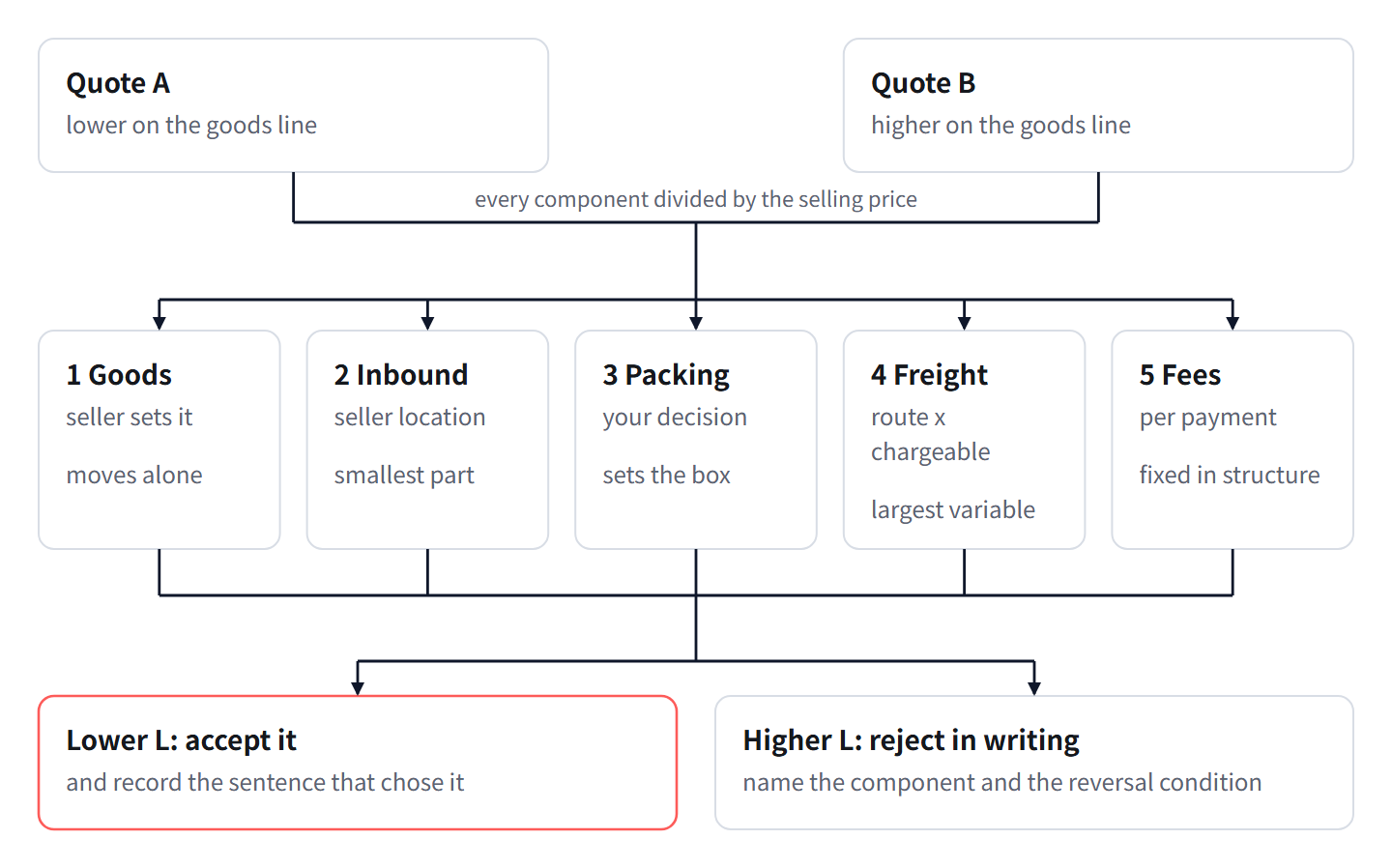
Normalise every quote against the selling price
Two quotes for two different products cannot be compared as totals. A heavier product will always look worse. Divide by the selling price and the comparison becomes meaningful across the whole catalogue.
Define one ratio per quote: L = landed total ÷ selling price. Everything else follows from it.
| Derived figure | How to get it | What it tells you |
|---|---|---|
| L, the landed ratio | Landed ÷ S | The only number comparable across products |
| Freight share | Freight ÷ landed | Above half means you are in the freight business, not the goods business |
| Goods share | Goods ÷ landed | Below half means negotiating the goods line is not where the next point is |
| Contribution | 1 − L | What is left for everything that is not this parcel |
| L sensitivity to packing | Recompute L with a mailer instead of a carton | The size of the lever you have not pulled yet |
Read L in bands, and set your own thresholds rather than accepting these:
| L band | Reading | Action |
|---|---|---|
| Below 40% of S | Freight is not the constraint | Negotiate goods; consider holding stock if the SKU archetype supports it |
| 40% to 55% of S | Normal for most categories | Improve freight before goods; it is the larger movable part |
| 55% to 70% of S | Freight dominates; packing or route is wrong | Re-quote with an explicit packing instruction before you buy again |
| Above 70% of S | The product does not carry this route | Change route, change product, or stop selling it at this price |
The procedure, five steps, one artefact per quote:
- Write the store's selling price for that variant at the head of the row. If the variant sells at more than one price, use the price you actually expect to realise, not the list price.
- Enter the goods figure as a share of S, with the quantity it is quoted at.
- Enter the packed dimensions you expect, not the dimensions on the listing, and compute chargeable weight at the route's divisor.
- Multiply by the route rate to get freight as a share of S, then add the per-parcel component and any minimum that binds.
- Add inbound, and the fee that attaches to each payment. Write down L, the freight share, the divisor you used and the date.
The artefact is one row per quote in a sheet you can sort by L. Sorting is the point: the bottom of that list is the SKU whose freight you have never actually looked at.
Two properties of the ratio make it worth the five minutes. It survives a price change. If you discount the selling price by 10%, L rises for every SKU, and the ones with the highest freight share rise most, so a discount hits your bulkiest products hardest and the sheet shows you that before you run the promotion. And it survives a catalogue change. A ratio computed on a mug and a ratio computed on a jacket are the same kind of number, so a threshold you set once applies everywhere, which no absolute total can do.
One caveat: L is only as good as the selling price you put in the denominator. If you enter the list price and then discount most orders, every L in the sheet is understated by the same proportion, and the bulkiest SKUs are understated most. Enter the price you actually realise.
The six columns to fill before you approve
| Column | What you are filling in | Quote A | Quote B | If the cell is blank |
|---|---|---|---|---|
| Goods basis | Price per unit at which quantity, and whether the variant is confirmed | 26% of S at quantity one, variant confirmed | 31% of S at quantity one, variant confirmed | Ask for the quantity tier. A unit price at quantity one is not comparable to one at quantity ten |
| Packing assumption | What the warehouse will put it in, stated before the purchase | Supplier carton, 30 × 22 × 14 | Poly mailer, 28 × 20 × 6 | Instruct it. Unstated packing is an assumption you are paying for |
| Chargeable weight basis | Greater of actual and volumetric, with the divisor named | Volumetric wins: 1.85 kg at divisor 5000 | Actual wins: 0.90 kg | Ask which of the two governs and at what divisor. "By weight" is not an answer |
| Route type | Postal, commercial express or dedicated line, and whether a minimum binds | Dedicated line, 0.5 kg minimum | Dedicated line, same | Compare the same route first, then vary one thing at a time |
| Consolidation effect | What the total does when this parcel joins another | Box steps up at four units | Nests flat, two per footprint | Ask for the number both ways. It is often larger than the goods gap |
| Payment structure | How many payments, and what attaches to each | Two approvals, a processing fee on each | Two approvals, same | Decline a single bundled payment. You lose the ability to audit either half |
What a bundled quote hides, and the three questions that unbundle it
A bundled quote gives one number covering goods, handling and freight. It is not necessarily bad value. It is unauditable, which is a different and more durable problem.
It discloses none of the three inputs: the goods line on its own, the chargeable weight, and the rate applied to that weight. Without those three, you cannot tell next month whether a change in the number came from the seller raising a price, the parcel getting bigger, or the route changing. You also cannot tell whether a packing instruction made anything better, because there is no baseline.
Three questions, in this order, and accept nothing that answers a different one:
- What is the goods line on its own, at this quantity, for this variant?
- What chargeable weight is this built on, actual or volumetric, and at what divisor?
- If the measured weight comes in above that figure, do I approve the difference, or does the quote stand?
The third is the one that converts the document from an estimate into a commitment. A quote that stands is a fixed price. A quote that moves is an estimate, and should be priced as one.
Structurally, two payments solve this without an argument. The goods payment starts the purchase at the marketplace. The shipping payment is requested only after the parcel has arrived at the warehouse and been weighed and measured, and you approve it separately. If the amount prepaid exceeds the measured amount, the difference is returned to you.
One order into two shipments, or one consolidated parcel
Assumptions: an order of six units of one SKU, each unit 0.40 kg actual, each unit boxed at 22 × 16 × 8 cm. Rate r = 9% of S per chargeable kilogram, per-parcel component h = 2% of S, divisor 5000.
Consolidated into one carton, 34 × 26 × 22 cm:
- Volumetric = 34 × 26 × 22 = 19,448 ÷ 5000 = 3.89 kg. Actual 2.40 kg. Chargeable 3.89 kg
- Freight = 3.89 × 9% + 2% = 35.0% + 2% = 37.0% of S
Split into two parcels of three, each 26 × 18 × 18 cm:
- Volumetric per parcel = 8,424 ÷ 5000 = 1.685 kg. Actual 1.20 kg. Chargeable 1.685 kg
- Freight = 2 × 15.2% + 2 × 2% = 30.3% + 4% = 34.3% of S
Split over consolidated = 34.3 ÷ 37.0 = 0.927. Splitting is 7.3% cheaper on freight. What you buy with that 7.3% is a second tracking number, a second customs declaration, and, for a customer who ordered six units, a second arrival that they have to reconcile against one order.
The threshold is the useful part. Consolidation is cheaper when 3.89r + h is less than 3.37r + 2h, which rearranges to h greater than 0.52r. In words: consolidate whenever the per-parcel fixed component exceeds the freight on 0.52 chargeable kilograms. On a route priced mostly by weight, splitting can be marginally cheaper; on a route with a large fixed component, consolidation wins on arithmetic before you count the operational cost of two arrivals.
Consolidation of multiple orders into one parcel is included at no extra charge with us, so the saving above is freight arithmetic, not a service line.
The procedure that ends in one accepted quote
- Put both quotes on one sheet, in the six columns above. One row each.
- Fill every blank by asking, not by assuming. Run one round of questions. Any cell still blank after that round is a no for that quote.
- Compute L for each, using the same selling price and the same route.
- Recompute L with the packing instruction you intend to give. The quote that wins under your packing instruction is the quote to accept, not the one that wins as offered.
- Accept the lowest L. Write one sentence: "Accepted B, L = 41.1%, because A's carton adds 8.6 points of freight."
- For each rejected quote, write one sentence naming the component that lost it and the condition that would reverse it: "A would win if it ships in a 28 × 20 × 7 mailer."
- Send the packing instruction with the goods approval, in the same message, so the second payment is measured against the parcel you asked for rather than the parcel someone chose.
The artefact is an acceptance record: one chosen quote, one reason, and one reversal condition per rejected quote. The reversal condition is what makes the record worth keeping, because component 1 and component 4 move on their own and the file tells you which one to re-check.
Four costs that are easy to forget, and where they surface
| Cost | Where you first see it | Where it actually lands | How to surface it before approving |
|---|---|---|---|
| The fee on each payment | As a separate line at each approval | On the goods payment and again on the shipping payment, so more payments means more of it | Ask what attaches to each payment. |
| Re-handling when the packing assumption is wrong | When the measured weight comes back above your estimate | As a second packing decision, a second measurement, and a message thread you spend an hour on | State the packing before the purchase. Packing is a decision, not a fact you receive |
| Storage past the included 90 days | Nowhere, until it is charged or until you notice a parcel has been sitting | As a charge later, or as capital in units you cannot sell anywhere else | Write the exit condition before you buy: the date or the sell-through at which the units move or are written off |
| The second shipment after a split | As a second tracking number in the order | As customer service time, as a delivery the customer has to reconcile, and as a second chance of a delay | Prefer one parcel unless the arithmetic above wins by a margin worth that operational cost |
Συχνές ερωτήσεις
Should I ever accept the higher goods price?
Yes, when the goods gap is smaller than the freight gap, which is what the worked example shows. Write the condition down rather than the conclusion, because the two components move on their own and the condition is what tells you when to revisit.
How do I compare quotes for two different products?
Divide by the selling price. The landed ratio L puts a heavy product and a light product on the same scale, and the derived figures tell you whether freight or goods is the part to attack in each case.
Is a bundled quote always worse value?
No. It may be perfectly good value. It is unauditable, which is a separate problem: you cannot detect a change in any one input, and you cannot prove a packing instruction helped.
How many quotes do I need?
Two as a minimum, three when the SKU is new. Two prices for the same SKU from the same seller at two quantities is one quote, not two, because component 1 is the only thing that moved.
What happens when the measured amount is lower than what I prepaid?
The difference is returned to you. Record the measured figure as the new baseline for that SKU, because it replaces every estimate you derived from the listing.
Τι να κάνετε αυτή την εβδομάδα
- Take your three highest-volume SKUs and write the selling price S at the head of a row for each.
- Enter the goods share, and compute the chargeable weight from the packed dimensions you expect at divisor 5000.
- Compute L for each, sort the sheet, and look hard at the bottom row.
- Send one packing instruction with your next goods approval: mailer not carton, de-box where the item is not fragile, no void fill.
- Write the acceptance sentence and one rejection sentence for the last quote you approved, even if it has already shipped.
Συντάχθηκε και συντηρείται από την ομάδα sourcing της Lovegodrop. Πώς γράφονται και ελέγχονται αυτές οι σελίδες.
Ξεκινήστε με μια παραγγελία που έχετε ήδη πουλήσει
Συνδέστε ένα κατάστημα Shopify ή WooCommerce, επιλέξτε μια πληρωμένη παραγγελία και δείτε την προσφορά προμήθειας και αποστολής ακριβώς για αυτή την παραγγελία πριν δεσμευτείτε.