
Yupoo est un album photo, pas une boutique
Un album Yupoo contient des photos et un contact de chat, sans panier, sans prix et sans stock. Ce que cela implique pour l'étape entre l'album et l'achat.
L'essentiel
- Yupoo is an image-hosting album service. Sellers use it precisely because it is not a storefront.
- An album page tells you the range and the contact. It cannot tell you the price, the stock or the build.
- Read five signals: photo quality, watermark, contact block, size charts, update cadence.
- Four mitigations: two-way contact first, a test unit, a second candidate held, and a local copy of the photo.
- Save the photo, not the URL. Albums get renamed, split and deleted, and the photo is the durable handle.
What a Yupoo album is, structurally
A seller sends you a link. You open it and get a wall of photographs with a chat handle at the bottom of the page. There is no price anywhere on it, no add-to-cart button, no stock count, and no way to buy anything.
That is not a broken storefront. Yupoo is an image-hosting and album service, and the sellers using it are not trying to run a shop. They host albums and they take orders over a chat app. The album holds photographs, grouped into sub-albums, with a contact block; it holds nothing else.
The absence of the three things you would expect is the whole point of it. No cart means no public checkout. No price field means no public price list that a competitor can read. No stock system means no public record of what sold and what did not. A seller can rename an album, split it, merge it, or delete it, and there is no marketplace ledger anywhere that noticed.
What an album page tells you and what it does not
The practical consequence is one sentence: an album cannot be ordered from. Between the album and the purchase there has to be a sourcing step, and that step is a person or a service resolving a photograph into a listing that can actually be bought.
| What is on the album page | What you can read from it | What it cannot tell you | What to do with it |
|---|---|---|---|
| The photograph set | The range, the colourways, the styling | The price, the stock, the build | Save the single photo you want, not the album |
| The watermark | Whose album it is, and who else is using the same photographs | Whether that account is the seller | Search the watermark string elsewhere before you trust it |
| The contact block | Which chat handle to use | Whether the handle is still live, or how fast they answer | Message it from a throwaway account first |
| Album update times | Whether the seller is still active | Whether any specific item is in stock | Treat an album quiet for over eight weeks as dormant |
| Size charts, where they exist | The dimensions the seller claims | The dimensions the item is | Treat every figure as unverified until the warehouse measures it |
| View counters or comments | That traffic exists | Anything you can act on for one order | Ignore them |
The last two rows are where merchants misread the page. Activity on an album is not activity on an item, and a stated dimension on a page with no stock system behind it is a typed number, not a measured one.
Reading an album for sourcing signals
Five signals, and you can read all five in about four minutes. Each has a strong shape and a weak shape.
| Signal | Strong | Weak | What the weak shape means |
|---|---|---|---|
| Photo quality | Consistent lighting, the same background across the set, close shots of hardware and seams | Mixed sources, screenshots from somewhere else, model shots only | The seller may not hold the item |
| Watermark | One account, placed consistently | None at all, or three different ones in one album | The photo set is circulating |
| Contact block | One or two named handles, with hours stated | A single handle, no hours, or a handle that changes between albums | There is no stable counterparty |
| Size charts | A chart per product type, with the unit stated | None, or one chart copied across every album | The figures are decorative |
| Update cadence | New photos or sub-albums at a steady interval | A burst, then nothing for months | The range behind the link is not being maintained |
Read them together rather than one at a time. Strong photos with no watermark is a different seller from weak photos with a strong contact block, and the two need different handling.
The risk that comes with a seller who has no storefront
A seller with no public storefront has none of the things that normally constrain a seller. There is no marketplace holding a record of the transaction, no rating they have to protect, and no listing history you can look up. What they have is an album they can delete and a handle they can abandon, and both cost them nothing.
That is the risk profile, and it does not make the source unusable. It makes it a source you use with four things in place.
- Two-way contact before any money moves. Message the handle and ask three things in one message: the price, the stock, and how the item is packed. Keep the answer in the thread. A handle that answers none of the three has told you what you needed.
- A test unit on the smallest SKU, before anything larger. The test is not about the item; it is about whether the handle is a seller.
- A second candidate held from the same photograph, so the album is not a single point of failure.
- A local copy of the source photograph, with the album URL and the date beside it.
The fourth one is the one people skip, and it is the one that pays.
From an album page to a purchasable source
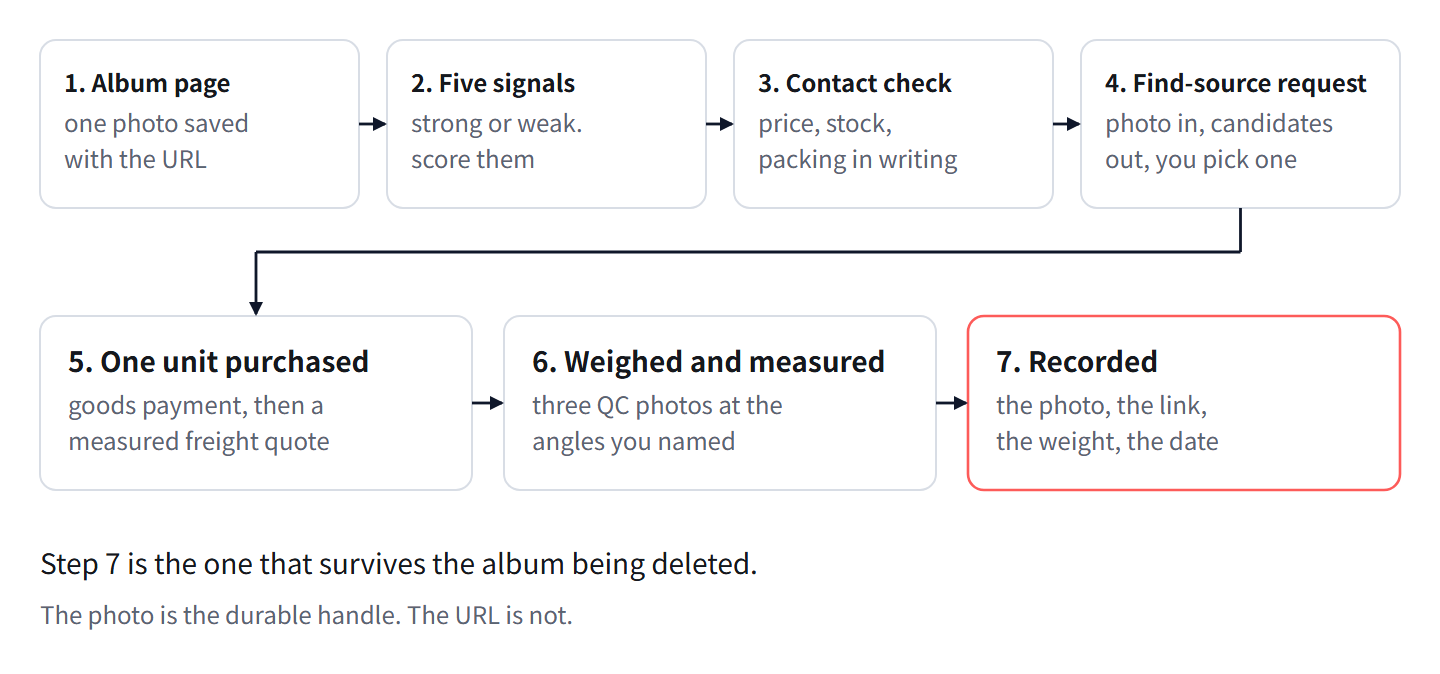
- Open the album and pick the exact photograph, not the album. Save it, and write the album URL and today's date beside it. Artefact: a local image with a provenance line.
- Read the five signals and mark each one strong or weak. Artefact: a five-line read of the seller.
- Message the contact handle from the album and ask the price, the stock and the packing in one message. Save the answer text, or the absence of one.
- Send the photograph to the sourcing line as a find-source request and ask for candidates from the six marketplaces. Artefact: a candidate list. The automated line returns candidates and goods pricing; the freight number needs the human line, because it depends on packed dimensions and route.
- Pick one candidate and store it against the variant, with the album URL beside it in the same row.
- Place one unit. When it reaches the warehouse, record the measured weight and the measured dimensions and set them against what the seller said in step 3. Artefact: the measured row, and your first real number for that seller.
Keeping an album-derived source stable when the album moves
Albums get renamed, split, merged and deleted. When that happens the URL you saved returns nothing, and the photographs you sourced from are gone with it. The source is not the album; the source is the photograph plus whatever you recorded at the time.
- Keep the local copy of the source photograph. The photograph is the durable handle and the URL is not.
- Record the album URL, the date you sourced, and the watermark string in the same row as the variant.
- When a link fails, re-source from the photograph, never from the URL.
- Re-read the update cadence monthly. A dormant album is the signal to promote the backup candidate, not to wait.
- When the seller changes handle, treat the old thread as closed and run the two-way contact again from the start.
There is one more case, and it is the one that catches merchants who did everything else right. The album comes back, but with different photographs: the seller rotated the range and the item you were sourcing is no longer pictured. The five checks have to be run again on the new photographs, because the item behind the same handle may not be the item you measured.
Worked example: one album page, three signals, one decision
Every input stated. An album contains 240 photographs across 6 sub-albums. The watermark is present and consistent across 5 of the 6. One contact handle, no hours posted. New sub-albums appear at roughly one every 5 weeks, and the most recent is 9 weeks old. There is no size chart anywhere in the album.
- Range arithmetic. 240 ÷ 6 = 40 photographs per sub-album. Three of the six sub-albums are colourways of the same product, so the distinct items behind the album are 4, not 240. The apparent range is 60 times wider than the real one.
- Signal score. Photo quality strong, watermark strong, contact block weak, update cadence weak, size charts absent. Two of five strong.
- The decision rule. Four or five strong, treat it as a primary source. Two or three, a test unit with a fallback held. Zero or one, do not use it until the two-way contact has happened.
- The result. Two of five puts this seller in the middle band: one test unit, a fallback candidate held from the same photograph, and the packing question asked in the first message rather than the fourth.
- The cadence check. The album's own interval is 5 weeks and the most recent activity is 9 weeks old, which is 1.8 times the interval. The seller is drifting, and a drifting seller is the one whose album disappears next.
When an album is the wrong kind of source
| Situation | Use the album? | Why |
|---|---|---|
| A one-off order the customer has already paid for | Yes | It is the fastest catalogue there is |
| A SKU you sell 40 units of a month | No | An album cannot hold stock, and there is nothing to bind |
| A multi-unit order | No | There is no quantity behind the photograph |
| A SKU where the packing decides the freight | Only with a test unit | The album states no packed dimensions |
| A SKU with a high return rate at your store | No | There is no marketplace standing behind the seller to appeal to |
| A catalogue build or a pre-order | No | Neither is a stock channel |
The pattern in that table is simple. Albums are good at showing you what exists and bad at guaranteeing that it will exist tomorrow.
Questions fréquentes
Can I order directly from a Yupoo album?
No. There is no cart, no checkout and no price on the page. The album is a catalogue and a contact, and the purchase happens after someone resolves the photograph into a listing that can be bought.
Why do sellers use an album instead of a store?
Because an album is not public in the way a storefront is. There is no public price list, no public stock and no public sales record, and the seller can take the whole thing down without a marketplace noticing.
Is a watermark enough to identify the seller?
It identifies the account that published the photographs. It does not tell you that the account holds the item, and the same photograph set circulates across several accounts.
What if the album disappears after I have bound the source?
Re-source from the photograph you saved. This is the case the local copy exists for, and the reason the record holds the watermark string as well as the URL.
How many units should the first order be?
One. The first order on an album-derived seller is a measurement of that seller, not a stock purchase, and one unit is the smallest order that produces a measured weight and a dispatch interval.
À faire cette semaine
- Pick your three album-derived SKUs and save the source photograph for each, with the URL and the date.
- Score the five signals on each seller and put the score in the SKU record.
- Message each contact handle with the price, stock and packing question in one message, and save the answer.
- Hold a second candidate for the SKU you depend on most.
- Place one unit on the weakest of the three and record the measured weight against what the seller claimed.
Rédigé et maintenu par l'équipe sourcing de Lovegodrop. Comment ces pages sont rédigées et vérifiées.
Commencez par une commande déjà vendue
Connectez une boutique Shopify ou WooCommerce, choisissez une commande payée et voyez le devis d'approvisionnement et d'expédition pour cette commande précise avant tout engagement.