
Twelve questions to ask a sourcing agent before you pay
Before the first payment you hold the approval they want. Twelve questions in four buckets, and a score that turns the answers into a go or a no-go.
Key takeaways
- Ask before the goods payment clears, because that is the last moment you hold anything they want.
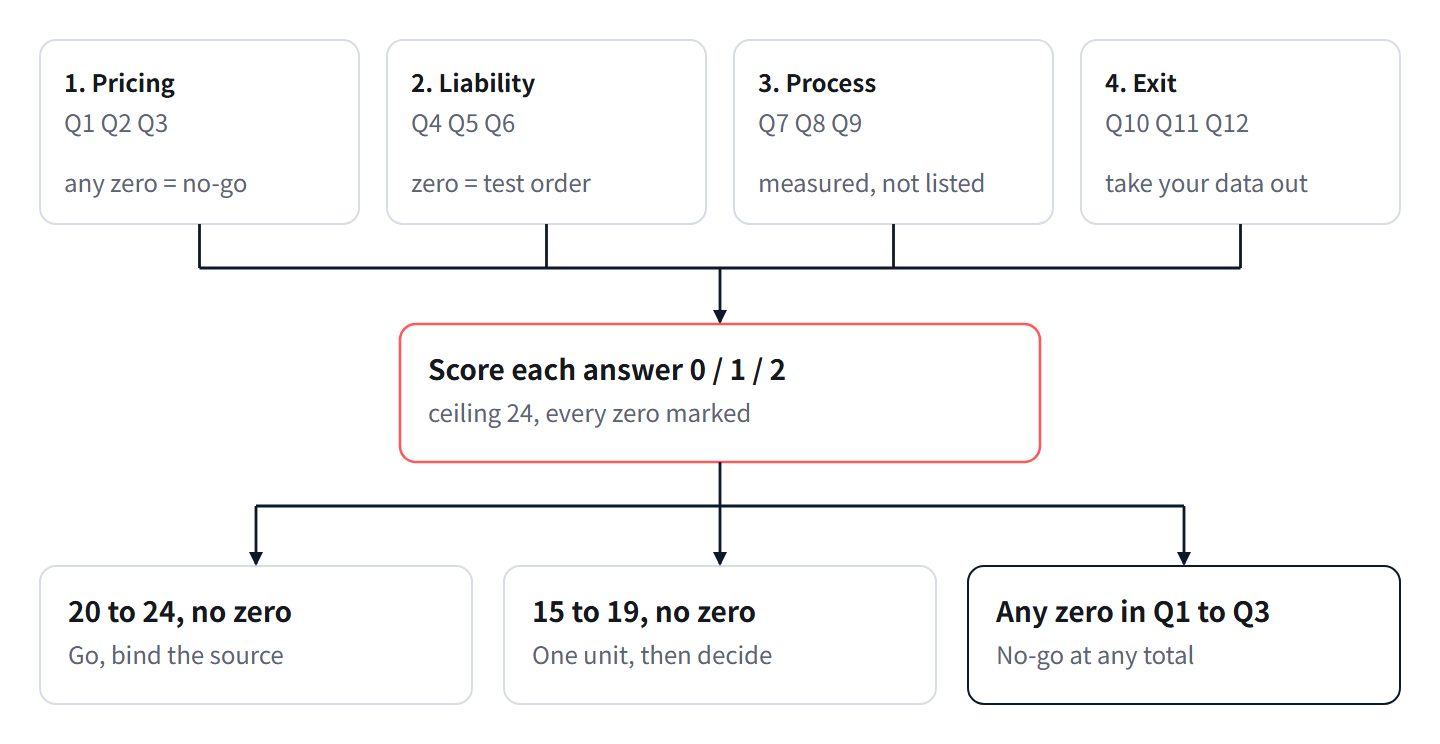
- Twelve questions in four buckets: pricing transparency, liability, process, exit. Score each 0, 1 or 2 out of 24.
- Any zero in the pricing bucket is a no-go on its own, whatever the total says.
- A quote that bundles goods and freight cannot be audited, because it discloses none of the three inputs the freight charge is built from.
- Two questions cannot be answered before the first order: will the seller dispatch, and what will the parcel actually weigh. Bound them with a one-unit order.
The first payment is the only leverage you will ever have
A sourcing agent has your SKU, your store and a goods payment they want you to approve. The moment that payment clears, the relationship inverts: they hold your money, your goods and your customer's order, and the instruments left to you are a message thread and a complaint. Before it clears, you hold the one thing they are asking for.
That is the whole argument for asking before you pay rather than after. Every answer you get before the payment is an answer you extracted. Every answer you get after it is a favour, and a favour from a party who already has the money is worth exactly what they decide it is worth.
There is a second reason, and it is practical rather than tactical. The answers are cheaper before you have an order at risk. A vague answer about the return window is a curiosity on the day you ask and a lost order on the day you need it, and by then the thing you can do about it has shrunk to absorbing the loss.
Twelve questions, four buckets, one pass. Each one is here because the answer determines something you can act on, and each one has a shape that should stop you and a shape that should not.
Bucket one: pricing transparency
Three questions, and they are first because the other nine are worthless if these three go badly. They are also the three an agent is most likely to wave at rather than answer, because answering them means disclosing a basis.
| # | Question | The answer that should stop you | The answer you can accept |
|---|---|---|---|
| 1 | Will the goods and the freight be two separate payments, each with its own approval? | "One all-in price", "shipping is included", a single combined invoice | Two approvals: the goods payment starts the purchase at the marketplace; the shipping payment is only requested after the parcel is weighed and measured |
| 2 | What governs the freight: actual weight, volumetric weight, or whichever of the two is greater? And what divisor? | "By weight", or a figure with no basis stated for it | Chargeable weight is the greater of actual and volumetric, the volumetric divisor is named for the route, and the measured figures are shown before you approve |
| 3 | What charges exist besides goods and freight, and are they published? | A service fee, a sourcing fee or a handling charge that surfaces after the quote | A short named list: storage, three QC photos per item, relabelling, repacking and consolidation included, and nothing else |
The third question is where most merchants stop one step too early. An agent who says "no service fee" has answered the question you asked and not the one you meant. The question you meant is: what will appear on the second payment that is not freight. Ask it in those words and you get a different answer.
Bucket two: liability
| # | Question | The answer that should stop you | The answer you can accept |
|---|---|---|---|
| 4 | When the item reaches the warehouse damaged or as the wrong item, who puts it right and within how long? | "The warehouse checks it", or a remedy with no deadline attached | An inspection before the shipping payment, three photos per item, and a stated window in which the purchase can be returned |
| 5 | If the seller dispatches nothing at all, what happens to my money? | "We will chase them", with no date and no mention of a refund | An escalation with a deadline attached, and the goods amount back to your balance when the purchase fails |
| 6 | Do you hold the goods until I approve, or does the parcel leave on a default? | Anything that leaves the warehouse without a second approval from you | Nothing leaves before you approve the shipping payment, and you can hold it for the included storage period at no charge |
Question 6 hides the risk that merchants never price, because it does not look like a risk. Storage for 90 days is included, which means holding costs you only your customer's patience, and patience is the one input you can spend deliberately. Auto-dispatch takes your last decision and hands it to someone whose interest in the parcel ending is not the same as yours.
Bucket three: process and evidence
| # | Question | The answer that should stop you | The answer you can accept |
|---|---|---|---|
| 7 | Do you measure at the warehouse, or do you use the weight the listing states? | The listing's stated figures feeding the quote | Weighed and measured at the warehouse before the quote is issued, with the measured figures shown, and the difference returned where you paid above the measured amount |
| 8 | Can I see the QC photos before I approve shipping, and can I choose what is in them? | Photos after dispatch, or a fixed set of three views you had no say in | Three photos per item, taken before the shipping payment, at the angles you name |
| 9 | Is my source one link or several, and what happens when the link dies? | One link, no fallback, no record of which seller it was | The link stored against the variant, a second candidate kept live, and a path to find the item again from a photo |
Question 9 decides whether a stock-out costs you two hours or two weeks. Marketplace listings are the least durable artefact in the chain: sellers rename them, take them down for reasons that have nothing to do with you, and come back with a different one. A source with no second candidate is a single point of failure you chose.
Bucket four: exit
| # | Question | The answer that should stop you | The answer you can accept |
|---|---|---|---|
| 10 | Is there a subscription, a minimum order quantity, or a volume floor? | Any of the three, or a contract with a term on it | None of them. Per order, no subscription, no minimum |
| 11 | If I stop, what do I take with me? | "The account closes", data stays on their side, links not exportable | An export of the variant links, the measured weights and dimensions, and the photo history |
| 12 | What is the return window on a purchase, and what does it cover? | A window that starts at dispatch, or one that covers damage but not a wrong item | Seven days from receipt at the warehouse, covering damage and discrepancy both, stated in writing |
The exit bucket is asked last and it is the cheapest to ask, because an agent who is confident about the service has nothing to lose by answering it. An agent who goes quiet on question 11 is describing what they expect the end of the relationship to look like, and they are doing it before you have sent a single order.
Separated quotes, bundled quotes, and the one that cannot be audited
A separated quote has two lines. The goods line is what the marketplace seller charges and it is fixed the moment the purchase is placed. The freight line is computed from the measured chargeable weight and the route, and it cannot be computed before the parcel is on the scale. You approve each one separately, in that order.
A bundled quote has one line. Goods and freight are combined into a single number computed before anything has been weighed, and the number is built from a weight the listing states.
Bundled quotes cannot be audited, and the reason is mechanical rather than moral. To check a freight charge you need three inputs: the measured actual weight, the measured packed dimensions, and the volumetric divisor for the route. A bundled quote discloses none of the three.
| Separated | Bundled | |
|---|---|---|
| Inputs disclosed | Measured weight, measured dimensions, divisor, route | A single total |
| Can the freight line be checked? | Yes, the arithmetic is reproducible by you | No, there is nothing to reproduce |
| When the listing understated the weight | You see the increase before you approve it, and where you paid above the measured amount the difference comes back | The increase is already inside a number you approved |
| Who holds the estimation risk | The side that measured the parcel | You |
The last row is the finding. Marketplace listings understate weight and dimensions routinely and by a wide margin, so somebody has to hold that risk. A separated quote puts it on the side that actually put the parcel on the scale, which is also the side that can do something about it.
This is also why a freight quote needs the human sourcing line rather than the automated one. Keyword, link and image search return candidates and goods pricing; the freight number depends on packed dimensions and route, and it is produced after measurement.
What the seven-day window covers and what it does not
Seven days on purchases, counted from receipt at the warehouse. That is the whole of it, and the three things it leaves out are the three merchants assume are inside it.
It does not cover a change of mind after dispatch. Once the shipping payment is approved and the parcel has gone, the purchase is complete, and the window that mattered has already closed.
It does not cover the goods arriving at the customer in a state the warehouse never saw. The window is a purchase-return mechanism, not a customer-returns mechanism, and the two are governed by different things.
It does not stop for a slow conversation. Seven days from receipt is seven days from receipt, and a thread that eats four of them has eaten four of them.
| What it covers | What it does not cover |
|---|---|
| The item is damaged when it arrives at the warehouse | A change of mind after the parcel has left |
| The item is not the one that was purchased | The customer sending it back to you |
| An accessory the listing promised is missing | A defect that only shows itself once the customer opens it |
| A quantity shortfall against the purchase | The days your own message thread consumed |
Which is why the window only works inside the sequence it was built for: goods payment, goods arrive, three photos, your approval. If the photos land on day six you have one day to act on them, and the thing to do on day one is to say which three angles you want.
Turning twelve answers into one number
Score each answer 2 for acceptable, 1 for partial, 0 for the shape that should stop you. The ceiling is 24.
| Bucket | Questions | Ceiling | Override |
|---|---|---|---|
| Pricing transparency | 1, 2, 3 | 6 | Any zero here is a no-go by itself |
| Liability | 4, 5, 6 | 6 | A zero caps you at a test order |
| Process and evidence | 7, 8, 9 | 6 | A zero in question 7 caps you at a test order |
| Exit | 10, 11, 12 | 6 | Two zeros together are a no-go |
| Total | 24 |
| Result | Verdict |
|---|---|
| 20 to 24 with no zero | Go. Bind the source and run real orders |
| 15 to 19 with no zero | One single-unit order first, then decide |
| Any zero in questions 1 to 3 | No-go, whatever the total is |
| One zero outside 1 to 3 | Ask that question alone, in writing; a second zero is a no-go |
| Two or more zeros | No-go |
Worked example, with every input stated. You send all twelve in one message and the answers come back as follows.
| Question | 1 | 2 | 3 | 4 | 5 | 6 | 7 | 8 | 9 | 10 | 11 | 12 |
|---|---|---|---|---|---|---|---|---|---|---|---|---|
| Score | 2 | 2 | 1 | 2 | 0 | 2 | 2 | 1 | 1 | 2 | 0 | 2 |
| Why it scored that | separate approvals | divisor named | a named list, then "and a small handling charge on some items" | inspection and a window | "we will chase them" | nothing ships without you | measured at the warehouse | three photos before approval, fixed angles | the link is stored, no second candidate | none | "the links are ours" | seven days from receipt |
Total = 2 + 2 + 1 + 2 + 0 + 2 + 2 + 1 + 1 + 2 + 0 + 2 = 17.
Seventeen with no zeros would be a test order. This one carries two, so the total is not what decides. Ask questions 5 and 11 again, each on its own, in writing. If 5 becomes a deadline with a refund behind it and 11 becomes an export, both move to 2 and the total becomes 21, which is a go. If either comes back in the same shape, the total stops mattering.
Asking all twelve in one message, and the two nobody can answer
Twelve questions sent one at a time take six days and produce six partial answers, each given without the pressure of the other eleven sitting beside it. Sent together they take one message, and the agent has to be consistent across all twelve at once.
- Write the twelve questions into a single document, in bucket order, numbered, with a blank line under each. Artefact: the question sheet.
- Under each one, write what you will do if the answer comes back in the wrong shape. You are committing yourself here, not them, and it is the part that makes step five work.
- Send the sheet as one message and ask for one answer per number, in order, in a single response.
- When the response arrives, score it the same day. Artefact: a dated scorecard with a total and every zero marked.
- For each zero, send one follow-up containing that question alone. Artefact: the second answer, filed under the same number.
- If the second answer is also the wrong shape, stop the conversation and use the fallback source. Artefact: a no-go on the record, with the reason beside it.
Two of the twelve cannot be answered before the first order, and it matters that you know which two, because otherwise you will read an honest "we cannot know yet" as evasion and score it zero.
The first: will this seller actually dispatch, and in how long. Nobody knows until a purchase is placed against them. The listing says nothing about their behaviour under a real order, and an assurance from the agent is an assurance, not a measurement.
The second: what the parcel will actually weigh and measure. The listing states figures and those figures are unreliable by a wide margin. The true chargeable weight does not exist until the parcel is on the scale.
You cannot get either answer in advance. You can bound them, and the binding is short.
- Place a single-unit order on the smallest SKU in the range before you commit to anything larger. That caps the exposure at one unit and one freight charge.
- Keep the goods payment and the shipping payment separate, so the unknown is only committed after it has been measured. This is the structural reason the two payments exist at all.
- Record the measured weight, the measured dimensions and the seller's dispatch interval on that first order, and treat those as the SKU's real figures from then on. Artefact: the measured row in your source record.
- Hold a second candidate for the same SKU from the first week, so the first seller's failure is a switch rather than a re-sourcing project.
Frequently asked questions
Is twelve questions going to get me ignored?
The agents worth keeping answer faster when the questions are numbered, because a numbered list tells them what a complete answer looks like. Six separate messages over six days is the version that gets ignored.
What if they answer nine and skip three?
Score the three that were skipped as zero and say so in the follow-up. A question that is not answered has been answered, and the card is what makes that visible to you three months later.
Do I need all of this for a supplier I have used for two years?
You need a short version. Re-score questions 7, 9 and 12 once a year, because those are the three whose answers drift while the relationship stays warm.
Why is the freight question more important than the goods one?
Because the goods line is fixed when the purchase is placed and the freight line is unknown until the parcel is weighed. Loss arrives through the unknown, not through the known.
Can I use the card on someone who will not answer in writing?
That refusal is itself the answer to questions 3 and 11. Record it as a zero, send the single follow-up, and then act on the card rather than on the conversation.
What to do this week
- Copy the twelve questions into one document, in bucket order, numbered.
- Write your own action under each one before you send anything, so the card governs you as well as the agent.
- Send the sheet to your current sourcing contact and score the response on the day it arrives.
- Send one follow-up per zero, that question alone, and file the second answer under the same number.
- Take your highest-volume SKU and place a one-unit order on it for no other purpose than to obtain a measured weight and a dispatch interval.
Written and maintained by the Lovegodrop sourcing team. How these pages are written and checked.
Start with one order you already sold
Connect a Shopify or WooCommerce store, pick one paid order, and see the sourcing and shipping quote for that specific order before you commit to anything.