
Lovegodrop vs EPROLO: zwei Arten, eine Fulfillment-Beziehung zu führen
Gleiches Land, kein Abo, beide versenden Ihre Bestellungen. Der Unterschied liegt darin, wie viel Sie freigeben und was Sie hinterher prüfen können.
Das Wichtigste in Kürze
- Same country, same no-subscription shape, similar promise. The real difference is where approval sits and what you can reconstruct after dispatch.
- Ask three questions of any provider: what do I approve, what happens without asking me, and what changes when the measured weight differs.
- Our model has two approval gates: goods payment to start the purchase, shipping payment after the warehouse weighs the parcel.
- Transparency is not a virtue claim, it is an audit capability. Ask what you can reconstruct from records three weeks after an order shipped.
- A single-flow relationship genuinely wins when you want one path, minimal decision-making, and volume moving without you being consulted.
Same country, same no-subscription shape: where control actually sits
A customer has written to ask why a parcel that was supposed to weigh nothing arrived in a carton the size of a shoebox, and you cannot answer because there is nothing in your inbox that lets you reconstruct what happened. Everything you were told came as prose. Nothing came as a document you can check.
EPROLO and Lovegodrop sit on overlapping ground. Both are China-based fulfilment operations. Both are structured without a subscription, so nothing is charged to you for holding an account. Both will hold stock, pack orders and ship them to your customers. For the same store, they are genuinely substitutable in the broad sense, which is exactly what makes the choice harder.
If the headline shape matches, the deciding difference has to be somewhere else, and it is in control. By control I do not mean how many buttons you get. I mean three things: what you get asked to approve, what proceeds without asking you, and what changes when reality diverges from expectation. Those three questions determine almost everything about working with either service.
There is a fourth question, and it is the one this page keeps returning to: after an order has shipped, what can you reconstruct? Transparency arguments tend to be made as accusations, which merchant reading this does not need and which no vendor deserves without evidence. Reframe it as an audit question instead. Given one order number from three weeks ago, which documents can you produce that together explain the charge, the route and the contents. That question has an answerable form, either party can answer it in writing, and the answer tells you what kind of relationship you are entering.
Worth being explicit about method: anything below describing EPROLO is written as what to verify with them, because plan terms, product surface and included services change, and we are not going to characterise another vendor's operation from outside it. Anything describing us comes from our own documentation.
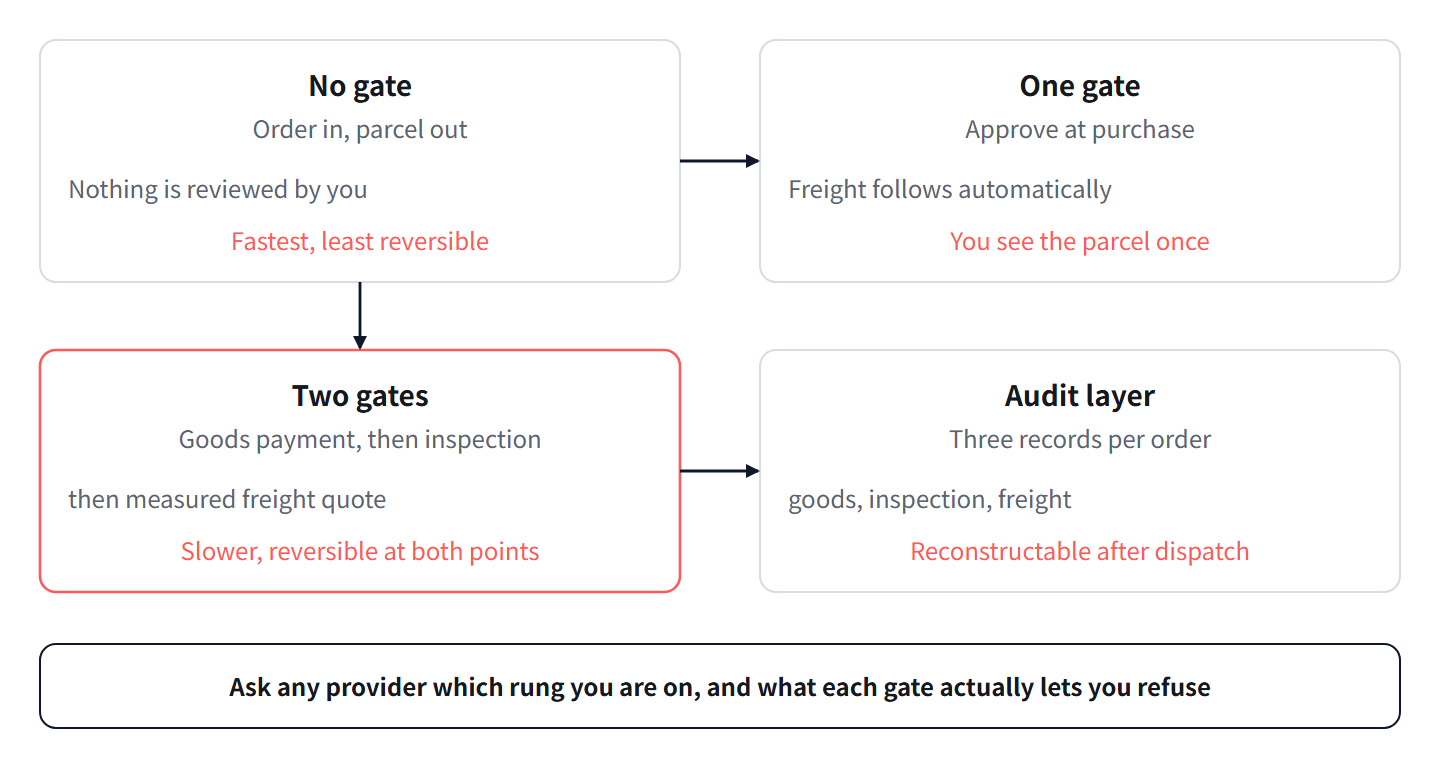
What you approve, what runs itself, what changes when weight differs
Read the middle column as a set of verification questions rather than claims. Read ours as documented today.
| The control question | Single-flow fulfilment: verify this | Lovegodrop as documented |
|---|---|---|
| What do I approve | Whether orders process start to finish once products are set up, or whether a per-parcel approval exists. Ask where it sits | Two payments, approved separately: goods to start the purchase at the marketplace, then shipping after measurement |
| What runs without asking me | Which steps proceed on their own, and at what point those become irreversible | Once a source is bound to a variant, subsequent orders route automatically until you change it |
| Measured weight exceeds the estimate | Requote, silent adjustment, or absorbed variance. Ask for the threshold in writing | The quote follows measurement. Any amount prepaid above the measured figure is returned |
| Measured weight comes in lower | Whether the difference is refunded, credited, or retained | Returned |
| Item differs from the listing | Whether inspection happens before dispatch, how many images you get, and who notices first | 3 QC photos per item at goods-in, before you approve anything further |
| The seller substitutes or ships short | How this is detected, who pays, and how many days you have to raise it | 7-day return window on purchases |
| Cancelling an order | Which stage becomes irreversible, and what it costs at each stage | Nothing irreversible before you approve each of the two payments |
| Packing adjustments | Whether repacking, consolidation and relabelling are included or itemised | Included, along with 90 days of storage |
| Subscription and minimums | Confirm there is no subscription, and ask whether any plan gates features you need | No subscription, no minimum order quantity, no sourcing fee |
That table is the whole comparison in one place, and the third row is the one that separates the models most cleanly. Two designs answer it differently by construction.
Published figures, checked 2026-11. EPROLO's published terms (checked 2026-11): a forever-free platform with no subscription, optional branding at $19.90/year (Lite) and $99/year (Pro), a 4.8 Trustpilot rating (931 reviews) and 4.8 on the Shopify App Store (577 reviews). On this side: no subscription and no sourcing fee, 90 days of included storage, three free QC photos per item before freight is approved, and goods at the marketplace's live price. One further row no other comparison on this site lists: individual buyers, not only merchants, can also buy through the platform, with or without a store.
A single-flow answer treats variance as noise to be absorbed, which is efficient and, when volumes are steady, genuinely cheaper in decisions. A two-gate answer treats variance as information to be surfaced, which costs one more interaction per parcel and buys you a chance to act. Neither is more honest than the other as a design; they distribute uncertainty between the merchant and the provider differently. Which you prefer depends on how predictable your parcels are, and you can measure that yourself with ten lines in a week.
Transparency as an audit question, not an accusation
Drop the word transparency for a moment, because it has been hollowed out. What a merchant actually wants is narrower and testable: given an order number, how much of what happened can be reconstructed from documents rather than from memory or from a support agent's summary.
Three properties make up that capability. Completeness: is there a record for each stage, purchase, inspection, freight, rather than a single final figure. Derivability: does each record contain its own inputs, so you can recompute the conclusion yourself rather than trusting someone else's arithmetic. Timing: were the records produced at the moment they describe, or assembled later in response to your question.
A single total at the end of the month satisfies none of the three, no matter how promptly support answers. Three records that each contain their own inputs satisfy all three, even if one of them contains news you do not like.
Here is the procedure that turns this into something you can actually hold. Send it to any provider you are evaluating, including us.
- Choose one order that shipped at least three weeks ago, and one that is currently mid-process. Artefact: two order numbers, stated in the request.
- Ask for the purchase record for the goods: which seller, which marketplace, which variant, how many units, and what the line total breaks into. Artefact: a document rather than a description.
- Ask for the inspection record: the images attached to those units, the recorded actual weight, and the recorded packed dimensions, with the date each was captured. Artefact: images plus two numbers with timestamps.
- Ask for the freight invoice: the route, the actual weight, the volumetric weight, the divisor used, and the chargeable weight, shown as separate lines rather than as one figure. Artefact: an itemised invoice.
- Recompute the chargeable weight yourself from those components and check it matches. Artefact: agreement or disagreement, recorded with the date.
- Ask what happens if any of the three is unavailable for that order. Artefact: the answer, which is more informative than the documents themselves.
- File all three types against that order number in your own records. You now have a baseline you can compare any other provider against.
Step six does the real work. Every operation has orders that went sideways, and the question is not whether documents exist for clean orders. It is whether they exist for the parcel that surprised everyone, because that is the parcel you will need to reconstruct.
Where the single-flow relationship wins outright
State the case properly, because it is a real one and it is usually glossed over in comparisons like this.
Minimal intervention. If your desire is to set the connection up once and then watch orders become parcels without further consultation, fewer gates is not a compromise, it is the requirement. Every approval we ask for is an interaction you have to make time for, and across hundreds of parcels a month that time is real.
One path for everything. A single relationship covering sourcing, storage, packing and shipping is easier to reason about than a stack. There is one support thread, one set of terms, one place to look. Merchants without an operations person value that more than any single feature.
Predictable parcels. If what you sell has a known size and weight and comes from one supplier per SKU, then variance is genuinely small, and paying attention to it every time is mostly waste. The two-gate design earns its keep when parcels surprise you; when they do not, it is friction.
Subscription-free simplicity. The absence of a monthly charge rewards merchants who want to test quietly and walk away without cancelling anything. Both operations have this property, and it removes the single most annoying barrier to experimenting.
Volume with variety. For a catalogue of many low-frequency SKUs, per-parcel decision-making scales badly. Moving volume through one path with minimal review is a legitimate operating choice, and plenty of well-run stores make it.
If the description above matches how you want to work, choose accordingly and use the rest of this page only for the documents you should still be collecting. Even a hands-off relationship needs an audit trail, and nothing in this section exempts any provider from producing one.
Where the order-first gate earns its keep
The gate costs time. Here is what it buys, stated without embellishment.
Variance that arrives as news. Marketplace listings routinely understate weight and dimensions. When your parcels routinely differ from what the listing claimed, learning that after dispatch means learning it too late to change packing, consolidation or route.
Inspection before the money. On our side the three QC photos are taken at goods-in, before you are asked to approve the shipping payment. That ordering means the inspection is a gate rather than a report, and a failed inspection costs you one declined payment instead of one wrong delivery.
Repacking and consolidation decisions. Knowing measured dimensions lets you decide whether a parcel is worth repacking or whether two orders should travel together. Those decisions are only available before dispatch, and they require the measured numbers.
Recovery weeks again. During the week when your main supplier goes quiet and goods have to be found from a photo, you are dealing with sellers you have never bought from. That is exactly when you want the right to look at something before committing further.
Multi-source baskets. Three sellers, one box, one decision about when to close it. The more judgement involved, the more a mid-process gate is worth having.
To put numbers against the trade, use the ten-parcel check: for your next ten parcels, record the claimed weight and the measured weight, and count how many differ by more than twenty percent. If the answer is one or two, a gate is largely friction. If it is five or six, a gate is the cheapest control you will ever install.
Decide with this table
| If this describes you | Choose | Because |
|---|---|---|
| You want set-and-forget fulfilment and your parcels are predictable | The single-flow relationship | Fewer decisions is the goal, and a gate delivers nothing you would act on |
| You have no operations capacity and want one counterparty | The single-flow relationship | One support thread and one set of terms beat any marginal control gain |
| Your parcels regularly differ from what listings claim | Lovegodrop | Measurement before payment turns a surprise into a decision |
| You buy from sellers you have not used before | Lovegodrop | Inspection before the shipping payment limits exposure |
| You want to repack or consolidate based on real numbers | Lovegodrop | Those decisions need measured dimensions, available only before dispatch |
| Your catalogue is many low-frequency SKUs | Either, leaning single-flow | Per-parcel reviews scale badly when each SKU ships rarely |
| You are about to test categories with route restrictions | Lovegodrop | Route eligibility and category questions get answered before you approve anything |
| A dispute is currently open and you need documents | Whichever provider can produce all three records | That answer is immediate evidence, and it is worth more than any promise |
The last row deserves a note. If you are reading this during a dispute rather than before one, skip the model comparison and go straight to the documents request. Nothing else on this page will help you this week.
The three documents any fulfilment provider must produce
Every provider reading this should be able to send all three. If one cannot, that is the finding.
| Document | What must be on it | Why you need it |
|---|---|---|
| Goods purchase record | The marketplace and seller identity, the items and variants bought, unit count, unit figure and line total, purchase date, and the marketplace order reference | This is the only record that proves what was actually bought and from whom. Without it you cannot tell whether the correct item was purchased or whether the number you are disputing came from the goods side at all |
| Inspection record | The QC images per unit, the recorded actual weight, the recorded packed dimensions, and the timestamp for each | It separates "the seller shipped the wrong item" from "the carton was oversized" from "the route is expensive". Three different problems, one document that distinguishes them |
| Freight invoice | Route name, actual weight, volumetric weight, the divisor used, chargeable weight, and every separate charge, listed rather than summed | This lets you recompute the charge yourself. A single total, however accurate, defeats the purpose, because accuracy cannot be verified without components |
Two additional records are worth asking for even though they are not universal, because when they exist they settle arguments quickly: the return or claim decision record, which shows who decided what after inspection failed, and the storage ledger, showing each item's goods-in date so you can check any later storage claim against it.
Ask for all of it before you need it. Requesting documents during a dispute is slower than requesting them during onboarding, and providers who are comfortable producing them will usually volunteer them when asked.
One parcel, reconstructed from those three documents
All inputs stated first, so the arithmetic can be checked by hand. One unit of a hard-goods product. The marketplace listing claimed a packed weight of 0.30 kilograms and dimensions of 20 x 15 x 8 centimetres. Measured at the warehouse: actual weight 0.41 kilograms, carton 25 x 17 x 9 centimetres. Assume the route uses a volumetric divisor of 5000, meaning cubic centimetres divided by 5000 gives volumetric kilograms, and note that not every route uses the same divisor, so it must appear on your invoice. Assume chargeable weight is the greater of actual and volumetric.
Estimate built on the listing:
Listing volumetric: (20 x 15 x 8) / 5000 = 2400 / 5000 = 0.48 kilograms.
So the best freight estimate available before anyone touches the parcel would have used 0.48 kilograms, since the listing's own claim of 0.30 is below even its own volume figure.
Measurement taken at the warehouse:
Measured volumetric: (25 x 17 x 9) / 5000 = 3825 / 5000 = 0.765 kilograms.
Measured actual: 0.41 kilograms. Chargeable is therefore 0.765 kilograms.
The variance: 0.765 / 0.48 = 1.594, meaning the real chargeable weight is 59.4 percent above what a listing-based estimate would have used. Anything prepaid against the listing would have run nearly sixty percent short, and somebody would have made that up elsewhere.
What each of the three documents contributes to understanding that gap. The goods record confirms one unit was bought from the named seller, at the named variant, on the named date, so the discrepancy is not a quantity error. The inspection record shows actual 0.41 kilograms and 25 x 17 x 9 centimetres with a timestamp, so the discrepancy is carton size rather than product weight. The freight invoice shows actual 0.41, volumetric 0.765, divisor 5000, and chargeable 0.765, and you can verify that last line yourself: 25 x 17 x 9 = 3825, and 3825 / 5000 = 0.765.
Two further calculations come out of the same figures and change the next decision.
Ratio of chargeable to actual: 0.765 / 0.41 = 1.87. The parcel is billed at nearly twice its real weight, which means reducing product weight achieves nothing. Only volume reduction matters. The volume at which volumetric equals actual is 0.41 x 5000 = 2050 cubic centimetres, so the target for any repacking is getting the carton under roughly 2050 cubic centimetres.
Assume repacking puts the same unit into a mailer measuring 22 x 15 x 6 centimetres: (22 x 15 x 6) / 5000 = 1980 / 5000 = 0.396 kilograms. That is below both the actual weight and the previous volume, so chargeable becomes 0.41 kilograms, the actual weight. The reduction is 0.765 - 0.41 = 0.355 kilograms, which is 46.4 percent of the original chargeable figure. Repacking and consolidation are included on our side, which is why this calculation is made against real measurements rather than against guesses.
Now take away the documents and watch what happens. Suppose the freight invoice had arrived as a single chargeable figure of 0.765 kilograms with no route, no divisor and no components. There is nothing to recompute, no way to know that the carton rather than the product caused it, and no way to know whether repacking would help. The number might be perfectly correct and still be unauditable, which is the distinction this whole page rests on.
Häufig gestellte Fragen
Are both services really free of a subscription?
Both are structured without one, which is shared ground between these two models rather than a differentiator. Confirm current terms directly with whoever you are evaluating, including whether any plan tier gates features you would need.
What is the practical cost of the second approval?
One decision per parcel, made after you can see inspection images and measured dimensions. If your parcels rarely surprise you, it costs time for little benefit. If they often do, it is the cheapest control available to you.
How do I test the audit claim without waiting for a dispute?
Run the seven-step procedure above on one shipped order and one open order, and recompute the chargeable weight from the invoice components yourself. A provider that can produce purchase, inspection and freight records for both orders has answered the question.
Is a total correct freight figure enough?
Not quite. Correct does not mean verifiable. Without route, actual weight, volumetric weight and divisor shown separately you cannot recompute anything, and you cannot tell whether a change next month came from the route, the packing or the parcel.
What happens on our side when the measured figure is below what I prepaid?
The difference is returned. That follows directly from quoting after measurement rather than before it, and it is the reason the quote arrives after the parcel reaches the warehouse rather than at product selection.
Was Sie diese Woche tun sollten
- Pick one order that shipped three weeks ago and request all three records for it from whichever provider you use now.
- Recompute the chargeable weight from the invoice components and compare it against the invoiced figure, recording agreement or disagreement.
- For your next ten parcels, record claimed against measured weight and count how many differ by more than twenty percent.
- Compute the volumetric-to-actual ratio on your three heaviest parcels, and mark which repacking decisions would follow.
- File the three records against one order number as your audit baseline, dated, so the next comparison starts from evidence.
Verfasst und gepflegt vom Lovegodrop-Sourcing-Team. Wie diese Seiten entstehen und geprüft werden.
Beginnen Sie mit einer bereits verkauften Bestellung
Verbinden Sie einen Shopify- oder WooCommerce-Shop, wählen Sie eine bezahlte Bestellung und sehen Sie das Beschaffungs- und Versandangebot für genau diese Bestellung, bevor Sie sich festlegen.