
1688 vs Taobao vs Weidian: welcher Marktplatz für welche Bestellung
Drei Marktplätze, drei Arten von Verkäufern dahinter. Stückzahl und SKU-Anzahl einer Bestellung entscheiden, wo Sie kaufen sollten.
Das Wichtigste in Kürze
- Judge the seller type first: it determines who answers your question and what happens when stock is wrong.
- Price order across marketplaces does not prove which listing is upstream; photo sets and spec completeness do.
- Many 1688 sellers will dispatch a single unit at the top tier price, sometimes with a handling charge; always confirm before paying.
- A SKU that only exists on one Weidian shop is a reorder risk, not a one-off risk, and needs a scored second candidate.
- Split an order across marketplaces when unit counts differ; consolidation still leaves as one outbound parcel.
Three marketplaces, three kinds of seller behind them
You have an order with three SKUs and a mix of unit counts, and you are about to place three purchases. The marketplace you choose for each line decides who answers your question when stock is wrong, whether you can get a document for the purchase, and how much of the price is the goods rather than the handling. Those are three different decisions and they usually have three different answers.
The structural difference is the seller, not the interface.
1688 is a wholesale marketplace. The seller is usually the factory or a trading company, the listing is priced in tiers by quantity, and it normally carries a specification block, because the buyer on the other side is another business that needs to know what it is ordering. Listings show a minimum order figure, and the variant grid tends to be complete because the seller is describing a production run rather than a single item they happen to have.
Taobao is a retail marketplace. Sellers are individuals and small shops, pricing is for a single unit, photography and copy are aimed at a consumer, and promotions move the price week to week. The buyer-protection habits of the platform are built for consumers, which is genuinely useful when a single unit arrives wrong and genuinely irrelevant when you are ordering for resale and need a document instead.
Weidian is mobile-first social commerce. Shops are frequently run by one person with no storefront infrastructure at all: no warehouse discipline, no maintained stock figures, no catalogue department. Listings are posted to a shop feed and sold through chat and sharing. That is not a criticism of the platform. It is the reason a Weidian listing can be the only place a product exists, and also the reason it carries a different risk profile.
Two consequences follow directly. On 1688, when you ask a technical question, you are often talking to someone who made the item. On Weidian, you are talking to the owner, who may be the only person there. Reply latency, stock accuracy and substitution behaviour all follow from that.
Eight things that decide which marketplace you use
| Dimension | 1688 | Taobao | Weidian |
|---|---|---|---|
| Typical pricing basis | Tiered wholesale price, stepped by quantity, with a minimum order figure shown | Single-unit retail price, moved by promotions and shop coupons | Single-unit price set by the shop owner, little visible structure |
| Minimum quantity behaviour | A stated minimum; many sellers still dispatch one unit at the top tier price, some add a handling charge, some decline | One unit is the normal case | One unit is the normal case |
| Negotiation | Expected, and realistic on repeat runs and on quantity | Rare on a single unit; the price is the price | Possible, but the owner may simply not answer |
| Document availability | Most likely of the three to be able to issue one for a business purchase | Consumer-facing purchase records | Rarely available |
| Returns in practice | Negotiated, and much easier once you are a repeat buyer | The most structured consumer return practice of the three | Depends entirely on the individual shop's willingness |
| Listing quality | Complete variant grid and a specification block; photography is often uniform and utilitarian | Consumer-grade photography, good copy, spec often incomplete | Owner-shot photography, variant grid often partial, spec often absent |
| Stock reliability | Best of the three, but the listing's stock figure still needs confirming before you pay | Good for single units; weak when you need several of one variant | Weakest; figures are often not maintained |
| What kind of order it suits | Multi-unit lines, and anything you will reorder on a schedule | Single-unit lines, gifts, and anything where consumer return practice helps | Products that exist nowhere else, and small-batch items |
Read the last row as the working summary and the rest as the reasons. A multi-unit line wants 1688 because the tier price is the point. A single-unit line wants Taobao because one unit is the native case and the return practice is better. A product that exists nowhere else wants Weidian, with preparation.
Why the same product shows up on all three at different prices
The usual chain is short. A factory or trading company lists on 1688 at wholesale tier prices. A reseller lists the same goods on Taobao at a retail price. A Weidian shop photographs the same item and lists it at whatever the owner thinks their feed will bear. Same object, three sellers, three prices, and none of them obliged to coordinate.
Price order does not tell you which listing is upstream. A Taobao promotion can push a retail listing below a 1688 tier-one price for a week. A 1688 tier-one price for a single unit can sit above Taobao retail, because the factory does not especially want to pick one unit out of a carton. So the cheaper listing is not automatically the primary one, and chasing the lowest number without identifying the upstream seller is how merchants end up bound to a listing that disappears.
Four checks identify the primary listing, and none of them involves the price.
First, the photo set. A factory's listing uses the same background, framing and prop set across many listings, and those photographs tend to reappear downstream on Taobao and Weidian listings. If the photographs on a Taobao listing also appear on a 1688 listing, the 1688 listing is upstream.
Second, the variant grid. The listing with the complete grid, including sizes or colours the others do not carry, is usually the one closest to production.
Third, the answer to a technical question. Ask about material, tolerance, or how many units ship in one carton. The seller who answers precisely is the factory or the trading company. The seller who answers with a photograph is reselling.
Fourth, the specification block. A listing that publishes dimensions, materials and packing quantity has done the work that a consumer listing never needs to do.
There is one more reason the same object carries different prices that has nothing to do with the chain: what is included. Packaging, a spare part, a branded box, or a different accessory bundle changes the price without changing the product. Before concluding that one listing is cheaper, check that you are comparing the same thing.
A decision procedure: unit count and SKU count in, one marketplace out
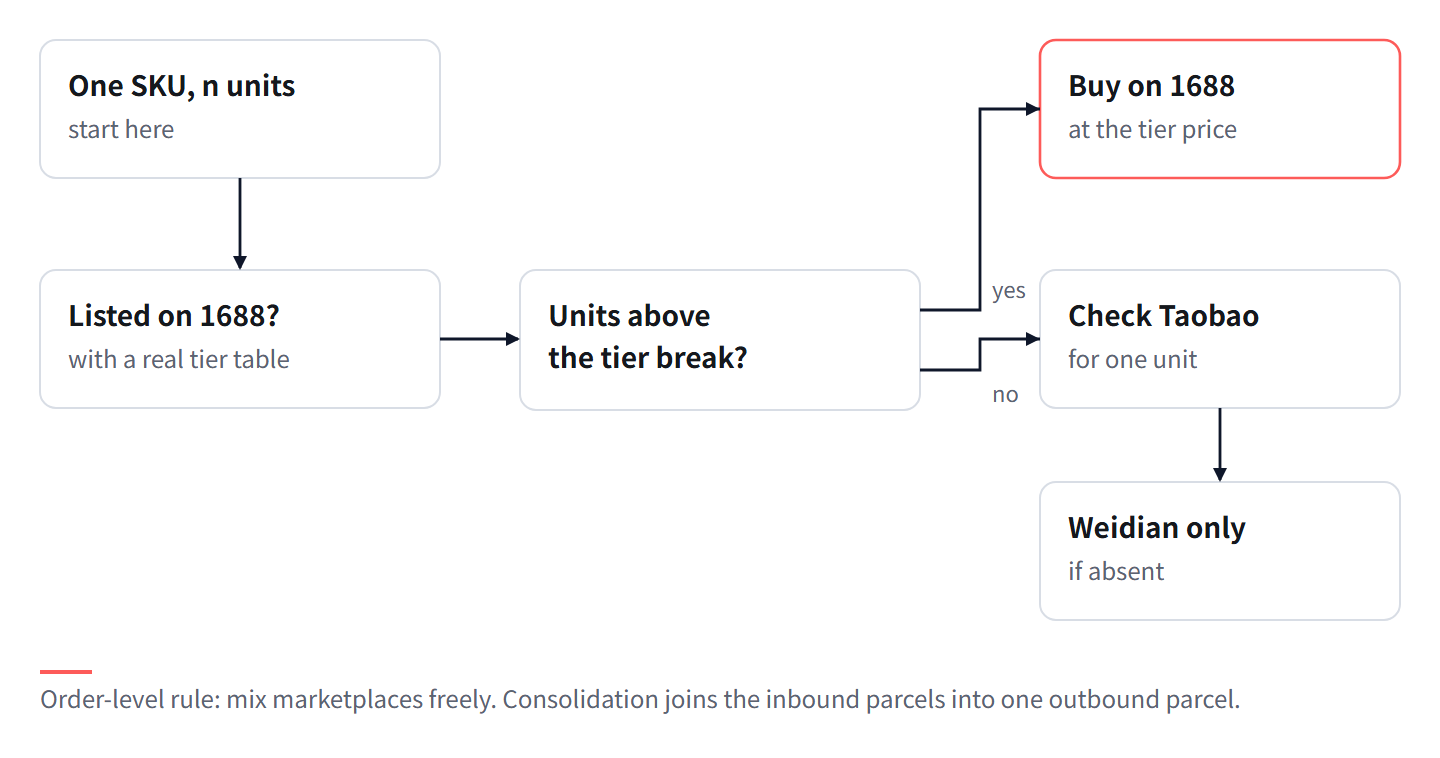
Run this per SKU, not per order. The inputs are the unit count of the line, u, and the number of distinct SKUs in the order, n.
- Check whether the SKU exists on 1688 at all. If it does not, and it exists on Taobao, buy there. If it exists only on Weidian, go to step 5.
- Read the 1688 tier table and find the tier break, which is the quantity at which the next price step starts. Call it b.
- If u is at or above b, buy on 1688 at that tier. The tier price is the entire reason to be there.
- If u is below b, compare the 1688 tier-one price plus any single-unit handling charge against the Taobao single-unit price. If the 1688 total is the higher of the two, buy on Taobao. Artefact: a one-line note recording which marketplace you used and why, stored against the variant.
- If the SKU exists only on Weidian, buy there, and treat it as a reorder risk: request the QC photo set before shipping, keep the link and a screenshot in your own records, and score a second candidate now rather than when the shop goes quiet.
- Record the decision against the variant so the next order of the same SKU does not repeat steps 1 to 4. Artefact: a bound link, or a recorded keyword, on every variant you sell.
| Condition | Marketplace | Why |
|---|---|---|
| u at or above the 1688 tier break | 1688 | Tier price only exists at quantity |
| u below the tier break, 1688 tier one plus handling is higher | Taobao | One unit is the native case there, and returns are more structured |
| u below the tier break, 1688 tier one plus handling is lower | 1688 | Take the cheaper line, but confirm the seller will dispatch one |
| SKU absent from 1688, present on Taobao | Taobao | No tier price to chase |
| SKU present only on Weidian | Weidian | No alternative exists; manage the risk instead |
| n above 1 with mixed unit counts | Mix, one marketplace per line | Consolidation still produces one outbound parcel |
Step 6 matters more than it looks. A merchant who runs this procedure once per SKU and records it turns sourcing into a lookup. A merchant who runs it every time is doing the same work forever.
How minimum quantities behave on 1688 when you only want one
A 1688 listing shows stepped pricing and a minimum order figure. Three things happen in practice when you want a single unit, and which one you get depends on the seller.
Some sellers dispatch one unit at the tier-one price without comment, because the listing is automated and the pick is cheap. Some add a handling charge, because picking one unit out of a sealed carton costs them labour and leaves them with an open carton. Some decline, or accept the order and then cancel it, which is the expensive case because it costs you the purchase round trip and leaves the order unfulfilled.
So the rule is confirm before paying, never assume. The confirmation is a single question asked in the seller's own language: will you dispatch one unit of this variant, and is it in stock today. That question is cheap and the cancellation is not.
There is no minimum order quantity on our side and no sourcing fee, so the constraint here is the seller's, not ours. What a sourcing agent actually does about it is four things. Places the purchase in the seller's own language rather than through a translated interface. Confirms stock and variant before any payment moves. Asks for single-unit dispatch explicitly, including the packing, so the item does not arrive crushed in an oversized carton. And consolidates the inbound parcels at the warehouse, so an order sourced from three separate sellers still leaves as one outbound parcel.
One more piece of arithmetic, because the tier table sometimes tempts merchants into over-buying. Assume a SKU where tier two starts at 5 units and tier three starts at 20, and assume you need 6. Buying to the 20-unit break is only rational if you expect to sell the other 14 before the variant changes or the listing moves. If you do not have that expectation, the extra units are stock you are holding against a forecast you have not made, and the tier saving is not the deciding factor.
When Weidian is the only place the product exists
This happens for two reasons, and they are worth separating because the response differs.
The first is structural. The product is made by a small workshop that sells through social channels and has never listed on a wholesale marketplace. There is no 1688 listing to find, because the maker does not operate there. In this case the Weidian shop is upstream, and it is the correct place to buy.
The second is timing. A product is small-batch or new, and the wholesale listing has not appeared yet. Here the Weidian shop is a temporary source, and the correct move is to keep looking rather than to bind permanently.
Either way, the risk profile is the same and it is worth naming plainly. One person means response latency, and latency matters when an order is stuck. No storefront infrastructure means stock figures are not maintained, so a listing can show available when it is not, and can disappear entirely. Variant substitution happens, because the owner ships what they have. A document for the purchase is rarely available. Returns depend on one person's willingness rather than on any process.
The mitigations are cheap and specific. Request the QC photo set before the parcel ships, which gives you three photographs of the actual unit rather than the listing's. Buy one spare when the unit count is small and the SKU matters, because a failed single-unit purchase costs more than a spare. Keep the link and a screenshot in your own records, because a shop feed does not preserve history the way a catalogue does. Bind the link to the variant, so a reorder is a lookup rather than a new search.
And treat a Weidian-only SKU as a reorder risk rather than a one-off risk. It is a SKU you will eventually have to swap out, so score a second candidate while the first one is still working.
Three ways to allocate one 3-SKU order
Every number below is a ratio to one Taobao unit price, which is the reference unit. No currency appears.
Stated assumptions:
- The order is three SKUs: SKU A at 1 unit, SKU B at 1 unit, SKU C at 6 units.
- The Taobao single-unit price for each SKU is 1.00 reference units.
- The 1688 tier-one price, for a single unit, is 0.95 of the Taobao price, plus a single-unit handling charge of 0.08 per line.
- The 1688 tier-three price, from 6 units, is 0.62 of the Taobao price per unit, with no handling charge.
- In allocation A, SKU A and SKU B are listed by the same Taobao shop, so there are 2 inbound parcels. In allocations B and C each SKU comes from a different seller, so there are 3.
- Consolidation of multiple inbound parcels into one outbound parcel is included at no extra charge.
| Allocation | SKU A, 1 unit | SKU B, 1 unit | SKU C, 6 units | Goods total | Ratio to allocation A | Inbound parcels |
|---|---|---|---|---|---|---|
| A: all three from Taobao | 1.00 | 1.00 | 6.00 | 8.00 | 1.000 | 2 |
| B: 1688 for the 6-unit line, Taobao for the singles | 1.00 | 1.00 | 3.72 | 5.72 | 0.715 | 3 |
| C: all three from 1688 | 1.03 | 1.03 | 3.72 | 5.78 | 0.7225 | 3 |
Allocation A, everything from Taobao: SKU A is 1.00, SKU B is 1.00, SKU C is 6 multiplied by 1.00 which is 6.00. Total 8.00. Inbound parcels 2.
Allocation B, 1688 for the 6-unit line and Taobao for the two singles: 1.00 plus 1.00 plus 6 multiplied by 0.62 which is 3.72. Total 5.72. Ratio to allocation A is 5.72 divided by 8.00, which is 0.715. Inbound parcels 3.
Allocation C, everything from 1688: SKU A is 0.95 plus 0.08 which is 1.03, SKU B is the same at 1.03, SKU C is 3.72. Total 5.78. Ratio to allocation A is 5.78 divided by 8.00, which is 0.7225. Inbound parcels 3.
Allocation B wins, and the reason is instructive. B and C differ by 0.06 reference units, which is about 1 percent of the goods total, and for that 1 percent allocation C takes on an extra seller relationship and an extra handling charge line. Allocation B keeps the two singles on the marketplace with the better consumer return practice, where a wrong single unit is cheap to fix.
Now change one input to see which variable actually drives the decision. Assume SKU C goes to 12 units and the 1688 tier-four price is 0.55 of the Taobao price. Allocation A becomes 1.00 plus 1.00 plus 12.00, which is 14.00. Allocation B becomes 1.00 plus 1.00 plus 12 multiplied by 0.55 which is 6.60, giving 8.60. The ratio drops from 0.715 to 0.614.
So the marketplace choice is driven by the unit count of the largest line, not by the SKU count of the order. A three-SKU order and a one-SKU order make the same decision if the largest line is the same size.
Häufig gestellte Fragen
Is 1688 always cheaper?
No. The tier price only exists at quantity. At one unit, the tier-one price plus a handling charge can exceed Taobao retail, and it usually does when the factory does not want small orders.
Can I order a single unit on 1688?
Often yes, but confirm with the seller before paying rather than after. Ask whether they will dispatch one unit of that variant and whether it is in stock today; a cancelled purchase costs more than the question.
Why is the Taobao price sometimes below the 1688 price?
Promotions, and different things included in the price. A consumer listing can be discounted below a wholesale tier-one price for a week, and a lower price may mean plainer packaging or fewer accessories.
Is it safe to source a SKU that only exists on one Weidian shop?
With preparation: the QC photo set before shipping, a spare unit when the count is small, the link and a screenshot in your own records, and a scored second candidate. Treat it as a SKU you will eventually swap out.
Should I split one order across marketplaces?
Yes, when the SKU count is above one and the unit counts differ. Consolidation at the warehouse joins the inbound parcels, so the customer still receives one parcel.
Was Sie diese Woche tun sollten
- List your top ten selling variants and write down which marketplace each one is currently sourced from, and why.
- For any line where you order five or more units, check whether a 1688 tier price applies and what the tier break is.
- For any SKU that only exists on one Weidian shop, record the link and score a second candidate now, while the first still works.
- Run the six-step decision procedure on your next three orders before you place them, and record the result against each variant.
- Ask one 1688 seller whether they will dispatch a single unit, and write the answer on the variant so nobody has to ask again.
Verfasst und gepflegt vom Lovegodrop-Sourcing-Team. Wie diese Seiten entstehen und geprüft werden.
Beginnen Sie mit einer bereits verkauften Bestellung
Verbinden Sie einen Shopify- oder WooCommerce-Shop, wählen Sie eine bezahlte Bestellung und sehen Sie das Beschaffungs- und Versandangebot für genau diese Bestellung, bevor Sie sich festlegen.