
نفس المنتج بثلاثة أسعار: كيف تعرف أي إعلان حقيقي
أربعة أسباب لظهور ثلاثة أسعار لنفس القطعة، وخمسة فحوص أن إعلانين لنفس القطعة، والحساب الذي يظهر أيها أرخص.
أبرز النقاط
- The four reasons: factory-direct versus a trader, batch size, material substitution, and a bundle versus the bare item.
- Material substitution is not a cheaper version of the item. It is a different item that photographs the same.
- The cheapest goods line produces the highest landed ratio, because packing weight is invisible on the listing and visible on the scale.
- Five checks establish that two listings are the same item: material, dimensions, weight, hardware and packing.
- Keep two sources recorded per SKU, filled from measured figures rather than from the listing, and re-measure when anything moves.
Four reasons the same item legitimately carries three prices
Three listings, three goods lines, one photograph. Before you conclude that two of them are a margin grab, there are four things that make the difference real, and a fifth that makes it a trap.
| Reason | What is actually different | Tell-tale signs | What it means for you |
|---|---|---|---|
| Factory-direct versus a trader | Who is selling. A trader sits between the factory and you | The seller's other listings span unrelated categories; the seller cannot answer a question about production; minimum quantity language on a single-unit listing | The trader's line is higher and the service may be better. This one is a choice, not a problem |
| Batch size | The goods line assumes a quantity | A price grid with a step at 10, 50 and 100; the title contains a quantity; a different number appears when you ask for one unit | The single-unit number is the grid's top step, and it is the only one that applies to you |
| Material substitution | A different build that photographs the same | The stated composition differs while the photographs are identical; the weight differs; the trim description is vaguer than the picture | This is a different product. It is not a cheaper version |
| Bundled versus bare | What is in the box | The listing includes an accessory set, a box or a card; the parcel is heavier; the title says "set" or "with" | You are buying things you do not sell, and paying freight on them |
Two of the four are harmless, one is a decision, and one is not the same item. The dangerous part is that all four look identical on a search page, and three of them are the same product.
Five checks that establish two listings are the same item
Run them in order and stop at the first failure. They are ordered by how expensive it is to be wrong about each one.
| Check | How to verify it | Pass condition |
|---|---|---|
| Material | The stated composition against the claim on your own product page, not against the photograph | The same stated composition, in words |
| Dimensions | Every axis you state, compared one by one | All axes within the tolerance you publish |
| Weight | The measured weight from a past order on the SKU, against what the listing claims | Within 1.25 times your recorded figure |
| Hardware and trim | A close-range photograph of each fitting, taken at the warehouse | The same fitting type and the same finish |
| Packing and completeness | What the listing includes, against what your store promises and what the customer will open | It matches what your page claims |
The third check is the one most merchants skip, because the listing's stated weight looks like a weight. It is a typed number, and it is usually the bare item's weight rather than the packed one. Only the warehouse figure governs the freight charge.
Why the cheapest goods line usually loses once the weight is measured
The freight charge is computed from chargeable weight, which is the greater of the actual weight and the volumetric weight. The volumetric weight is the packed volume divided by a divisor that belongs to the route. Two consequences follow, and both favour the listing that looks expensive.
First, a listing that packs in a large box pays on the box. The goods line and the packing are set by different decisions, and the cheap goods line is frequently paired with the heavy packing.
Second, the listing's stated weight is the least reliable number on the page. Goods are weighed and measured at the warehouse before the shipping quote is issued, and that measurement is the only figure that governs.
| What the listing says | What the warehouse finds | |
|---|---|---|
| Actual weight | The bare item, typed by the seller | The item packed, on a scale |
| Packed dimensions | Usually absent | Three axes, measured |
| Volumetric weight | Not computed | Derived from the measured volume |
| Chargeable weight | Not disclosed | The greater of the two, and the basis of the freight line |
The ratio that decides it is the landed ratio: landed cost divided by the goods line, with the store price indexed at 1.00. A goods line that is 30 percent lower and a freight line that is three times higher produces a landed ratio that wipes out the saving, and the arithmetic is in the worked comparison below.
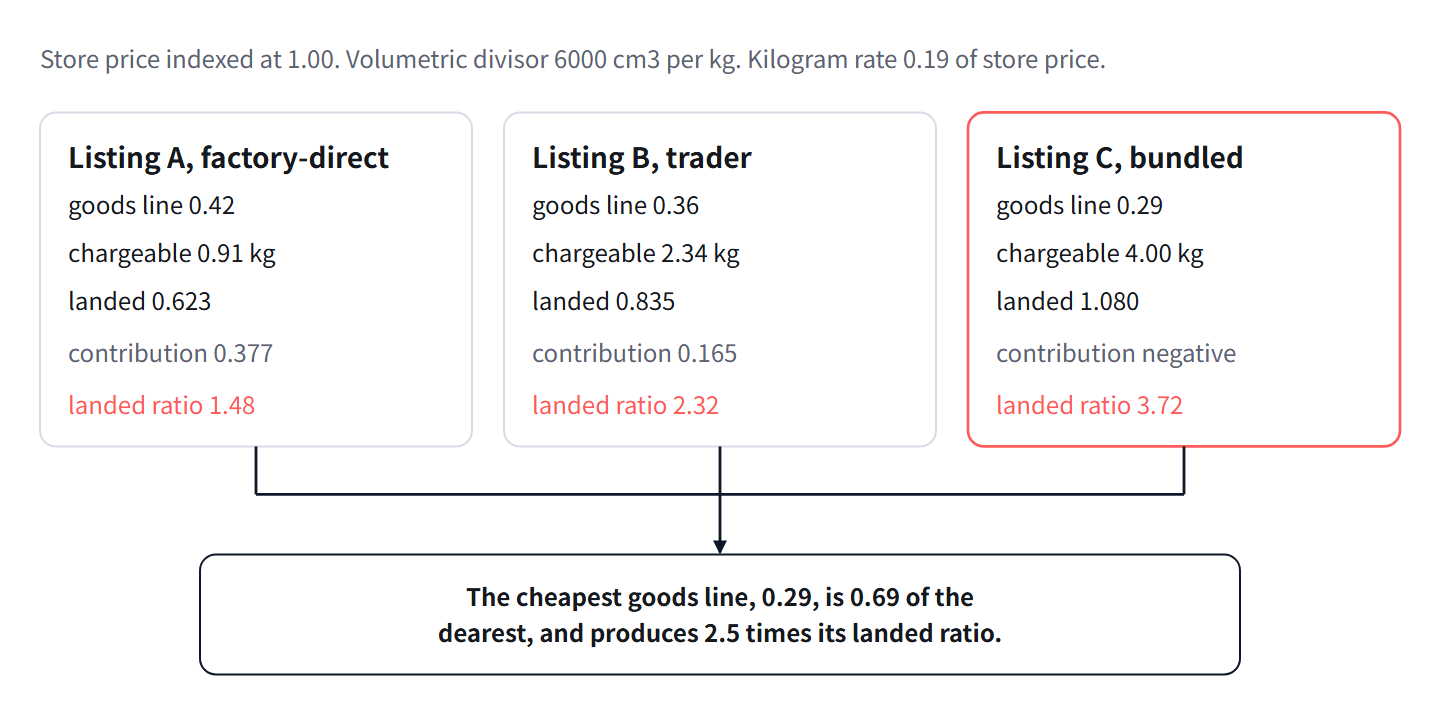
Worked comparison: three listings, one SKU
Every input stated before any result.
Assumptions. The store price of the SKU is indexed at 1.00. The volumetric divisor on the route is 6000 cm3 per kg. The kilogram rate on the route, expressed as a fraction of the store price, is 0.19 per kg of chargeable weight, taken from your own last three parcels on that route rather than from any table. Payment processing is 0.03 of the store price and is the same across the three. All three listings state an actual weight of 380 g and state no packed dimensions.
| A, factory-direct | B, trader | C, bundled | |
|---|---|---|---|
| Goods line, fraction of store price | 0.42 | 0.36 | 0.29 |
| Measured actual weight, g | 410 | 440 | 1150 |
| Measured packed, cm | 26 x 19 x 11 | 33 x 25 x 17 | 40 x 30 x 20 |
| Volume, cm3 | 5434 | 14025 | 24000 |
| Volumetric weight, kg | 0.91 | 2.34 | 4.00 |
| Chargeable weight, kg | 0.91 | 2.34 | 4.00 |
| Understatement against the listing's claim | 1.08x | 1.16x | 3.03x |
Freight, at 0.19 per kg of chargeable weight:
A: 0.19 x 0.91 = 0.173 B: 0.19 x 2.34 = 0.445 C: 0.19 x 4.00 = 0.760
Landed, adding the goods line, the freight and 0.03 of processing:
A: 0.42 + 0.173 + 0.03 = 0.623 B: 0.36 + 0.445 + 0.03 = 0.835 C: 0.29 + 0.760 + 0.03 = 1.080
Contribution, at a store price of 1.00:
A: 1.00 - 0.623 = 0.377 B: 1.00 - 0.835 = 0.165 C: 1.00 - 1.080 = negative 0.080
Landed ratio, landed divided by the goods line:
A: 0.623 / 0.42 = 1.48 B: 0.835 / 0.36 = 2.32 C: 1.080 / 0.29 = 3.72
Four findings, and the fourth is the one that matters.
- The cheapest goods line is 0.29, which is 0.69 of the dearest at 0.42, a saving of 31 percent on the goods line.
- It produces a landed ratio of 3.72, which is 2.5 times the best of 1.48.
- Freight is 41 percent of the goods line on A, 124 percent on B and 262 percent on C.
- C loses money on cost alone, before a single item is returned, and C is also the listing that understated its weight by 3.03 times.
What C is: the bundled listing. The goods line is quoted low and the parcel carries an accessory set the store does not sell, which is why the goods line and the weight move in opposite directions. The tell-tale was visible on the listing page and the arithmetic confirms it.
A permanent two-source record per SKU
One row per SKU, kept in whatever you already use, filled from measured figures and not from the listing.
- Create the row with these fields: SKU, primary link, backup link, marketplace, measured actual weight, measured packed dimensions, chargeable weight, freight fraction, landed ratio, the three QC angles, and the date measured. Artefact: the record.
- Fill it from the last fulfilled order on that SKU. A listing can only tell you what it claims; a fulfilled order tells you what happened.
- Re-measure when the packing changes, when the seller changes, or when a parcel arrives above 1.25 times the recorded weight.
- Read all three listings again each quarter and record the movement in the goods line and in the measured weight, in the same row.
- When the primary link dies, promote the backup and re-source against the measured figures rather than against the photographs. Artefact: a switched source with no re-measurement needed.
Step 5 is what the record is for. Standard practice is to bind a source in advance of the need, so the comparison on this page happens before the stock-out rather than during it.
Ranking three listings that all pass the five checks
Sometimes all three are the same item. Then the tie-break is not the goods line.
- Rank by landed ratio, using measured figures from the record, not by the goods line.
- Discard any listing whose measured weight is above 1.25 times its stated weight. That listing is not careless about weight, it is careless about everything.
- Discard any listing whose packing does not match what your product page promises the customer will open.
- Among what is left, take the seller with the shortest dispatch interval across your own last ten orders on the SKU, taken from your records.
- Record the runner-up as the backup on the same row, and note the date and the ratio.
The listing that is a different product wearing the same photographs
This is the material substitution case in the table at the top, and it is the reason the five checks exist.
| Warning sign | What it usually means |
|---|---|
| The photographs are identical to a listing at a different goods line, and there is no watermark | The photograph set is circulating, and at least one of them did not take it |
| The stated dimensions are in a different unit, or one axis is missing | The seller does not know the item |
| The colour names do not match the photographs | The photographs are from a different production run |
| The material line says "same as picture" | There is no material claim you can hold them to |
| The listing offers more colourways than any real production run carries | A catalogue listing, not a stock listing |
| The seller cannot answer a question about the trim in one message | A trader with no access to the item |
| The goods line moved within a single week, twice | The number is not tied to a cost |
Any one of those is a reason to keep looking. Two of them together on a listing with the cheapest goods line is the pattern in the worked comparison.
When the three prices are all the same item
Then the cheapest goods line is the one to take, and the reason is that the packing is the same, so the freight will be too. The worked comparison only turns out the way it does because the three parcels are not the same size.
Two conditions attach. The three must have passed all five checks, including the weight check against your own measured record. And the goods line must be stable for a week, because a number that moves weekly is not a cost.
الأسئلة الشائعة
Is the cheapest listing always the wrong one?
No. When the packing is the same the freight is the same, and then the cheapest goods line is correct. The cheapest listing loses when its packing is heavier, which is common because a low goods line is often paired with a bundle.
How do I know the volumetric divisor for my route?
Ask for it as part of the freight quote. It is an input to the calculation, and an agent who will not state it has not given you a quote you can check.
Can I use the listing's stated weight for the comparison?
No. Use the measured weight from a past order on the SKU. The listing figure is typed by the seller and is usually the bare item rather than the packed one.
What if two listings pass all five checks and have the same landed ratio?
Take the one with the shorter dispatch interval across your own last ten orders, and record the other as the backup.
How often should the record be re-measured?
On every change of packing, seller or marketplace, and otherwise when a parcel arrives above 1.25 times the recorded weight.
ما يجب فعله هذا الأسبوع
- Pick the SKU where you have seen three listings and write the three goods lines in one row.
- Pull the measured weight and dimensions from your last fulfilled order on that SKU and put them in the same row.
- Compute the landed ratio for each of the three using your own last three parcels to set the kilogram rate.
- Run the five checks across the three and discard any that fail.
- Record the winner as the primary and the runner-up as the backup, with the date.
كتبه ويحافظ عليه فريق التوريد في Lovegodrop. كيف تُكتب هذه الصفحات وتُدقَّق.
ابدأ بطلبية سبق أن بِعتها
اربط متجر Shopify أو WooCommerce، واختر طلبية مدفوعة، وشاهد عرض الشراء والشحن لتلك الطلبية تحديدًا قبل أي التزام.