
Lovegodrop مقابل DSers: أداة AliExpress أم خدمة توريد من الصين
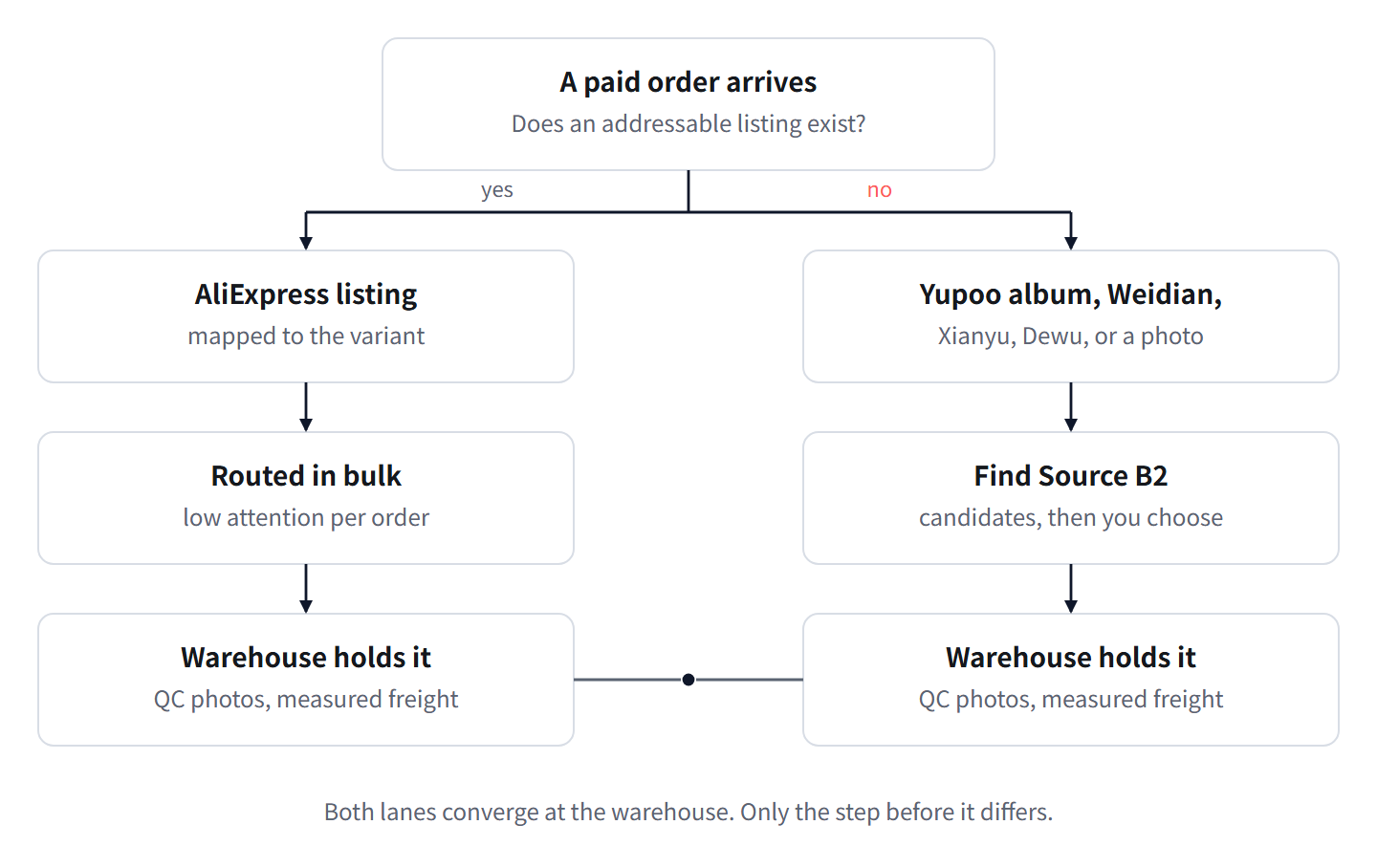
أحدهما يوجه الطلبات إلى إعلانات موجودة في AliExpress. والآخر يجد البضاعة حين لا تكون موجودة. الحد هو هذا الشرط بعينه.
أبرز النقاط
- A routing tool automates a purchase it can already address; a sourcing service has to find the address first.
- The useful coverage metric is the share of orders you can route today, not the share of SKUs that have a listing.
- Six SKUs out of forty can be 15 percent of the catalogue and 36 percent of the orders, and the two numbers lead to opposite decisions.
- Automation multiplies whatever supply quality you already have, in both directions: it scales a good supplier and propagates a bad one.
- Running both is normal. The discipline is one source per variant, so no order can be sent twice.
The boundary is the item that is not on AliExpress
A customer bought the last variant in stock. The listing behind it has been removed from AliExpress, and the tool that has routed your orders for two years now has nowhere to send this one. You can re-map the SKU, or you can find the goods.
DSers is an order-routing tool over AliExpress supply. It maps your store variants to AliExpress listings and places the orders, and when the mapping is intact it does that with very little of your attention. Lovegodrop is a sourcing and fulfilment service over six Chinese marketplaces: 1688, Taobao, Weidian, Yupoo, Xianyu and Dewu.
The two are not competing for the same job on every SKU. They compete on exactly one condition: what happens when the item is not on AliExpress.
If your catalogue was assembled by browsing AliExpress and importing what you found, that condition rarely arises, and the routing tool is the right instrument. If your catalogue contains anything you went looking for, a Yupoo album a seller sent you, a Weidian shop a contact recommended, an item you saw on another store's product page, then the condition arises constantly, and a routing tool has nothing to route to.
The practical question is not which is better. It is the share of your orders that the AliExpress side can address today, and that number is almost always lower than merchants assume before they measure it.
What each does when the product is only somewhere else
The table is the heart of the comparison. It describes the SKU you actually have, and it is worth filling in for your own top ten before you read further.
| Where the product exists | DSers | Lovegodrop |
|---|---|---|
| On AliExpress, listing live, mapping intact | The case it is built for. The order is placed against the listing | Bind Source B1 attaches the same kind of link to the existing variant |
| On AliExpress, listing removed or sold out | The mapping has no target. Verify what the tool offers; in the normal case you re-map to another listing or handle the order by hand | Find Source B2 takes the product page or a photo and returns candidates from the six marketplaces |
| Only on 1688 | Not the supply the tool routes to. Verify whether a non-AliExpress source can be mapped in your account | Native. 1688 is one of the six, and the purchase is placed there |
| Only on Weidian | Not addressable by an AliExpress routing tool | Native. Weidian is one of the six |
| Only in a Yupoo album | An album is photos with no checkout. There is no listing to map and no order to place | Native. A photo from the album is the standard input to Find Source |
| Only on Xianyu or Dewu | Not addressable by an AliExpress routing tool | Native; both are among the six |
| Known only from a photo or another store's product page | Nothing to map | Image search, keyword search and link input return candidates automatically |
| On AliExpress and also cheaper on 1688 | Routes the AliExpress listing | Sources the 1688 equivalent and binds it to the same variant |
| The listing exists but the seller raised the price | The routing continues; the margin absorbs the change | The goods price is visible as a separate component before the purchase, which makes the comparison legible |
The eighth row is the one a DSers user should read twice. The same product is frequently listed in both places, and the routing tool will send you to the one it can address. That is not an error, it is the consequence of where the tool operates. Whether the other listing is a better source for that SKU is a sourcing question, and it is worth asking once per SKU rather than never.
Published figures, checked 2026-11. DSers's published plans (third-party reviews, checked 2026-11): Basic free, Advanced $19.9/month, Pro $49.9/month, Enterprise $499/month, with 14-day trials on the paid tiers. On this side: no subscription and no sourcing fee, 90 days of included storage, three free QC photos per item before freight is approved, and goods at the marketplace's live price. One further row no other comparison on this site lists: individual buyers, not only merchants, can also buy through the platform, with or without a store.
The ninth row is a structural difference rather than a feature one. When the goods payment and the freight payment are separate and the goods price is stated on its own, a price move on the goods side shows up as a change in one named component. When the two are folded together, the move shows up as a change in a total, and you have to work backwards to find the cause.
The rows that matter most are the three in the middle. Weidian, Yupoo and Xianyu are where a large share of the interesting supply in Chinese ecommerce lives, and none of them present a listing that an AliExpress routing tool can order from.
Automation can only automate an address it already has
This is the sentence that separates the two categories, and it is not an argument about either product.
A routing tool automates a purchase it can already address. The mapping holds a destination; the automation pushes the order to it, in bulk, and reconciles the tracking that comes back. Every feature downstream of that, the bulk placement, the variant mapping, the supplier switching, the tracking sync, is an optimisation of a purchase whose address is known.
A sourcing service has to find the address first, and that step is not automatable in the same sense. Keyword search, link input and image search can return candidates automatically, and on our side they do, along with goods pricing. What cannot be automated is the freight side, because freight depends on packed dimensions and on the route, and neither is known until the goods exist in a warehouse and someone has measured them. That is why a freight quote comes from the human sourcing line.
The consequence for a merchant is that the two automations save different kinds of time. The routing tool saves you the handling time on orders you would otherwise place by hand. The sourcing service saves you the search time on SKUs you would otherwise be unable to fulfil at all.
| Function | An AliExpress routing tool | A sourcing service |
|---|---|---|
| Place an order against a known source | Automated, in bulk | Not the job; fulfilment happens after the purchase |
| Map a store variant to a supplier listing | The core automation | B1 binding, a one-time action per variant |
| Monitor price and stock on the mapped listing | Continuous | Not offered for marketplace sellers; availability is answered at purchase time |
| Adjust your retail price when the source moves | Repricing rules | Not offered |
| Find a source where there is none | Nothing to automate | Candidate search automated, freight quote on the human line |
| Quote freight | From the supplier listing | After the warehouse weighs and measures; overpayment returned |
| Consolidate two orders into one parcel | Depends on the supplier, and separate orders usually travel separately | Consolidation included |
| Inspect before dispatch | Verify what the seller ships | 3 QC photos per item, included |
| Hold goods | Not part of the tool | 90 days included |
Where the AliExpress tool is clearly the better answer
Three conditions, and when all three hold, DSers is the right choice and moving would be a mistake.
The first is high AliExpress coverage. If the great majority of your orders can be addressed by a listing that exists today, then the sourcing problem rarely arises, and the tool that solves the routing problem with the least intervention wins by default.
The second is high order volume with a low intervention budget. Routing in bulk is the single largest handling-time saving available in this category, and its value scales with the number of orders. A merchant placing many orders a day across a stable catalogue gets more from that automation than from any sourcing feature, because the sourcing feature is idle when nothing is broken.
The third is catalogue stability. If your SKU list has not changed much and your suppliers have not moved, then the mapping work is already done, and it is a sunk asset. Re-deriving mappings that already work is a cost with no corresponding benefit.
There is a fourth worth naming: a merchant who does not want to do sourcing work at all. Sourcing means reading candidates, comparing them, making a judgement, and occasionally rejecting all of them. Some merchants would rather not. That is a legitimate preference, and if it is yours, a tool that removes you from that decision loop is a better fit than a service that puts you in it.
None of this is a criticism of the tool. It is the description of the case in which the tool is the answer, and it is the case most merchants are in when they start.
Running both: split the SKUs without shipping twice
The hybrid arrangement is common and it works, provided the split is deliberate. A mixed order is where it fails, because consolidation only works inside one warehouse.
- Export your SKU list and mark each variant with one of two tags: mapped, or unrouted. A variant gets exactly one tag; a variant with two sources is an order waiting to be sent twice.
- Send the unrouted list to the sourcing side in one batch, with a product page or a photo attached to each line, so the candidates come back in one pass rather than one email at a time.
- Bind the chosen source to each existing variant by B1, so the store's product pages are untouched. Artefact: a sheet with one source per variant and the date it was verified.
- Set the rule for mixed orders before the first one arrives. Either fulfil the whole order on one route, or split it and tell the customer, but do not let it happen by accident.
- Test with two live orders, one per route, and check that tracking is written back to the store the same way on both.
- Reconcile weekly for the first month: for every order, confirm it was sent once, and note any order that produced two parcels.
The double-shipping risk is the reason to do this in writing. An order with one mapped line and one unrouted line will, on a naive setup, produce two parcels from two places, arriving separately, with the customer receiving one tracking email and then another. In some cases that is the right outcome and you should choose it deliberately, telling the customer that two items are on the way. In most cases it is worse than consolidating, and consolidation is only available where one warehouse holds both goods.
A useful refinement is to assign routes by order behaviour rather than by SKU. If a SKU is ordered on its own most of the time, its route hardly matters. If a SKU is usually bought together with another, put both on the same route, so the pair consolidates.
Decide by the share of your catalogue that is on AliExpress
The decision keys on one number, and the number has to be computed the right way.
| Order-weighted share that an AliExpress listing can address today | What to do |
|---|---|
| 90 to 100 percent | Stay with the routing tool, and use a sourcing service only for the exceptions |
| 70 to 90 percent | Keep the tool for the covered SKUs and route the rest deliberately, one source per variant |
| 40 to 70 percent | Run both in earnest and expect the sourcing side to grow; do the audit monthly |
| Under 40 percent | Make the sourcing service the primary route and keep the tool for the SKUs where it still works |
| You do not know the number | Do the audit before deciding anything else |
The reason the metric is order-weighted is that SKU counts hide the truth. The SKUs with no AliExpress listing are not distributed at random through your catalogue. They are the ones you chose because they were not available on the open listing sites, and disproportionately they are the ones that sell.
The corollary is that this number moves. A listing that exists today can be gone next month, and every one that disappears moves an order from the left column to the right. Recomputing the number monthly is the cheapest early warning available, and it takes the twenty minutes the next procedure describes.
Three SKUs, one mixed catalogue: the coverage arithmetic
Every figure below is an assumption you replace with your own. The method is the point, not the numbers.
Assume a catalogue of 40 SKUs. Assume 34 of them have a live AliExpress listing you can map today, so SKU coverage is 34 out of 40, or 85 percent. That is the number most merchants carry in their heads, and it feels like a covered catalogue.
Now weight it by orders. Assume that over the last 90 days the top 5 SKUs carried 60 percent of your orders, and that 3 of those 5 are among the 6 with no listing. Assume those 3 carried 36 percent of orders between them.
The order coverage is 100 minus 36, or 64 percent. The gap between the two metrics is 21 percentage points, and the gap is the entire decision.
The concentration ratio makes it sharper. Those 3 SKUs are 3 out of 40, or 7.5 percent of the catalogue by count, and they carry 36 percent of the orders, which is 4.8 times their weight. A metric that treats all SKUs equally cannot see that, and it is the reason the SKU-count figure misleads.
Now convert it into work. Assume 300 orders a month. At 36 percent uncovered, 108 orders a month have no route. Assume an unrouted order handled by hand takes 12 minutes of your time: that is 1,296 minutes, or 21.6 hours a month, which is 2.7 working days.
Finally, convert it into the mixed-order problem. Assume 30 percent of orders contain more than one line, and assume that on a half of those the lines sit on different routes. That is 45 orders a month producing two parcels where one would do, and each of those is a support conversation you did not budget for.
The output of the arithmetic is not a verdict, it is the two numbers at the top of the sheet: 85 percent and 64 percent. Which one you act on decides which tool is primary.
Audit your own catalogue against that share
This procedure produces the number the previous section needs. Run it monthly; it is the cheapest early warning you have.
- Export every published variant from your store, with its SKU and its order count over the last 90 days.
- Sort by order count, descending, and keep the top 30. The tail below that does not move the decision.
- For each of the 30, search for it on AliExpress and record one of three results: found and mappable, found but not usable, or not found.
- Record the reason for every "found but not usable" in one line, because the reasons repeat and they tell you what kind of problem you have.
- Sum the order counts of the SKUs in the third column and divide by the total order count of the 30. Artefact: the order-weighted uncovered share, as a percentage, dated.
- Do the same sum for the SKU counts, and keep both numbers side by side. The gap between them is the size of the mistake you would have made.
- Repeat on the first of each month. A share that is rising means your supply is drifting away from the listing sites, and it will not fall back on its own.
الأسئلة الشائعة
Can DSers and Lovegodrop run against the same store at the same time?
Yes. Both read orders and write tracking back, and neither modifies your store's theme, checkout or apps. The constraint is not technical, it is operational: each variant must have exactly one source, or one order will be sent twice.
What happens to a SKU whose AliExpress listing I mapped and which then disappears?
The mapping loses its target and the order has no route. That is the moment to send the product page or a photo to the sourcing line and bind the result to the same variant. The store page does not change, so the reviews and the sales history stay with it.
Is 1688 always a better source than AliExpress for the same product?
No. Sometimes the same seller is behind both, and sometimes the listing on the marketplace side is worse on stock or on packing. The useful test is to source one SKU both ways in the same month and compare the measured landed result, not the advertised one.
Does automation make a weak supplier safer?
No, it makes a weak supplier faster. Monitoring and repricing propagate whatever the source does, including going out of stock. Automation pays for itself when the supply behind it is sound and costs you more when it is not.
How do I know the freight figure I am working with is real?
Ask when it was measured. A freight figure produced at product selection is an estimate built on the listing's claimed weight and dimensions. A figure produced after the warehouse weighs the parcel is a measurement, and on our side any amount prepaid above it is returned.
ما يجب فعله هذا الأسبوع
- Export your top 30 variants by order count and search each one on AliExpress, recording found, unusable, or not found.
- Compute the order-weighted uncovered share from the third column and write today's date beside it.
- Pick the three uncovered SKUs that carry the most orders and send them to a sourcing line with a photo or a product page each.
- Find one SKU that appears in mixed orders and move its route so the pair travels together.
- Put the audit in the calendar for the first of next month, because the number moves.
كتبه ويحافظ عليه فريق التوريد في Lovegodrop. كيف تُكتب هذه الصفحات وتُدقَّق.
ابدأ بطلبية سبق أن بِعتها
اربط متجر Shopify أو WooCommerce، واختر طلبية مدفوعة، وشاهد عرض الشراء والشحن لتلك الطلبية تحديدًا قبل أي التزام.